4–6 Week AI QA Scorecards for Regulated Teams With CRM Playbooks

AI QA scorecards automatically evaluate calls and chats against a defined rubric, scoring them and flagging coaching or compliance issues at scale. The limit is nuance. Tone, empathy, and judgment calls still need a person in the loop. Here’s how the pipeline works and how to build one that holds up.
TL;DR:
- Most effective AI QA scorecards focus on observable, fact-based criteria like disclosures and commitments, with weights reflecting actual outcome drivers.
- AI excels at fact-checking and compliance checks but still requires human review for subjective judgment, tone, and empathy.
- Starting with simple rubrics of three categories and narrow questions improves accuracy, builds trust, and simplifies calibration during pilot phases.
- Continuous validation against human scores and business outcomes is essential to ensure the scorecard measures meaningful performance.
- Integrating AI scoring with CRM, compliance workflows, and prebuilt industry-specific playbooks facilitates scalable, consistent deployment across large teams.
Table of Contents
- What Is an AI QA Scorecard, and How Does the Scoring Pipeline Work?
- How Do You Structure Categories, Weights, and Fatal Questions?
- Which QA Tasks Can AI Handle, and Which Need a Human?
- How Should You Pilot and Roll Out a New Scorecard?
- How Do You Know the Scorecard Is Actually Working?
- How Does an Integrated Platform Make AI Scorecards Easier to Deploy?
- Why AI QA Scoring Amplifies Good Judgment, Not Replaces It
- Deploying Validated AI QA Scorecards With RevRing
- Sources
- FAQ
What Is an AI QA Scorecard, and How Does the Scoring Pipeline Work?
An AI QA scorecard is a structured rubric that an AI system applies to every recorded call, chat, or email to produce a consistent, auditable score. The process runs through five connected stages, and each one shapes the accuracy of the final number.
- Record and transcribe: The call gets captured and converted to text, with speaker separation and timestamps.
- NLP and tagging: The transcript gets scanned for intent, sentiment, keywords, and compliance phrases.
- Rubric application: The system checks each scorecard question against the tagged transcript.
- Scoring and justification: A numeric score gets generated per question and overall, with a cited transcript excerpt explaining why.
- Insights for coaching: Summaries, strengths, and gaps get surfaced to managers and agents.
This pipeline typically moves from transcription to NLP tagging to scoring, producing outputs teams can act on immediately: a 0 to 100 call score, question-level reasoning, a plain-language summary, and any flagged compliance items. Rule-based checks (did the agent state a required disclosure?) run alongside model-based judgment (did the agent sound rushed?), and the best systems keep those two categories visible separately rather than blending them into one opaque number.
How Do You Structure Categories, Weights, and Fatal Questions?
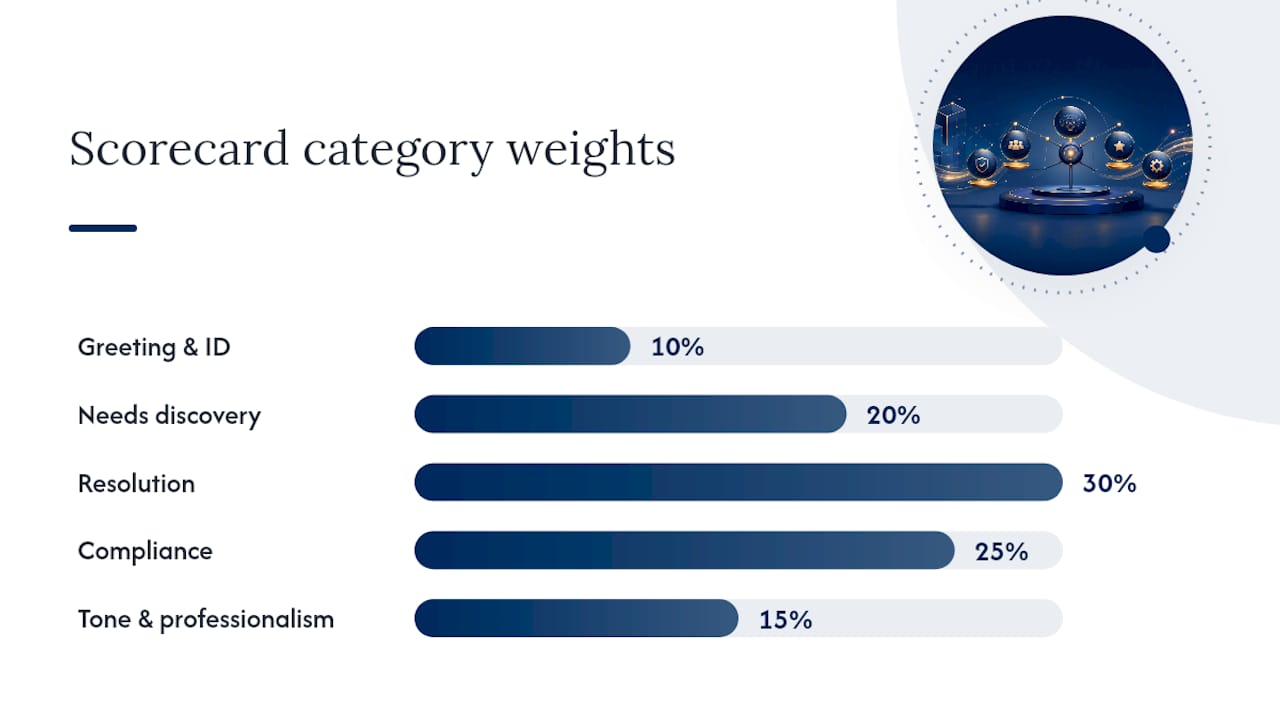
A scorecard is only as good as its architecture. Most effective rubrics organize around five to seven criteria split across a handful of categories, with weights that add up to 100%.
A typical structure looks like this:
-
Greeting and identification (10%): Did the agent verify identity and state the required disclosures?
-
Needs discovery (20%): Did the agent ask open questions and confirm the customer’s actual issue?
-
Resolution (30%): Was the problem solved, or was a clear next step set?
-
Compliance (25%): Were required scripts, consent language, or regulatory disclosures present?
-
Tone and professionalism (15%): Was the interaction respectful and controlled?
Weights should reflect what actually drives outcomes for your business, not what feels important on paper. A well-structured scorecard uses categories, criteria, and weights that total 100%, and fatal questions sit outside that math entirely. A fatal question is a toggle: if the agent skips a required consent statement, mishandles personally identifiable information, or omits a legal disclosure, the whole call fails regardless of score. Use fatal questions sparingly, and reserve them for genuine compliance or safety exposure, not stylistic preferences.
When building your first template, stick to observable behaviors. “Did the agent state the cancellation policy verbatim?” is answerable. “Did the agent seem engaged?” is not, at least not for an AI reviewer.
Which QA Tasks Can AI Handle, and Which Need a Human?
AI is excellent at fact-checking a transcript. It’s unreliable at reading a room. Knowing where the line sits is the difference between a scorecard people trust and one they quietly ignore.
- Presence and absence checks. Did the agent say the required phrase, disclose the fee, or confirm the account number? AI handles this with high consistency because it’s a literal text match.
- Explicit commitments and numbers. Did the agent quote the correct rate, promise a callback time, or state a specific policy detail? These are verifiable against the transcript.
- Subjective and cultural judgment. Empathy, sarcasm, de-escalation skill, and cultural appropriateness require human interpretation that current models still get wrong often enough to matter.
- High-stakes edge cases. A call involving a threat, a legal gray area, or an unusual complaint needs a trained reviewer, not a confidence score.
The practical answer is a hybrid workflow: let AI score every call on fact-based criteria first, then route anything below a set confidence threshold, or anything touching a fatal question, to a human reviewer. Vendor guidance consistently recommends narrow, fact-based questions and small ordinal ranges because compound or vague questions are exactly where AI accuracy drops.
How Should You Pilot and Roll Out a New Scorecard?
Start small. Rubrics with three categories and two to three observable criteria each consistently produce higher AI accuracy and build agent trust faster than broad, subjective rubrics with a dozen questions.
- Pick one team or one call type for the pilot, run it for four to six weeks, and define success upfront (agreement rate with human QA, coaching adoption, agent feedback).
- Sample 10 to 20 calls weekly where both AI and a senior reviewer score the same interactions, then compare results by question, not just overall score.
- When disagreement clusters on one criterion, that’s a rubric wording problem, not an AI problem. Fix the definition before blaming the model.
- Tell agents exactly what’s being measured and why before the scorecard goes live. Coach-first framing, not gotcha framing, is what makes adoption stick.
This kind of structured AI-versus-human audit is standard guidance for any organization deploying automated evaluation at scale, and it should run on a fixed cadence, not just at launch.
Pro Tip: Run your first calibration audit before you tell agents scores count toward anything. You want clean data on where AI and human reviewers diverge, not defensive behavior skewing the sample.
How Do You Know the Scorecard Is Actually Working?
Accuracy alone doesn’t prove value. A scorecard that agrees with human reviewers 95% of the time but tracks the wrong things is still a bad scorecard.
Accuracy validation comes first. Well-defined, observable criteria with decent audio quality typically land in the 80 to 90% correlation range between AI and human scores, and that’s a healthy target, not a failure to chase 100%. Track a confusion matrix by question to see whether errors cluster on subjective items (expected) or fact-based items (a rubric or transcription problem).
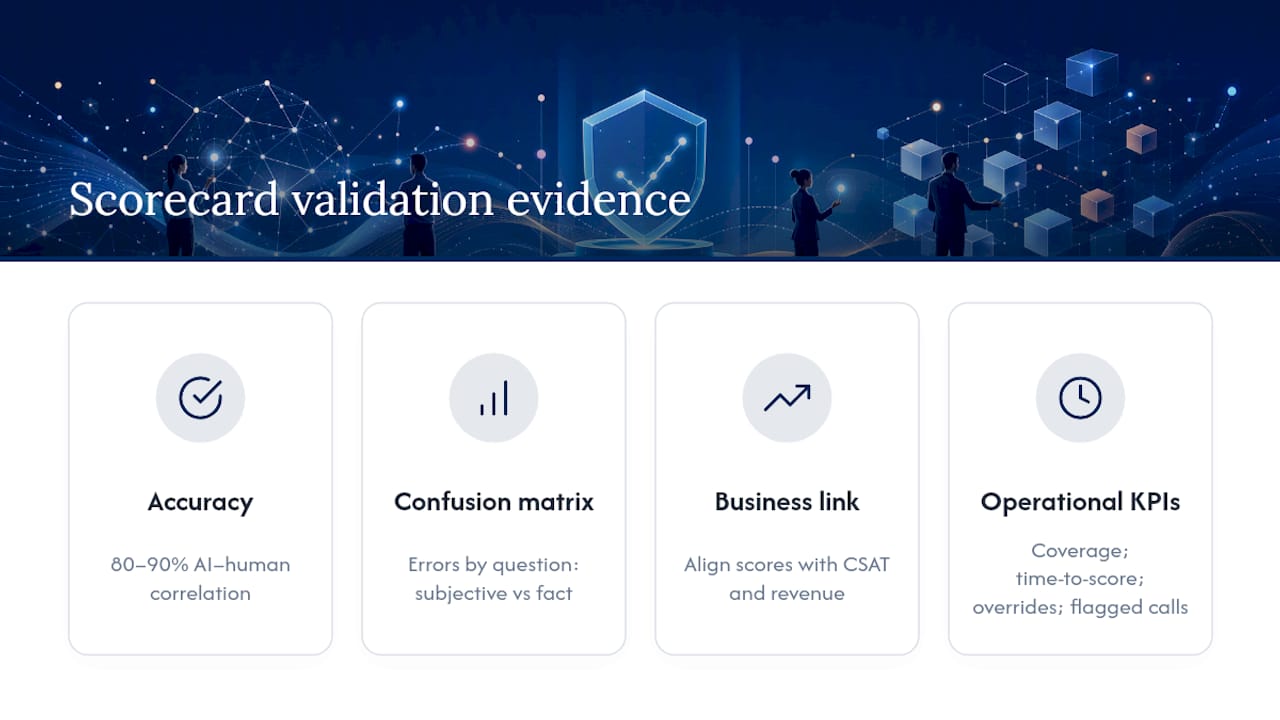
Business correlation matters more. Contact centers that validate scoring criteria against outcomes like CSAT, resolution rate, and revenue get coaching that actually moves the metrics leadership cares about, instead of just checking process boxes.
Operational KPIs round it out: coverage percentage (what share of calls get scored), time-to-score, override rate, and flagged-call volume all tell you whether the system is keeping pace with call volume or quietly falling behind.
How Does an Integrated Platform Make AI Scorecards Easier to Deploy?
Building a scorecard from scratch is one project. Wiring it into telephony, CRM, and compliance workflows is another, and it’s usually the harder one. An integrated approach cuts that friction by connecting the pieces from day one.
- Prebuilt playbooks for regulated sectors like insurance and healthcare reduce the manual configuration of fatal questions and disclosure checks.
- CRM connectivity means scores and flagged calls attach directly to the lead or client record instead of living in a separate report.
- Compliance infrastructure, including TCPA, DNC, and HIPAA BAA support, matters when fatal questions touch regulated conversations.
- Scaling agent count from a small team to a large one works better when scorecards, routing, and CRM data are already connected rather than bolted on later.
Why AI QA Scoring Amplifies Good Judgment, Not Replaces It
The industry conversation keeps framing AI QA as a replacement for human reviewers. That’s the wrong lens. AI increases coverage from a small sample to every call, and it holds scoring consistent across shifts and reviewers, which humans alone struggle to do. What it doesn’t do is replace the calibration and coaching judgment that makes scores mean anything.
Real behavior change on a team typically takes six to twelve months, not the six weeks a pilot report might suggest, which is why continuous sales training is your team’s ultimate ringer. Treat governance, regular calibration cadence, and transparency with agents as ongoing work, not a launch checklist you finish once.
— Marc
Deploying Validated AI QA Scorecards With RevRing
RevRing is built for teams that don’t want to stitch together a scoring tool, a CRM, and a compliance layer separately. AI call scoring runs on the same platform as your dialer, your CRM connectivity, and your industry-specific playbooks, so a scorecard you design for insurance or healthcare calls comes with the fatal-question logic and compliance infrastructure already in place.
That matters most during scale. Teams that grow from a handful of agents to hundreds need scorecards that stay consistent without a QA team rebuilding rubrics for every new hire cohort, and RevRing’s prebuilt workflows are designed to carry that weight without an overhaul of what’s already running. Regulated sales teams can also connect AI scoring to HIPAA BAA compliance requirements directly inside the same system that handles calling and CRM data.
If you’re evaluating what a validated AI QA scorecard could look like inside your own stack, check current plans starting at $39.99 per seat per month, or explore how the AI automation features connect scoring to your existing workflows.
FAQ
How Is AI Being Used in QA Testing?
AI reviews recorded calls and chats against a scorecard rubric, flagging compliance gaps and scoring fact-based criteria like disclosures and commitments automatically. It typically works alongside human reviewers, who handle subjective judgment like tone and empathy that AI still struggles to score reliably.
How Do You Build a QA Scorecard?
Start with three to five categories, weight them to total 100%, and write behavior-based questions tied to observable transcript evidence rather than impressions. Add fatal questions only for genuine compliance risks, such as missing consent language, and pilot the rubric on a small team before rolling it out broadly.
Is QA Getting Replaced by AI?
No. AI extends QA coverage from a small sample to every interaction, but it doesn’t replace human calibration, coaching, or judgment on subjective criteria. Most programs run AI-human audits on a regular cadence to keep scoring accurate and agents trusting the process.
What Are AI QA Scorecards?
An AI QA scorecard is a structured rubric an automated system applies to calls or chats to generate a consistent score, question-level reasoning, and coaching insights. RevRing runs this scoring inside the same platform as CRM connectivity and compliance workflows, so results attach directly to the lead or client record.
How Accurate Is AI Call Scoring Compared to Human Reviewers?
Well-defined, observable criteria typically produce 80 to 90% correlation between AI and human scores. Vague or compound questions lower that accuracy, which is why rubric wording matters more than the model itself.