$500–$1,500 TCPA Risk for U.S. Real Estate Cold Calling (Revring)

Cold calling is legal for U.S. real estate professionals, but only inside strict guardrails: the Telephone Consumer Protection Act (TCPA), the Telemarketing Sales Rule (TSR) and National Do Not Call Registry, and a growing list of state-level “mini-TCPA” statutes. Three actions separate a legal campaign from a lawsuit waiting to happen: verify and document consent before every dial, scrub every list against the DNC Registry on a strict cadence, and log everything. State law is often stricter than federal law, and your paperwork is your best defense when someone complains.
TL;DR:
- Verifying and documenting consent is essential, especially for autodialed or prerecorded calls, with written consent being the safest standard.
- Scrubbing lists against the National Do Not Call Registry every 31 days and maintaining internal suppression lists are legally required practices.
- Calling within the recipient’s local time zone and adhering to strict calling hours significantly reduces compliance risk.
- State telemarketing laws often impose stricter rules than federal law, requiring a conservative approach that treats the toughest regulation as the default.
- Using a connected, compliant platform helps ensure adherence to all legal requirements, scale operations, and prevent costly violations.
Table of Contents
- Federal Baseline: TCPA, TSR, and the National Do Not Call Registry
- State-Level Variations and ‘Mini-TCPA’ Risks
- Consent, Dialing Technology, and One-to-One Consent Rules
- Calling Windows, Time Zones, Scrubbing, and Recordkeeping
- Penalties, Enforcement, and Why Lawsuits Happen
- Your Compliance Checklist Before You Dial
- How a Connected Platform Closes the Compliance Gaps Agents Miss
- Get Compliance Built Into Your Dialer, Not Bolted On After
- Sources
- FAQ
Federal Baseline: TCPA, TSR, and the National Do Not Call Registry
Two federal frameworks govern every real estate cold call, text, or ringless voicemail placed in the United States. They overlap, but they are not the same law, and confusing them is how brokerages end up under-covered on compliance.
The TCPA regulates the technology and consent behind a call. It restricts calls made with an automatic telephone dialing system (ATDS) or an artificial or prerecorded voice to wireless numbers without prior express consent, and it gives consumers a private right of action. That last part is what makes the TCPA dangerous for agents: a single homeowner can sue without waiting for a regulator to act, and statutory damages run $500 per violation, up to $1,500 if the violation is willful. A 200-number cold-calling session gone wrong is not a hypothetical fine. It’s a real number, multiplied by every call.
The TSR, enforced by the FTC, governs the conduct of the call itself. It requires prompt oral disclosures, recordkeeping, calling-time restrictions, and enforcement of the Do Not Call Registry. This is the rulebook that dictates when you can call, what you must say at the start of the call, and how long you keep your records.
Here’s the myth that gets agents in trouble: many real estate professionals assume solicitation calls for listings or buyer leads sit outside telemarketing law because “it’s just prospecting, not a sale.” It doesn’t. Calls made to generate listings or solicit leads are telemarketing under both TSR and TCPA rules, full stop. There is no real estate carve-out.
What each law requires in practice:
- TCPA: prior express consent before autodialed or prerecorded calls/texts to wireless numbers; consent must be verifiable, not assumed.
- TSR: immediate disclosure of who’s calling and why; no calling before 8 a.m. or after 9 p.m. in the called party’s time zone; caller ID transmission; specific recordkeeping obligations.
- DNC Registry: consumers who register their number must not be called for sales purposes, with narrow exceptions.
- Private right of action (TCPA): an individual consumer, not just a regulator, can sue you directly.
Pro Tip: Treat “prospecting calls” and “sales calls” as legally identical. If the FTC or a plaintiff’s attorney would call it telemarketing, so should your compliance policy.
The Registry itself has a meaningful exemption that agents rely on constantly: the established business relationship (EBR). If a consumer has done business with you or inquired about your services within a defined window, you may generally call them even if their number is on the Registry. But EBR is not a blanket shield. It expires, it doesn’t override TCPA consent requirements for autodialed or prerecorded calls, and it varies in how aggressively state regulators interpret it. Relying on EBR as your only defense is a common and expensive mistake. NAR’s own guidance to members confirms that TCPA, TSR, and DNC rules apply squarely to real estate professionals, and recommends scrubbing lists routinely and building clear office policies around it rather than leaning on exemptions.
State-Level Variations and ‘Mini-TCPA’ Risks
Federal law is the floor, not the ceiling. A growing number of states have layered their own telemarketing statutes on top of the TCPA and TSR, and several of them are considerably stricter. If your farming area crosses state lines, or you’re calling out-of-state investors and referral leads, you are exposed to whichever state’s rules apply to the number you’re dialing, not just the state where your office sits.
State “mini-TCPA” laws impose stricter calling windows, broader autodialer definitions, registration or bond requirements, and their own private rights of action that can increase your exposure well beyond what federal law alone would create. A few examples that matter to real estate teams:
- Florida: Florida’s mini-TCPA is one of the most aggressive in the country, applying to a broader range of automated technology than federal courts have historically required and carrying its own private right of action with per-call damages.
- Texas: Texas SB140 tightened telemarketing registration and enforcement, adding state-level exposure on top of federal TCPA liability for calls into Texas numbers.
- Oklahoma: Oklahoma’s telemarketing statute layers additional registration and procedural requirements onto sellers calling into the state.
- New York: New York enforces its own consumer protection and do-not-call rules alongside the federal Registry, with state attorney general enforcement power.
- California: California pairs the federal framework with its own consumer privacy and telemarketing statutes, and California courts have at times read autodialer definitions more broadly than federal appellate courts.
The practical rule for any multi-state calling program: default to the strictest rule that could plausibly apply to a given number. If you don’t know which state’s rules govern a specific lead, treat it as if the toughest version applies. A conservative compliance expert’s take on this is blunt but accurate: state definitions of what counts as an autodialer are proliferating and often broader than federal courts require, which means a conservative dialer policy is the only safe approach for campaigns that cross state lines.
For brokerages running lists that span multiple states, triage looks like this in practice:
- Tag every lead by the area code and confirmed state of the called number, not the agent’s location.
- Flag numbers in known strict states (Florida, California, Texas, Oklahoma, New York) for extra review, registration checks, and tighter calling windows.
- Apply the tightest calling-hours rule across your entire list rather than maintaining separate schedules per state, unless your CRM can enforce state-specific windows automatically.
- Check state telemarketer registration or bonding requirements before launching a campaign into a new state. Some states require sellers or telemarketers to register or post a bond before making commercial calls, and skipping this step can trigger penalties independent of any TCPA violation.
This is where a lot of small teams get hurt. They build one national script and one national calling schedule, assume federal rules cover them, and never check whether the state on the other end of the line has its own registration requirement or a lower bar for what counts as an autodialer.
Consent, Dialing Technology, and One-to-One Consent Rules
Not all consent is equal, and the FCC has spent the past several years narrowing what counts as valid consent for automated and AI-driven outreach. Getting the consent tier wrong is the single most common root cause of TCPA exposure in real estate cold calling.
There are effectively four consent tiers agents need to understand:
- Prior express written consent: required for prerecorded or autodialed marketing calls/texts; needs a clear, signed or digitally verifiable agreement naming the specific caller.
- Prior express verbal consent: acceptable in some contexts but harder to prove after the fact without a recording or timestamped log.
- Implied consent (EBR): a limited exception tied to an existing business relationship, not a substitute for written consent when autodialers or prerecorded voice are involved.
- One-to-one consent: the newer, narrower standard requiring that consent be given to one specific seller or caller, not harvested by a lead-generation site and shared across dozens of buyers.
The one-to-one consent shift matters enormously for real estate teams that buy leads from aggregators. If a lead form’s consent language authorizes “our marketing partners” to call, rather than naming your brokerage specifically, that consent may not hold up under current FCC standards. Before you dial a purchased lead list, confirm the exact consent language the lead actually agreed to, not just that a checkbox was clicked somewhere upstream.
Dialing technology adds another layer of risk. Courts and regulators have gone back and forth on exactly what qualifies as an “automatic telephone dialing system,” and that ambiguity is not resolved in a way agents can safely bet on. The operationally safe move is to assume any predictive or auto-dialing technology could be classified as an ATDS and require the same consent standard you’d apply to a fully automated system.
AI voice adds a sharper edge to this. The FCC has confirmed that calls made using AI-generated or cloned voices are treated as artificial or prerecorded voice under the TCPA, which means prior express consent is required before you use an AI voice assistant to call a prospect, exactly as it would be for a traditional prerecorded message. There is no AI exception carved into the statute.
Pro Tip: If you’re evaluating any calling technology, ask the vendor directly whether it treats every outbound line as ATDS-capable by default. If they can’t answer clearly, assume yes and require written consent across the board.
Practical controls that keep dialing technology inside legal lines:
- Require documented, one-to-one consent before any auto-dialed or prerecorded call.
- Treat AI voice and voice-clone tools the same as prerecorded messages for consent purposes.
- Log the consent source (form, call recording, signed document) with a timestamp tied to each contact record.
- Avoid blended lead sources where consent language is vague about which specific company may call.
Calling Windows, Time Zones, Scrubbing, and Recordkeeping
Operational discipline is where most compliance programs fail, not in the legal theory but in the daily mechanics of running a dialer. Four practices carry almost all of the real-world risk: calling hours, DNC scrub cadence, abandon rates, and documentation.
1. Enforce calling windows by the called party’s time zone, not yours. The FCC and TSR both anchor permissible calling hours, generally 8 a.m. to 9 p.m., to the time zone of the person receiving the call, not the agent placing it. Compliance experts consistently flag this as the most-violated rule in practice: teams that map calling hours to their own office clock, rather than the called number’s actual time zone, routinely violate allowed calling windows without realizing it. If you’re calling from a Denver office into Florida leads at 7 a.m. your time, you’re already past the legal window on their end.
2. Scrub every calling list against the National Do Not Call Registry at least every 31 days. This 31-day cadence is a hard federal requirement, and maintaining your own internal suppression list on top of it is part of the safe-harbor defense you’ll need if a complaint ever surfaces. Internal suppression matters just as much as the Registry scrub: every prospect who has personally asked you to stop calling goes on your own do-not-call list permanently, regardless of what the national Registry says.
3. Keep abandon rates low, ideally below a small single-digit percentage. The TSR’s abandoned-call rules exist to prevent the “dead air” experience consumers get from predictive dialers that connect more calls than agents can actually answer. Staying under a 3% abandon rate, and configuring your dialer to hang up and log any call that goes unanswered by a live agent within the required window, is part of demonstrating good-faith compliance during an audit.
4. Document everything, and keep it long enough to matter. Regulators and plaintiffs’ attorneys asking for proof during a dispute typically want the same handful of things: consent timestamps, scrub logs, call scripts, and recordings. Documentation, specifically consent records, scrub logs, and scripts, is consistently described as the most effective practical defense against TCPA class actions, more effective than any argument about intent or good faith. Retain call logs, consent records, and monthly scrub proof for multiple years, not weeks. If your CRM purges records after 90 days, you have no defense the moment a complaint lands eighteen months later.
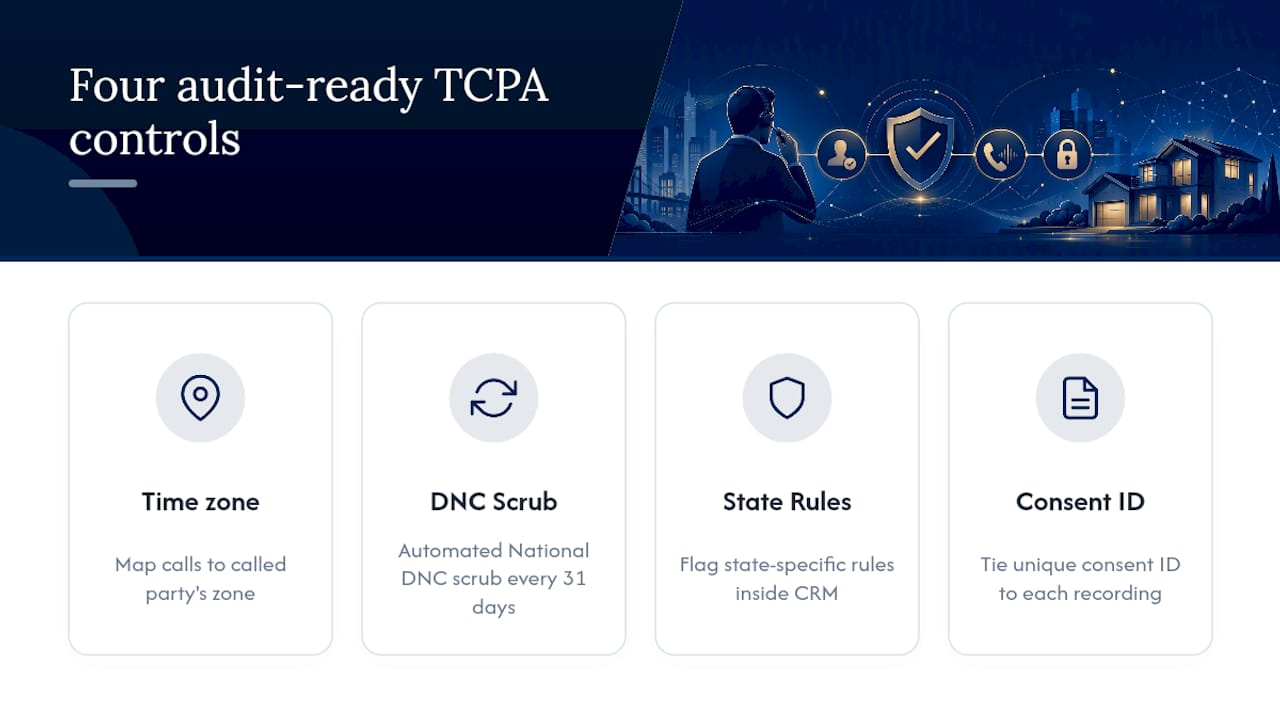
The controls that regulators actually ask for during an audit are specific and technical: mapping your calling list to the called party’s time zone, running automated 31-day DNC scrubs, flagging state-specific rules inside your CRM, and tying a unique consent ID to every recorded call are the exact controls enforcement teams request when they investigate a complaint. If your current setup can’t produce these on request, that’s the gap to close first.
Penalties, Enforcement, and Why Lawsuits Happen
The financial exposure here is not theoretical, and it scales fast because it’s per call, not per campaign.
Under the TCPA, statutory damages run $500 per violation and up to $1,500 per violation if the caller acted willfully or knowingly. A single agent who dials 500 unconsented autodialed calls in a bad campaign isn’t looking at one fine. They’re looking at a number that multiplies with every unconsented call on the list, and TCPA cases are frequently certified as class actions, which turns individual exposure into brokerage-wide exposure.
On the federal enforcement side, the FTC brings civil penalty actions under the TSR for deceptive telemarketing practices, failure to honor Do Not Call requests, abandoned-call violations, and prerecorded message abuses, with penalty amounts adjusted periodically for inflation. State attorneys general layer additional fines and, in states with mini-TCPA statutes, their own private rights of action on top of federal exposure.
The behaviors that trigger most real estate telemarketing complaints and lawsuits are predictable:
- Calling numbers on the DNC Registry without a valid, documented EBR exception.
- Using autodialers or AI voice tools without prior express written consent.
- Calling outside the called party’s local time window, especially across time zones.
- Failing to honor a “stop calling me” request and reaching the same number again later.
- Buying lead lists with vague or bundled consent language and treating them as fully compliant.
None of these require malicious intent to become a lawsuit. Most TCPA cases against real estate teams start with an honest operational gap, a stale list, a missed scrub, an unclear consent form, not a deliberate scheme. That’s exactly why documentation matters more than good intentions: a plaintiff’s attorney doesn’t ask whether you meant well. They ask whether you can produce the consent record.
Your Compliance Checklist Before You Dial
A functioning compliance program isn’t a legal memo sitting in a drawer. It’s a routine your team actually runs, broken into what happens immediately, what happens every month, and what you demand from any vendor before you sign a contract.
Day zero, before any campaign launches:
- Scrub the entire calling list against the National Do Not Call Registry.
- Verify consent status for every number, flagging anything without a documented, one-to-one consent record.
- If more than a small fraction of the list lacks clear consent documentation, pause the campaign rather than dial through the gap and hope no one complains.
Ongoing routines, run monthly without exception:
- Re-scrub the full list against the Registry at least every 31 days, even for numbers you’ve called before.
- Audit a sample of consent records each month to confirm timestamps, source, and language actually match what your compliance policy requires.
- Retrain agents on required opening disclosures, opt-out handling, and what to do the moment a prospect says “stop calling.”
- Update your internal suppression list immediately when anyone requests removal, and confirm it’s actually enforced on the next dial cycle, not just recorded.
Vendor and technology due diligence, before you buy anything:
- Require proof that the platform can export timestamped, per-call consent records on demand.
- Confirm automated DNC suppression runs on the required cadence with a retrievable log.
- Verify the system enforces calling windows based on the called number’s time zone, not a default office schedule.
- Ask for abandon-rate reporting and confirm it stays within TSR guidance.
- Confirm audit logs are retained for a period measured in years, not weeks.
Pro Tip: Build your monthly compliance audit as a recurring calendar event with a named owner, not a task someone remembers “eventually.” Compliance programs that fail usually didn’t lack rules. They lacked a person responsible for running them.
How a Connected Platform Closes the Compliance Gaps Agents Miss
Most of the compliance failures above share a root cause: the consent record lives in one system, the calling log lives in another, and the DNC scrub happens manually in a spreadsheet nobody remembers to update. Revring was built around the idea that compliance infrastructure has to live in the same place as the dialing and CRM activity it’s supposed to govern, not bolted on afterward.
That means consent capture, TCPA and DNC compliance workflows, and CRM data live in one connected system rather than three disconnected tools an operations manager has to reconcile by hand. For a real estate brokerage, that translates into automated suppression list updates, per-call audit trails tied to consent records, and workflows built around the exact checklist items above rather than generic call-center features — all of which can integrate with virtual tours to enhance real estate marketing effectiveness.
The scalability question matters here too. One documented Revring client scaled from 12 agents to 180 agents while keeping compliance intact, which is the exact scenario where manual spreadsheets and disconnected tools break down. Compliance infrastructure that works for a 12-person team has to keep working without a rebuild at 180.
Signals that mean it’s time to pause a campaign, not push through it:
- A noticeable spike in do-not-call complaints or opt-out requests within a short window.
- An internal audit that turns up consent records you can’t actually produce.
- Any state enforcement inquiry, even an informal one, tied to your calling activity.
If any of those show up, the right move is to pause outreach into the affected list segment, run a full consent and scrub audit, and involve legal counsel before resuming, not after. For a small brokerage, that pause might cost a slow week. For an enterprise team running thousands of dials a day, the calculus is the same, just with more zeros attached: the cost of pausing is always smaller than the cost of a class action built on a gap you already knew about.
— Marc
Get Compliance Built Into Your Dialer, Not Bolted On After
Revring is the alternative to stitching together a dialer, a CRM, and a compliance spreadsheet as three separate systems that never quite agree with each other. Built specifically for regulated outreach, it connects consent capture, automated DNC suppression, timezone-aware calling windows, and audit logging into a single workflow tailored to real estate teams.
That means the checklist covered in this article, consent verification, 31-day scrubs, per-call recordkeeping, timezone enforcement, isn’t something your ops manager tracks by hand across four different tools. It’s built into how the platform dials. Plans start at $39.99 per month per seat on the Starter tier, scaling up through Scale and Pro, with pricing details available for every tier so you can match the plan to your team’s calling volume. Real estate brokerages considering the switch can review how the platform handles industry-specific workflows or see the full breakdown of dialer, CRM, and compliance features before requesting a live demo.
Sources
Telemarketing law changes often enough that a one-time read isn’t sufficient. These are the primary sources worth checking directly rather than relying on secondhand summaries:
- Complying with the Telemarketing Sales Rule
- 47 U.S. Code § 227 - Restrictions on Use of Telephone Equipment (TCPA)
- Telephone Consumer Protection Act (TCPA) — FCC consumer guide
- Donotcall
- Telemarketing & Cold-Calling — National Association of REALTORS®
State attorney general and secretary of state websites are worth checking individually for any state where you actively call, since mini-TCPA statutes and telemarketer registration requirements change without much national coverage.
FAQ
Is It Illegal for Real Estate Agents to Cold Call?
No, cold calling itself is not illegal for real estate agents. It becomes a legal problem when calls violate TCPA consent requirements, ignore the National Do Not Call Registry, or skip state-specific telemarketing rules that may apply to the number you’re dialing.
What Are the Legal Rules for Cold Calling in Real Estate?
The core rules come from three sources: the TCPA (consent and autodialer restrictions), the TSR (disclosures, calling hours, recordkeeping, and DNC enforcement), and any applicable state mini-TCPA statute. You must verify consent before auto-dialing, scrub against the DNC Registry at least every 31 days, and call only within the recipient’s local time window.
What Is the 80/20 Rule in Cold Calling?
The 80/20 rule in cold calling is a sales productivity heuristic, not a legal standard.
Is Cold Calling Dead in Real Estate?
Cold calling isn’t dead, but it is far riskier to run without compliance infrastructure than it was a decade ago. Agents who verify consent, scrub lists on schedule, and document every call continue using it as a legitimate lead source, while those who skip those steps face rising TCPA litigation exposure that has pushed many teams toward more compliant, tech-supported dialing setups.
How Much Does RevRing Cost for a Real Estate Team?
Revring’s plans start at $39.99 per month per seat for the Starter tier, with Scale at $59.99 and Pro at $89.99 per month per seat. Enterprise pricing and a CRM-only option at $70 per month per seat are also available, with full details on the pricing page.