Blended Call Center Setup: A Manager’s Playbook for 2026

A blended call center is a customer service model where the same agents handle both inbound and outbound calls from a single system, instead of splitting staff into separate teams. That structure changes how you run the floor: agents fill idle time between inbound calls with outbound work, wait times drop because more people are available to answer, and your team responds to campaigns in near real time instead of waiting for a dedicated shift.
The operational payoff shows up fast once routing rules and dialer pacing are dialed in correctly. A single blended team gives you more flexibility than two siloed ones, and it typically means less idle payroll and faster follow-up on leads.
Here’s what blending changes on day one:
- Higher agent utilization — agents pick up outbound tasks during inbound lulls instead of sitting idle.
- Faster callbacks — a missed inbound call or an abandoned queue item gets outbound follow-up within the same shift, not the next day.
- Simplified routing — one skill-based system decides where every interaction goes, instead of managing two separate queues and two separate reporting stacks.
Key Takeaways
A blended call center works when inbound priority routing, disciplined dialer pacing, and blended KPIs are all configured together, not added one at a time after problems appear.
| Point | Details |
|---|---|
| Start with the 80/20 baseline | Reserve roughly 80% of agent capacity for inbound, tune the ratio once real volume patterns emerge. |
| Pilot before scaling | Run 8 to 12 agents for two to three weeks and measure abandon rate, occupancy, and QA scores before expanding. |
| Track blended KPIs together | Occupancy, service level, abandon rate, and contact rate all move together and need one shared dashboard. |
| Build the compliance checklist first | Confirm TCPA, DNC, PCI, and HIPAA requirements with legal counsel before configuring dialer campaigns. |
| RevRing maps directly to the buyer checklist | Its predictive dialer, CRM integration, AI call scoring, and compliance tooling supported one client’s scale from 12 to 180 agents. |
Table of Contents
- What Is a Blended Call Center, and What Are the Common Models?
- What Features Does Blended Call Center Software Need?
- What Are the Pros and Cons of Blending Inbound and Outbound Teams?
- How Do You Set Up a Blended Call Center Step by Step?
- How Do You Choose the Right Blended Call Center Software?
- What Staffing Ratios and KPIs Should You Track?
- What Compliance Rules and Pitfalls Should You Watch For?
- How Did One Operation Scale a Blended Model Successfully?
- How Do You Monitor and Optimize a Blended Operation After Launch?
- When Should You Blend, and When Should You Keep Teams Separate?
- How Does RevRing Support a Blended Call Center Build?
- Where to Learn More About Regulations and Blended Contact Center Practices
- Sources
What Is a Blended Call Center, and What Are the Common Models?
A blended contact center manages both inbound and outbound interactions so the same agent pool answers customer calls and places proactive outreach from one environment. That’s the core distinction from a dedicated setup, where inbound support reps never touch outbound dialing and outbound sales agents never field support tickets. Blending pools the labor, the software, and the reporting into one operation.
Not every blended center looks the same. Most fall into one of four patterns, and the right one depends on your call mix and your risk tolerance.
- Fully blended agents — every agent handles both inbound and outbound work continuously, with the system prioritizing inbound automatically.
- Part-time blended (shift or queue based) — agents work dedicated inbound blocks during peak hours, then shift to outbound campaigns during predictable lulls.
- Campaign-triggered blending — outbound dialing pauses or throttles automatically when inbound volume crosses a threshold, then resumes once queues clear.
- Omnichannel blended contact centers — voice blending extends to chat, SMS, and email, with agents working a unified queue across channels rather than just phone calls.
Support-first operations (healthcare intake, insurance claims) tend to favor part-time or campaign-triggered blending, since inbound service quality can’t slip. Sales-first operations (real estate lead follow-up, lead generation shops) often run fully blended models because outbound volume is the primary revenue driver and inbound calls are typically warm leads calling back.
What Features Does Blended Call Center Software Need?
The software stack determines whether blending actually works or just creates chaos. A handful of components do the heavy lifting.
- ACD and skill-based routing — the automatic call distributor decides which agent gets which interaction based on skill, availability, and priority rules.
- Blended dialer (predictive, progressive, or preview) — predictive dialers automatically call multiple numbers and connect answered calls to available agents, which boosts outbound contact rates but demands careful pacing to avoid dropped calls and compliance exposure.
- CRM integration with screen pops — agents see caller history the instant a call connects, whether it’s inbound or outbound.
- IVR — routes inbound callers to the right skill group before an agent ever picks up.
- Workforce management (WFM) — forecasts volume across both inbound and outbound work so scheduling doesn’t leave gaps.
- Omnichannel support — SMS, email, and chat integrated into the same agent workspace and reporting layer.
- Real-time dashboards and call recording — visibility into queue depth, agent status, and compliance-relevant call capture.
These pieces interact constantly. A well-configured system pauses or slows the outbound dialer automatically when inbound traffic spikes, freeing agents to answer waiting customers instead of finishing a dial campaign. RevRing’s predictive dialer builds that logic in natively, along with CRM connectivity that keeps screen pops synced across both directions of traffic.
Pro Tip: Set inbound as the non-negotiable priority in your routing rules, then build outbound fallback tiers underneath it. If inbound queue time exceeds your service-level target, the dialer should throttle automatically rather than requiring a supervisor to notice and intervene manually.
What Are the Pros and Cons of Blending Inbound and Outbound Teams?
Blending isn’t universally better than keeping teams separate. It’s a trade of complexity for efficiency, and that trade only pays off under certain conditions.
Advantages:
- Higher agent utilization, since idle time between inbound calls gets filled with outbound work instead of wasted.
- Faster response to campaigns and lead follow-up, because agents are already logged in and available.
- Simplified staffing forecasts once volume patterns stabilize, since you’re managing one pool instead of two.
- Better cross-training, which reduces single-point-of-failure risk when someone calls in sick.
Drawbacks:
- Training complexity rises, since agents need proficiency in both service scripts and sales or outreach scripts.
- Campaign interference is real: an aggressive outbound push can starve inbound queues if pacing rules aren’t strict.
- Reporting overhead increases, because you now need blended KPIs instead of two simpler, siloed scorecards.
- Customer experience risk climbs if agents context-switch poorly between a support call and a sales pitch.
Blending tends to be a net positive when your inbound volume is moderate and predictable, your outbound campaigns are lead follow-up rather than cold volume, and your compliance exposure is manageable. Dedicated teams still make sense for high-volume, highly regulated inbound support (think emergency healthcare lines) or aggressive outbound sales floors where dialer pacing needs to run at maximum intensity without inbound interruptions.
The hidden costs are the ones that surprise most operations managers: change management resistance from agents who’ve only ever done one job type, the QA overhead of scoring two different call types instead of one, and the tuning period needed to get dialer throttling right before it either drops too many inbound calls or leaves agents idle too often.
How Do You Set Up a Blended Call Center Step by Step?
Setting up a blended operation works best as a sequence, not a simultaneous rollout. Skipping steps is the single most common reason pilots stall.
- Define goals and KPIs first. Decide whether you’re optimizing for cost reduction, faster lead response, or improved customer satisfaction, then pick 3-4 KPIs that will tell you if it’s working.
- Choose your deployment model. Cloud-based platforms dominate for good reason. A cloud deployment guide is worth reviewing if you’re weighing cloud against on-premises hardware, since cloud setups typically launch faster and scale without new equipment purchases.
- Select your software. Match platform capabilities against your call mix. A team that’s 80% inbound support with occasional outbound follow-up needs different dialer settings than a team running heavy outbound lead campaigns.
- Design routing and priority rules. Build the logic that governs when outbound pauses for inbound, and document it so it survives staff turnover.
- Integrate CRM and data flows. Screen pops and unified customer records need to work identically whether the call is inbound or outbound.
- Configure dialer behavior. Set pacing ratios, abandonment thresholds, and time-of-day restrictions before you dial a single live number.
- Build training and scripts. Agents need separate scripts for inbound service and outbound outreach, plus guidance on switching between mindsets mid-shift.
- Pilot with a small group. Run a limited team through the full workflow before scaling company-wide.
- Scale once KPIs hit target. Expand headcount and campaign volume only after the pilot proves the routing and dialer rules hold up under real load.
Each step needs an owner and a deliverable. The routing design step, for example, should produce a written decision tree, not just a verbal agreement in a meeting.
Pro Tip: Run your pilot with 8 to 12 agents for two to three full weeks minimum. Anything shorter won’t capture a full weekly volume cycle, and you’ll misjudge how the dialer behaves during your slowest and busiest days. Measure abandon rate, agent utilization, and first-contact resolution before deciding to scale.
How Do You Choose the Right Blended Call Center Software?
Vendor selection comes down to matching features against your actual call mix and compliance exposure, not chasing the platform with the longest feature list.
- Routing flexibility — can you build custom priority rules, or are you stuck with a fixed inbound/outbound split?
- Dialer types and controls — does the platform support predictive, progressive, and preview modes, and can you adjust pacing in real time?
- CRM and telephony integrations — will it connect to your existing systems, or does it force a rebuild of your customer data pipeline?
- Analytics and reporting — can you see blended KPIs (not just separate inbound and outbound dashboards) in one view?
- WFM and QA tooling — does the platform forecast blended staffing needs and support call scoring for both call types?
- Security and compliance support — does it handle TCPA and DNC list management for outbound, PCI scope reduction for payment calls, and HIPAA business associate agreements if you handle healthcare data?
- SLA and uptime guarantees — what’s the vendor’s documented uptime commitment, and what’s the support response time when something breaks?
- Multi-tenant vs. single-tenant architecture — larger regulated operations often need dedicated infrastructure rather than shared multi-tenant environments.
Growth-focused teams generally prioritize dialer flexibility and CRM depth. Tightly regulated industries like insurance and healthcare should weight compliance tooling and audit trails more heavily than raw dialer speed. RevRing’s industry-specific insurance workflows and healthcare-focused compliance features reflect that split directly in how the platform is configured for each vertical.
Pricing usually breaks into seat-based subscription costs plus usage-based add-ons for telephony minutes, AI call scoring, and CRM modules. Budget for the add-ons up front. A quote that looks cheap on seats alone often gets expensive once you layer in the telephony and compliance modules you actually need.
What Staffing Ratios and KPIs Should You Track?
Blending ratios describe how much of an agent’s time goes to inbound versus outbound work. A commonly cited starting point for blending ratios is to reserve most agent capacity for inbound response, with a smaller portion available for outbound dialing during confirmed lulls. That ratio isn’t a law, it’s a starting assumption you tune based on your actual inbound volume patterns. A support-heavy operation might run closer to 90/10, while a sales-heavy operation with light inbound volume might flip it toward 60/40 outbound.
Whatever ratio you choose, a handful of KPIs tell you whether the blend is working:
| KPI | What It Measures | Typical Target Range |
|---|---|---|
| Occupancy | Percent of logged-in time agents spend actively on calls or after-call work | Typical target ranges aim for high utilization without causing burnout |
| Service level | Percent of inbound calls answered within a target time | Targets often aim for the majority of calls to be answered quickly |
| Average handle time (AHT) | Average duration of a call plus wrap-up time | Varies by call type |
| Abandon rate | Percent of inbound callers who hang up before reaching an agent | Low abandon rates are generally targeted |
| Contact rate | Percent of outbound dial attempts that reach a live person | Contact rates vary based on campaign type and list quality |
| Conversion rate | Percent of contacted outbound leads that result in a desired outcome | Varies by campaign |
Occupancy is the metric that most directly reflects blending success, but pushing it too high backfires.
Pro Tip: When occupancy climbs but your quality assurance scores start slipping in the same reporting period, that’s your signal to ease outbound dialer pacing, not push harder. High utilization with declining call quality is the fastest way to lose the customer experience gains blending was supposed to deliver.
What Compliance Rules and Pitfalls Should You Watch For?
Blended operations carry compliance exposure on both sides of the phone, and treating them as one combined risk category rather than two separate ones is where most teams underinvest.
- TCPA and DNC handling for outbound — regulatory frameworks limit automated outbound calling and impose recordkeeping requirements that your dialer configuration and call lists must respect, including honoring do-not-call requests immediately and maintaining internal suppression lists.
- PCI scope reduction for payment calls — if agents ever take payment information over the phone, your platform needs to either avoid capturing card data in recordings or use secure payment capture tools that keep that data out of scope.
- HIPAA considerations for healthcare data — any operation handling protected health information needs a signed business associate agreement with its software vendor and strict access controls on call recordings and CRM notes.
- Record-keeping and disclosure requirements — outbound scripts often require specific disclosures at the start of the call, and those recordings need retention policies that match your jurisdiction’s rules.
Beyond the legal checklist, a few operational pitfalls show up again and again in blended rollouts. Improper dialer pacing is the most common: set the predictive dialer too aggressively and you’ll generate abandoned calls that frustrate prospects and trigger regulatory scrutiny. Bad routing rules that don’t properly deprioritize outbound during inbound spikes will quietly worsen your abandon rate even while your outbound numbers look strong. Reporting gaps between inbound and outbound systems make it hard to spot problems until they’ve already cost you a compliance incident. And QA teams that only score inbound calls, or only score outbound calls, miss half the picture in a genuinely blended operation.
Compliance rules for automated dialing and consumer communications vary by jurisdiction and by industry, and they change over time. This guidance is informational. Confirm current requirements with legal counsel or a compliance specialist before configuring dialer behavior or outbound campaigns, particularly in regulated industries like healthcare, insurance, and financial services.
For a deeper look at one specific regulatory area, RevRing’s breakdown of TCPA compliance requirements covers the disclosure and consent rules that most directly affect outbound dialing configuration.
How Did One Operation Scale a Blended Model Successfully?
One RevRing client’s growth trajectory illustrates what disciplined blending looks like in practice. The operation started with 12 agents running largely separate inbound and outbound workflows, with lead follow-up lagging behind because outbound calling competed for the same hours as inbound support coverage.
The shift to a blended model meant consolidating both call types onto one platform, integrating CRM data so agents saw full customer history regardless of call direction, and building routing rules that gave inbound calls automatic priority while outbound dialing filled the gaps.
The operation scaled significantly in agent count while maintaining compliance across that growth. That scale-up didn’t happen by simply adding headcount to the old process. It required rebuilding routing logic, retraining QA to score blended interactions, and adjusting dialer pacing as call volume patterns shifted with each stage of growth.
The pilot phase revealed something the team hadn’t anticipated: agents needed explicit context-switching cues between inbound service mode and outbound outreach mode, or call quality dropped during the transition moments. That finding led to script and workflow adjustments that got built directly into the onboarding playbook for every new agent added after that point, which is a large part of why the scale-up held together operationally rather than fraying at the edges.

How Do You Monitor and Optimize a Blended Operation After Launch?
Launch day is the start of the work, not the finish line. Blended operations need a monitoring rhythm that catches drift before it becomes a crisis.
- Design dashboards around blended KPIs, not separate inbound and outbound views, so supervisors see the full picture in one glance.
- Review daily metrics (service level, abandon rate, occupancy) and weekly metrics (conversion rate, QA scores, contact rate trends) on separate cadences, since daily noise obscures weekly patterns.
- Build a QA scoring form that evaluates both inbound and outbound calls against distinct criteria, and sample at least 5-10% of calls per agent per week.
- Run root-cause analysis whenever a KPI moves outside its target range, rather than waiting for a quarterly review to notice the trend.
- A/B test scripts and dialer settings in small controlled batches: change one variable at a time, whether that’s a script opening line or a pacing ratio, and measure the outcome before rolling changes company-wide.
Research on customer experience practices consistently points to cross-functional accountability and continuous testing as the difference between operations that improve steadily and those that plateau after launch. That means QA, workforce management, and campaign strategy need to share the same dashboard and the same review cadence, not operate in separate silos reporting to different meetings.
Coaching should be tied directly to the performance signals your dashboards surface. An agent whose occupancy is high but whose QA scores are slipping needs a different coaching conversation than one whose occupancy is low but whose call quality is excellent. Weekly one-on-ones anchored in specific KPI movement, rather than general performance chats, tend to produce faster improvement.
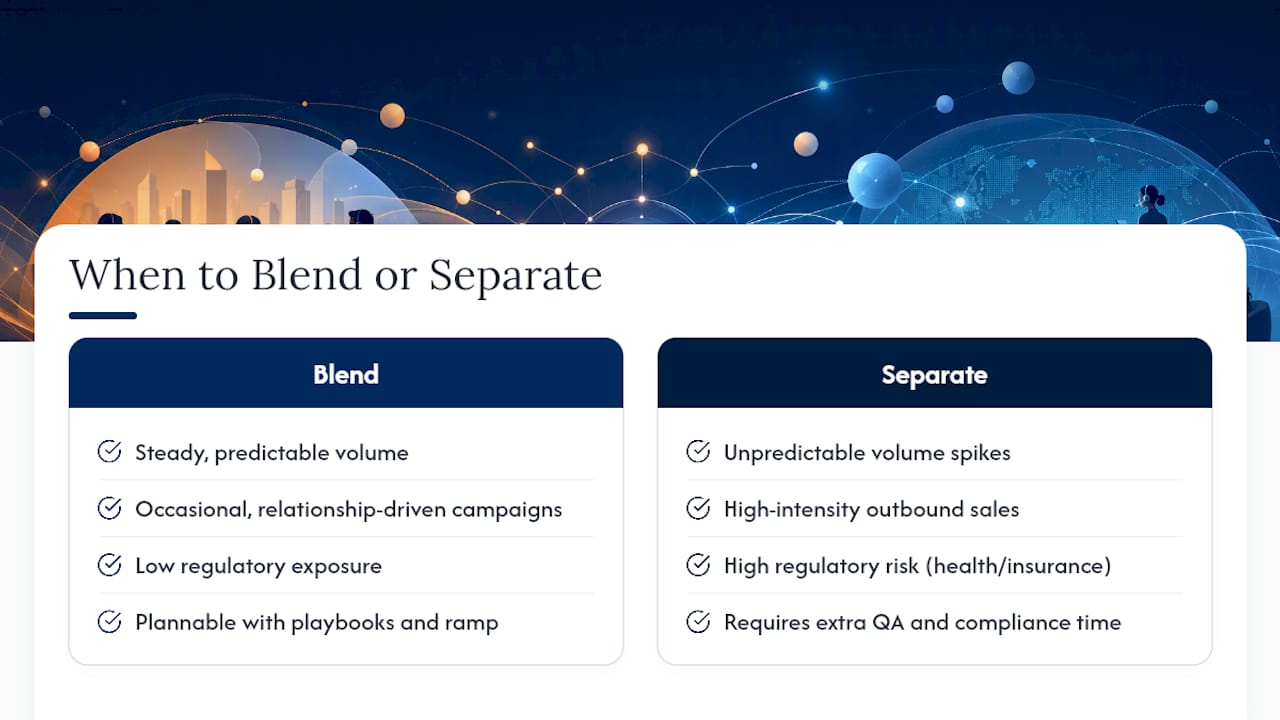
When Should You Blend, and When Should You Keep Teams Separate?
The conventional advice treats blending as an obvious upgrade over dedicated teams, and that’s an oversimplification. Blending is a genuine operational advantage only when your call mix and your risk profile line up in specific ways.
Volume mix is the first signal. If your inbound volume is steady and predictable, with clear lulls you can forecast, blending fills those gaps productively. If your inbound volume spikes unpredictably (a common pattern in healthcare intake or claims processing), a blended dialer that’s mid-campaign when a spike hits will create exactly the kind of abandoned-call problem that damages both customer trust and compliance standing.
Campaign frequency is the second. Teams running occasional, relationship-driven outbound (renewal reminders, appointment confirmations, warm lead follow-up) blend well because the outbound work is lower volume and lower urgency than aggressive cold-calling campaigns. Teams running high-intensity outbound sales pushes often get better results keeping that function separate, at least until routing and pacing rules are proven under blended load.
Regulatory risk is the third, and it’s the one most operations managers underweight. A healthcare or insurance operation blending inbound patient or policyholder calls with outbound outreach needs dialer pacing, consent tracking, and QA scoring that account for both directions simultaneously. That’s a heavier lift than a customer service operation with minimal outbound compliance exposure, and it’s worth building in the extra QA time rather than discovering the gap during an audit.
What tends to get underestimated across all three signals is change management. Moving agents from a single-function role to a blended one is a real adjustment, and resistance is predictable, not a sign something’s wrong with the plan. Structured playbooks that give agents clear scripts, clear priority rules, and a defined ramp period reduce that friction substantially compared to an unplanned “figure it out” rollout. That’s the piece RevRing’s industry-tailored workflows are built to address directly, since a playbook that’s already been proven in a similar vertical removes a lot of the guesswork agents otherwise face during the transition.
How Does RevRing Support a Blended Call Center Build?
RevRing gives operations managers one platform instead of the patchwork most blended centers run on: a predictive dialer with adjustable pacing controls, native CRM connectivity for screen pops on every call regardless of direction, AI-driven call scoring that covers both inbound and outbound interactions, and compliance tooling built for TCPA, DNC, and HIPAA business associate requirements out of the box.
That combination is what let one client scale from 12 agents to 180 while holding compliance steady through every stage of growth, using the industry-tailored playbooks built into RevRing’s insurance and healthcare workflows to shorten the ramp period for new agents. Workforce management and reporting are built into the same environment, so you’re not stitching together three vendors to get one blended view of your operation.
If you’re evaluating whether blending fits your call mix, the fastest way to find out is to see the routing and dialer controls in action against your own volume patterns. Check RevRing’s plans or get a walkthrough of the platform to map your current setup against what a blended architecture would actually look like for your team.
Where to Learn More About Regulations and Blended Contact Center Practices
- For automated dialing and outbound calling rules, consult the Consumer Financial Protection Bureau’s regulatory guidance before finalizing dialer configuration.
- For a technical definition of predictive dialer behavior and pacing mechanics, the Wikipedia overview of predictive dialers covers the core mechanics operations teams need to understand.
- For customer experience benchmarks and design principles, the Harvard Business Review’s customer experience best practices outlines the measurement and accountability framework worth adapting to blended workflows.
- For broader customer service culture and coaching practices, Harvard Business Review’s guide to exceptional customer service is a useful reference for building QA standards.
- For cloud deployment planning specifically, the cloud communication platform guide walks through the infrastructure decisions that precede software selection.
Consult the regulatory sources for compliance decisions, the dialer documentation for pacing and technical configuration, and the customer experience research for QA design and coaching cadence. Each source answers a different part of the setup process, and none of them substitutes for the others.