Map SEC, FDA & IRS Rules to an Auditor Ready Audit Trail

A compliance audit trail is a tamper-evident, time-stamped chronological record capturing who did what, when, where, and why across a system or process. The single non-negotiable requirement is immutability, whether through WORM storage or a cryptographic audit-trail alternative, paired with exportability that satisfies your regulator’s retention window. Get those two elements wrong and everything else, from SEC Rule 17a-4 to FDA 21 CFR Part 11 to NIST guidance, becomes irrelevant.
TL;DR:
- Effective compliance audit trails must be immutable and stored in a tamper-evident format, satisfying regulatory retention and export requirements.
- The record must include detailed fields such as user identity, specific actions, synchronized timestamps, location, reason for change, and cryptographic integrity metadata.
- Regulatory standards like SEC Rule 17a-4 and FDA 21 CFR Part 11 demand specific formatting, retention periods, and proof of unaltered data, complicating multi-framework compliance.
- Building a validated, operational audit trail involves defining event models, choosing proper immutability methods, separating storage, and conducting regular testing and monitoring.
- Managed compliance platforms integrate communication, CRM, and automation tools, reducing fragmentation and ensuring audit trail reliability for regulated industries.
Table of Contents
- What Makes a Compliance Audit Trail Different From a System Log
- Why a Compliance Audit Trail Matters Beyond Checking a Box
- The Fields Every Audit Trail Record Needs to Capture
- How SEC, FDA, and IRS Rules Shape Audit Trail Requirements
- Building and Validating a Compliance-Grade Audit Trail
- Keeping an Audit Trail Effective After Launch
- Where Audit Trails Break Down at Scale
- How Revring Supports Audit-Ready Compliance Operations
- What Most Compliance Guides Get Backwards
- Get Your Compliance Audit Trail Running Without the Custom Build
- Sources
What Makes a Compliance Audit Trail Different From a System Log
Most systems already generate logs. Almost none of those logs qualify as a compliance audit trail on their own.
A raw system log is a byproduct: it exists because software emits messages when things happen, and someone decided to write them to a file. A compliance-grade audit trail is a deliberate record built to withstand scrutiny. NIST frames it as a chronological sequence of audit records that documents activity affecting a specific operation or event, and that framing matters because it implies structure, not just noise.
Four attributes separate the two:
- Computer-generated. The record is created automatically by the system, not typed in manually after the fact.
- Independent. No single user, including administrators, can edit or delete entries without leaving evidence.
- Immutable. Once written, the entry is locked, hashed, or otherwise protected from silent alteration.
- Readable. An auditor with no engineering background can interpret the record without a translator.
Strong implementations capture activity at multiple layers, application, database, and operating system, because a gap at any single layer creates a blind spot an investigator will eventually find. Application logs show intent, database logs show the actual data change, and OS-level logs confirm nothing was altered outside the application’s visibility.
Why a Compliance Audit Trail Matters Beyond Checking a Box
The value shows up long before an examiner walks in the door.
Audit trails are the primary evidence regulators request during examinations. When the SEC or a state insurance regulator asks how a decision was made, the audit trail is the answer, not a reconstructed memory of what someone thinks happened. That evidentiary weight is why compliance audit trails support AML alert investigations, dispute resolution, and internal fraud detection across regulated industries far beyond banking.
A well-built trail earns its cost in a few concrete ways:
- Regulatory evidence. Produces a defensible record during examinations, subpoenas, or licensing reviews.
- Fraud and incident investigation. Lets security teams reconstruct exactly what a compromised account touched.
- Dispute resolution. Settles customer complaints about pricing, consent, or unauthorized changes with data instead of opinion.
- Operational transparency. Gives leadership and partners visibility into who is actually doing what inside core systems.
None of this requires a breach or a subpoena to pay off. Insurance agencies using it to prove TCPA-compliant outreach, and healthcare practices proving HIPAA-compliant record access, both lean on the same underlying structure.
The Fields Every Audit Trail Record Needs to Capture
Auditors do not evaluate audit trails on volume. They evaluate them on whether specific fields exist for every entry, every time.
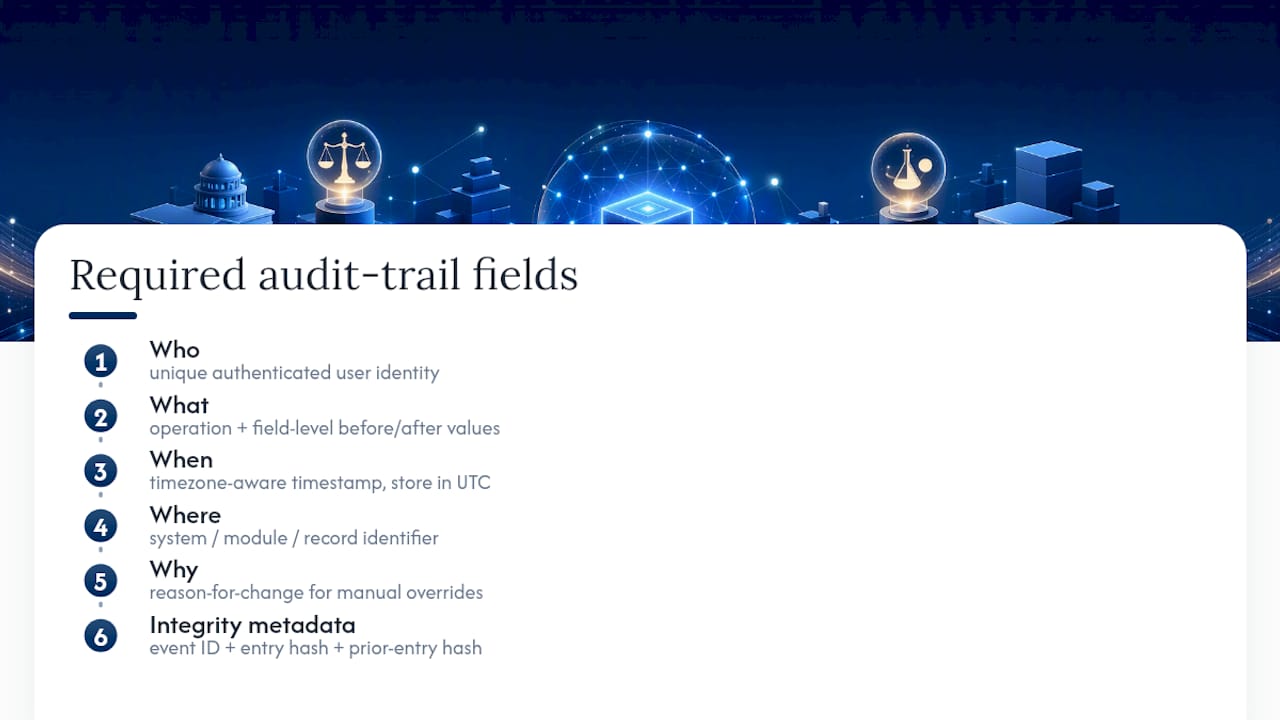
Who. Every entry needs a unique, authenticated user identity, never a shared service account or a generic “admin” login. Shared credentials are one of the fastest ways to fail an audit, because they make it impossible to attribute an action to a specific person.
What. The exact operation performed, plus field-level before and after values. “Record updated” tells an auditor nothing. “Premium changed from $412 to $389” tells them everything.
When. A synchronized, timezone-aware timestamp. Systems spread across regions should standardize on UTC internally and convert for display, since clock drift between servers is a common source of audit failures that has nothing to do with actual wrongdoing.
Where. The system, module, or record identifier tied to the event, so an entry can be traced back to its exact source without guesswork.
Why. A reason-for-change field where applicable, particularly for manual overrides, exception approvals, or anything a human decided to do outside the normal workflow.
Integrity metadata. A unique event ID, a cryptographic hash of the entry, and a link to the prior entry’s hash, forming a chain that proves nothing was inserted or removed after the fact.
Pro Tip: If your team can’t answer “who approved this specific change and why” in under sixty seconds using your own audit trail, treat that as a finding before an auditor does.
The IRS Safeguards program lists a similarly detailed set of required audit content, including privileged action monitoring and protection from unauthorized modification, and that level of specificity is the standard auditors now expect across sectors, not just federal contractors.
How SEC, FDA, and IRS Rules Shape Audit Trail Requirements
Regulatory language turns into engineering requirements faster than most teams expect once you map it directly.
SEC Rule 17a-4 governs broker-dealers and requires records to be preserved in a non-rewriteable, non-erasable format, traditionally WORM storage. The 2022 amendment introduced an audit-trail alternative: firms can use a system that isn’t strictly WORM if it maintains an audit trail proving no record was altered or deleted, and that audit trail must itself be downloadable and transferable in a reasonably usable electronic format on request.
FDA 21 CFR Part 11 applies to electronic records in FDA-regulated industries and requires secure, computer-generated, time-stamped audit trails that do not obscure previously recorded information. Retention has to run at least as long as the underlying record it documents, not on a separate, shorter clock.
SOX, HIPAA, and NIST add their own layers: SOX generally requires extended retention on certain financial records, typically several years, while SEC Rule 17a-4 sets a multi-year retention window with initial years in an easily accessible format. Retention periods are not interchangeable across frameworks, which is exactly why teams operating under multiple regulations often end up designing for the longest applicable window rather than juggling several.
What auditors actually request when they show up: a sample of records with full before/after detail, proof the trail itself hasn’t been altered, and an export delivered in a format they can analyze without your engineering team translating it first.
Building and Validating a Compliance-Grade Audit Trail
Treat this as a build sequence, not a wish list. Each step depends on the one before it.
- Define the event model first. Decide which fields are mandatory for every record type, and standardize on before/after capture for anything that mutates data. Assign a unique event ID at creation, never after the fact.
- Choose your immutability method. WORM storage (object lock on cloud storage) satisfies SEC 17a-4 directly. Append-only database patterns paired with cryptographic hash chaining using SHA-256 satisfy the audit-trail alternative and work well when WORM infrastructure isn’t practical.
- Write synchronously where it counts. Asynchronous logging pipelines are fine for low-risk read events, but any write tied to a financial transaction, a consent change, or a regulated decision needs a synchronous write to the audit store. The gap between “action happened” and “audit entry saved” is a risk window regulators specifically look for.
- Separate storage from operational data. The audit store should sit outside the reach of the application’s normal admin roles, with its own access controls and encryption at rest, so a compromised application account can’t touch its own evidence trail.
- Keep it indexable. Encryption and immutability can’t come at the cost of exportability. Build the schema so a full export, filtered by date range, user, or record, can run without a custom engineering task each time.
- Test the whole thing. Verify capture completeness against a known set of test transactions, run tamper tests against the immutability layer, and do periodic export round-trips to confirm what regulators would actually receive matches what the system recorded. Pairing automated immutability checks with reviewer spot checks catches gaps that automated testing alone tends to miss.
Pro Tip: Run your export process at least once a quarter, not just when a regulator asks. The first time most teams discover their export is broken is during an actual examination.
Keeping an Audit Trail Effective After Launch
Building the trail is the easy half. Operating it is where most programs quietly fail.
Regulators have shifted focus from “does a log exist” to “does anyone actually watch it.” Compliance self-checks increasingly grade programs on documented monitoring, detection, and remediation, not on the mere presence of records sitting untouched in storage.
A functioning program needs:
- Named ownership. One person or team accountable for reviewing the audit trail on a defined schedule, not “whoever has time.”
- Automated anomaly detection. SIEM or GRC integration with alert thresholds for unusual patterns, like a single account touching an abnormal volume of records overnight.
- Risk-based retention. Tier events by regulatory exposure rather than retaining every low-risk read event as long as a financial record change, which balances storage cost against genuine compliance need.
- A defined export SLA. A documented process for producing regulator-ready exports within a set turnaround, tested before it’s needed under pressure.
Escalation paths matter as much as detection. An alert that fires with no one assigned to act on it is functionally the same as no alert at all.
Where Audit Trails Break Down at Scale
Four failure patterns show up repeatedly, and each has a mitigation that doesn’t require a rebuild.
- Cost at scale. High-volume systems generate enormous log volumes. Tiered retention and selective capture by risk level keep storage costs sane without losing anything a regulator would actually ask for.
- Privileged-account tampering. Admins with database access can, in theory, alter their own audit trail. Separating the audit store into its own immutable system with a controlled write path closes that gap.
- Clock drift. Servers across regions or vendors drift out of sync, which breaks timeline reconstruction. Centralized NTP and UTC-standardized timestamps fix this at the infrastructure level.
- Format heterogeneity. Different systems log differently, which fragments the record. Normalizing to a common schema before storage keeps cross-system investigations coherent.
How Revring Supports Audit-Ready Compliance Operations
Revring’s revenue acceleration infrastructure connects communication tools, CRM systems, AI automation, and compliance functionality in one environment built specifically for regulated sales operations.
For insurance, real estate, and healthcare organizations, that matters because fragmented tools are usually where audit trails break down first, one system logs calls, another logs consent, a third logs data changes, and nobody can reconstruct a single clean timeline.
- Industry-specific compliance infrastructure including support for regulations like TCPA, DNC, and HIPAA BAA built into the platform rather than bolted on afterward.
- Tailored playbooks and workflows designed to integrate into existing operations, reducing resistance teams usually meet when a new compliance process gets introduced.
- Documented scalability, with users reporting growth from 12 to 180 agents while maintaining compliant call and lead-handling practices throughout that expansion.
- Unified lead and communication tracking, giving compliance teams one system to pull from instead of reconciling records across disconnected tools.
For organizations managing regulated outreach and client intake, that consolidation is often what determines whether an audit trail is actually reliable, or just theoretically complete.
What Most Compliance Guides Get Backwards
The conventional advice treats audit trails as a storage problem: buy WORM, hash everything, retain for X years, done. That advice isn’t wrong, but it’s incomplete in a way that causes real failures.
The regulatory language itself, especially the shift in how examiners evaluate compliance self-checks, makes clear that storage architecture is the floor, not the ceiling. An immutable, perfectly hashed audit trail that nobody reviews is functionally identical to no audit trail at all when an examiner asks “who caught this anomaly, and when.”
Most teams over-invest in the technical build and under-invest in the operational layer: named ownership, review cadence, and an export process that actually works under pressure instead of just in theory. That imbalance is backwards. A mid-tier immutability solution with a disciplined review process will outperform a cryptographically flawless system that sits unmonitored.
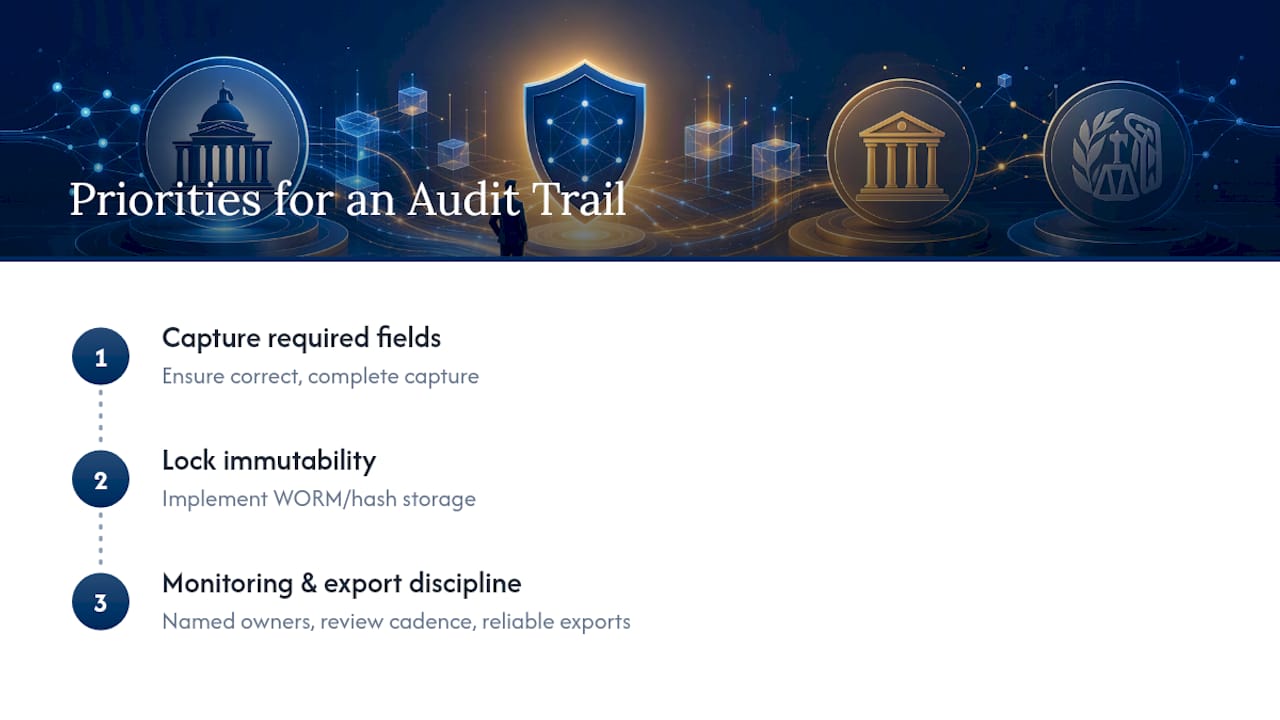
If you’re starting from zero, prioritize in this order: get the required fields captured correctly first, lock down immutability second, and build the monitoring and export discipline third, before you spend another dollar hardening infrastructure nobody is watching.
— Marc
Get Your Compliance Audit Trail Running Without the Custom Build
A platform can give regulated sales and intake teams built-in call logging, retention, and export capability instead of forcing you to stitch together telephony, CRM, and compliance tools separately. That means your TCPA-relevant call activity, consent records, and agent actions live in one system with the audit trail already structured for exportability, not scattered across three vendors you have to reconcile manually before an examination.
The predictive dialer platform captures call activity and disposition data automatically, while the AI and automation layer applies playbooks tailored to your industry’s compliance requirements without a lengthy rebuild. Insurance agencies, real estate brokerages, and healthcare practices use infrastructure designed to help scale teams while keeping TCPA and HIPAA obligations intact. Request a demo through Revring’s platform overview to see how the audit and retention features map to your specific regulatory requirements.