Insurance Lead Management: Agency Playbook & Checklist

The most effective insurance lead management approach pairs a strict speed-to-lead workflow with automated routing, lead scoring, and audit-ready compliance controls. Nothing else on this list matters if a hot lead sits in an inbox for two hours while a competitor’s agent already has them on the phone.
Your next move this week: set a short response SLA for every inbound lead, tag every intake form with a source field, and route anything unanswered after 15 minutes to a backup agent automatically. Three signals worth watching as you build this out:
- Lead response speed decays fast: Harvard Business Review found contact and conversion odds drop sharply once the initial follow-up window closes.
- The global insurance market keeps expanding, according to Statista, which means the agencies with tighter pipelines capture disproportionate share.
- Compliance isn’t optional. The FTC’s Telemarketing Sales Rule governs consent and recordkeeping for any automated outbound dialing you add.
Key Takeaways
Insurance lead management works when speed-to-lead, standardized intake, and compliance controls run automatically instead of depending on individual agent memory.
| Point | Details |
|---|---|
| Enforce a response SLA | Set a 5 to 15 minute speed-to-lead target and route unanswered leads automatically. |
| Standardize intake fields | Capture source, product interest, renewal date, and consent status on every lead. |
| Track five core KPIs | Monitor speed-to-lead, contact rate, conversion rate, source ROI, and renewal rate weekly. |
| Build compliance into the workflow | Native TCPA and DNC screening with consent logs prevents costly manual gaps. |
| Consider a platform pilot | RevRing combines predictive dialing, CRM connectivity, and compliance logging in one system. |
Table of Contents
- Why Does Insurance Lead Management Actually Move the Needle?
- Six Best Practices for Insurance Lead Management
- What Features Should a Lead-Management System Include?
- Which KPIs Actually Predict Insurance Lead Conversion?
- How Do You Roll Out a New Lead-Management Workflow?
- What Does Good Day-to-Day Lead Operations Look Like?
- How Do You Choose the Right Lead-Management Platform?
- How RevRing Fits This Playbook
- Frequently Asked Questions
- Sources
Why Does Insurance Lead Management Actually Move the Needle?
Insurance lead management determines whether a marketing dollar turns into a bound policy or evaporates into a CRM graveyard. Agencies that manage leads well don’t just close more deals today. They protect renewal revenue, because the same discipline that gets a prospect to sign also gets an existing client to renew instead of shopping around.
Pipeline health is the real product here. A well-managed pipeline gives you predictable volume, faster velocity from first contact to bound policy, and a clearer read on lifetime value across auto, home, life, and commercial lines. Weak lead management, by contrast, produces the pattern most agency owners know too well: leads go cold, follow-up gets inconsistent, and cross-sell opportunities on existing books of business get missed entirely.
The business outcomes tend to cluster around a few areas:
- Fewer policy lapses, because renewal reminders and touchpoints happen on schedule instead of by memory.
- Higher first-contact conversion, since organized intake means agents aren’t chasing down missing details before they can even quote.
- Stronger cross-sell performance, because a documented history of a client’s coverage makes it obvious when a bundle or upsell fits.
- More reliable forecasting, since consistent data lets you model pipeline volume instead of guessing.
The NAIC serves as the reference point most agencies use when they need regulatory or market context for how customer data should be handled across state lines. That matters more as agencies scale past a single office and start managing leads across multiple licensed territories.
Six Best Practices for Insurance Lead Management
Most agencies don’t need a bigger lead budget. They need to stop losing leads they already paid for. Here’s the priority order that actually moves conversion numbers.
1. Standardize what you capture on every lead. Every intake form, whether it comes from a web form, a call center transfer, or a referral, should capture the same core fields: name, contact info, product interest, current carrier (if any), renewal date, lead source, and consent status. Inconsistent intake is the single biggest reason agencies can’t measure lead source ROI later.
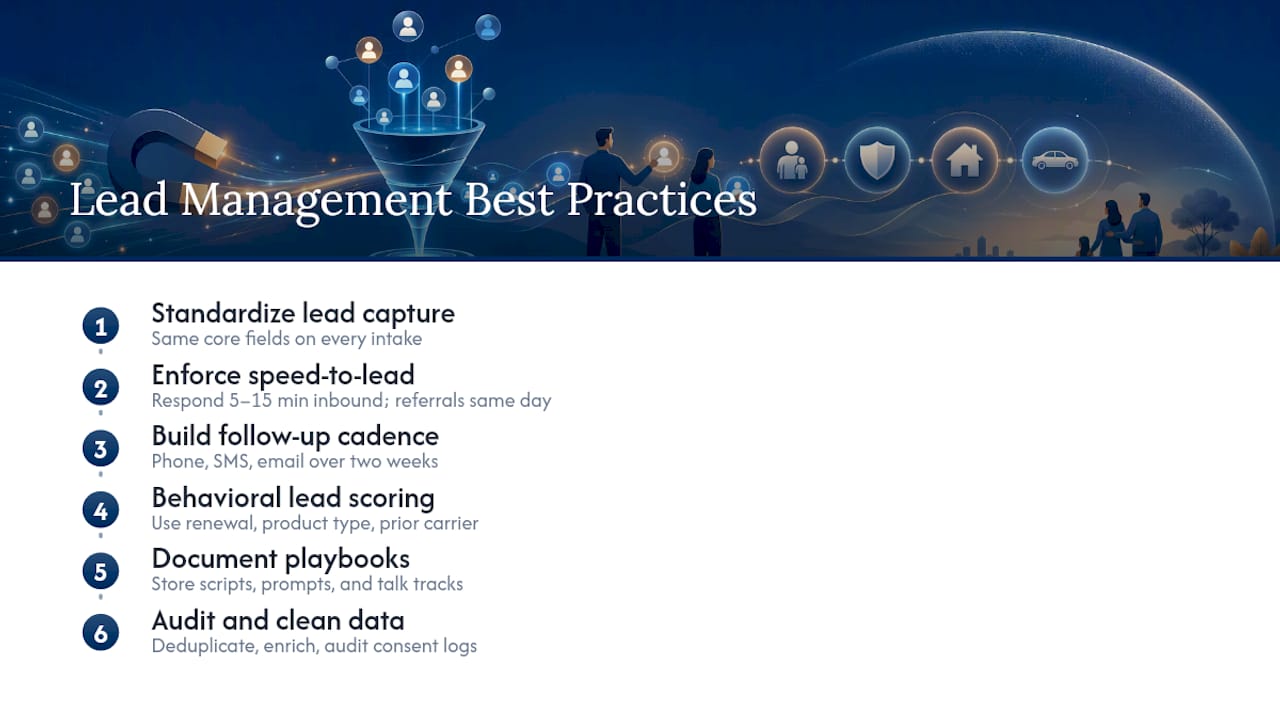
2. Treat speed-to-lead as a hard rule, not a goal. Set a target response window (5 to 15 minutes for inbound, same business day for referrals) and build routing that enforces it. HBR’s research on lead decay makes the case clearly: the odds of reaching a prospect fall fast once the clock starts running.
3. Build a real follow-up cadence, not a single call. Nationwide’s agent guidance notes that many consumers need multiple touches before they buy. A cadence that mixes phone, SMS, and email across the first two weeks outperforms a single call attempt every time. Document the sequence so every agent runs the same play.
4. Score leads based on how insurance buyers actually behave. Someone requesting a quote 30 days before their renewal date behaves differently than someone browsing a comparison site. Weight your scoring model toward buying signals specific to insurance: renewal proximity, product type, and prior carrier status matter more than generic engagement metrics borrowed from other industries.
5. Write down your playbooks. Objection-handling scripts, cross-sell prompts, and renewal talk tracks should live somewhere every agent can access, not in the head of your top producer. New hires ramp faster and your best practices survive turnover.
6. Audit your data regularly. Deduplication, enrichment, and consent-log audits aren’t glamorous, but they’re what keeps you compliant and keeps agents from wasting time chasing the same lead twice under two different names.
Pro Tip: Run a “lead autopsy” every month on your five oldest unconverted leads. You’ll almost always find a pattern (a missing field, a routing gap, a dropped follow-up) that’s costing you more than any single lost deal.
What Features Should a Lead-Management System Include?
A platform that just stores contact records isn’t lead management software, it’s a filing cabinet with a login screen. The systems that actually change outcomes share a specific set of capabilities.
Multi-channel capture and deduplication. Leads arrive from web forms, call transfers, referral partners, and purchased lists. The system needs to normalize all of it into one record and flag duplicates before an agent wastes a call on a name already in the pipeline.
Automated routing with real rules. Territory, product line, licensing, skill level, even ping-post logic for purchased leads: routing should happen instantly, not sit in a queue for a manager to sort manually. LeadSquared documents this kind of auto-routing as standard for businesses scaling their intake volume.
Scoring with a manual override. Automated scoring speeds triage, but agents need the ability to bump a lead up manually when they spot a signal the algorithm missed.
Outbound tools that match your call volume. A predictive dialer and blended inbound/outbound calling let agents spend time talking, not dialing and waiting.

Integration with the systems you already run. CRM connectivity, carrier AMS integration, and secure document handling matter because insurance workflows generate paperwork the moment a quote turns serious.
Compliance built into the workflow, not bolted on after. TCPA and DNC screening, consent logs, and call recording need to happen automatically, every time.
The gap between agencies that convert well and those that don’t usually isn’t lead volume. It’s whether the system enforces the rules automatically or leaves compliance and follow-up to memory.
Which KPIs Actually Predict Insurance Lead Conversion?
Tracking too many metrics is almost as bad as tracking none. A handful of numbers tell you nearly everything you need to know about pipeline health.
- Speed-to-lead: time from lead creation to first contact attempt. This is the single strongest predictor of conversion, per the lead decay research from HBR.
- Contact rate: the percentage of leads you actually reach, not just call.
- Qualified-lead conversion rate: how many contacted leads turn into bound policies, segmented by product line.
- Lead source ROI: cost per lead against policies bound, broken out by source so you can cut underperforming channels.
- Pipeline velocity: average time from first contact to close, which tells you where deals stall.
- Renewal and churn rate: the metric most agencies underweight, even though retained revenue usually outweighs new acquisition.
Benchmark these internally by source and product rather than against generic industry averages. A referral lead and a purchased ping-post lead will never convert at the same rate, and comparing them directly just muddies your read on what’s actually working. Build a weekly ops review around five or six fields: new leads by source, average speed-to-lead, contact rate, leads in each pipeline stage, and renewals due in the next 30 days. That’s enough to catch a slipping metric before it becomes a quarter-ending problem.
How Do You Roll Out a New Lead-Management Workflow?
- Design the intake model first. Decide the minimum fields every lead needs (contact info, source tag, product interest, consent status) before you touch any software settings.
- Set routing rules and SLAs. Assign explicit ownership for every lead type and write down the response-time targets, don’t leave them implied.
- Build your first 90 days of follow-up templates. Draft the call scripts, SMS templates, and email sequences for the most common lead types before launch, not during it.
- Run a 30 to 60 day pilot. Pick one lead source or one product line, track the core KPIs weekly, and assign a single owner accountable for the pilot’s results.
- Iterate, then scale. Adjust scoring rules and automation based on pilot data, document what worked, and train the rest of the team before expanding company-wide.
What Does Good Day-to-Day Lead Operations Look Like?
The daily rhythm matters as much as the strategy behind it. Agents should start each shift by clearing new-lead alerts, working scheduled callbacks, and checking renewal reminders due that week. Managers should scan for unassigned leads and response-time outliers before lunch, not at the end of the month.
Ownership needs to be explicit: someone owns qualification, someone owns follow-up execution, and someone owns data corrections when a duplicate or bad phone number surfaces. Without that clarity, everyone assumes someone else is handling it.
Rising duplicate rates, leads sitting unassigned for more than an hour, or response times creeping past your SLA are the three earliest warning signs that your lead-management system is breaking down, and each one is fixable within a week if you catch it early.
How Do You Choose the Right Lead-Management Platform?
- Confirm compliance depth first. TCPA and DNC screening, consent logging, and call recording should be native, not an add-on you configure yourself. Review RevRing’s TCPA compliance guidance for what a built-in compliance layer should cover.
- Check the integration surface. Does it connect to your carrier AMS, your existing CRM, and your telephony provider without custom development work?
- Ask about migration and playbook support. Vendors like Salesforce and others in this space vary widely on how much hands-on onboarding they provide, so ask directly.
- Understand the pricing structure. Per-seat pricing, usage-based telephony and AI add-ons, and contract flexibility all affect your real cost at scale, not just the sticker price.
Short Research Brief: Speed-to-Lead and Conversion Impact
HBR’s analysis of online sales leads found conversion odds fall off a cliff once initial contact is delayed. That single finding underpins nearly every speed-to-lead SLA in this article.
Response speed isn’t a nice detail for a sales culture. It’s the variable with the clearest, most repeatable link to whether a lead becomes a customer.
The FTC’s Telemarketing Sales Rule shapes how fast you can act, too: automated dialing and prerecorded messages carry consent and recordkeeping obligations that must be designed into your speed-to-lead workflow, not layered on after the fact.
Lessons From Implementing Lead Workflows at Scale
Agencies that scale lead management well almost always start with their highest-value product line, not everything at once. Trying to automate every workflow in month one usually produces a system nobody trusts.
Three lessons hold up consistently: automate what’s repetitive and leave judgment calls to agents, keep a manual override on every scoring and routing rule, and treat your compliance logs as a daily habit rather than a monthly cleanup project.
How RevRing Fits This Playbook
Everything in this article, speed-to-lead discipline, automated routing, standardized intake, and compliance logging, maps directly to what RevRing was built to run. The platform pairs a predictive dialer with smart routing (round robin, skill, geo, and ping-post) so hot leads reach an available agent in minutes instead of sitting in a queue, and it connects natively to the CRM you already use or to RevRing’s own CRM module if you’re consolidating tools.
Compliance isn’t an afterthought, either. TCPA and DNC workflows, consent logs, and call recording run inside the same system that handles your outreach, which is the gap that trips up agencies trying to stitch together separate dialer and compliance tools. Visit the insurance industry page to see how workflows get tailored to agency licensing and product lines, and check pricing plans to compare seat-based tiers against your current stack.
A sensible pilot: pick one product line, run it through RevRing for 30 days, and track speed-to-lead, contact rate, and conversion against your current baseline. If the numbers move the way this article predicts they should, you’ll have the data to justify a full rollout. Book a demo to scope that pilot against your agency’s specific routing and compliance needs.
Frequently Asked Questions
What is insurance lead management, exactly? Insurance lead management is the process of capturing, tracking, scoring, routing, and following up with prospective policyholders from first contact through bound policy and renewal. It covers the systems and routines an agency uses to make sure no lead falls through the cracks.
How fast should an agency respond to a new insurance lead? Aim for 5 to 15 minutes on inbound web and call leads. HBR’s research shows contact odds drop quickly the longer that window stretches.
What’s the difference between lead management software and a CRM? A CRM stores contact and relationship data broadly. Lead management software adds routing rules, scoring, automated follow-up sequences, and often telephony, purpose built for converting new prospects rather than just managing existing relationships.
Do TCPA rules apply to insurance lead follow-up calls? Yes. Any automated dialing, prerecorded message, or SMS sequence used in follow-up needs to account for consent and recordkeeping requirements under the FTC’s Telemarketing Sales Rule.
How do I know if my agency’s lead management is failing? Watch for rising duplicate lead rates, leads sitting unassigned for more than an hour, and response times creeping past your stated SLA. All three are fixable once flagged, but they compound quickly if ignored.