Omnichannel vs Multichannel: What’s the Real Difference?

Multichannel means running separate channels with separate strategies and separate data. Omnichannel means unifying those same channels around one connected view of the customer. That’s the entire distinction. Everything else, from tech stack to team structure, flows from that single choice.
Here’s how to know which one fits your business right now:
- Pick multichannel first if you’re short on integration tools, need to test channels quickly, or your team is too small to manage cross-channel data governance.
- Invest in omnichannel once customer journeys routinely span three or more touchpoints and you’re losing sales to repeated context, inconsistent offers, or disconnected service handoffs.
The comparison table below and the four-step roadmap later in this piece will help you map your own situation to a decision. Most companies don’t choose one permanently. They start multichannel, prove demand, then integrate.
Key Takeaways
Omnichannel wins on customer retention and revenue per customer, but multichannel remains the faster, cheaper starting point for teams without integrated data systems.
| Point | Details |
|---|---|
| Core distinction | Multichannel runs independent channels; omnichannel unifies them around one customer record. |
| Revenue impact | Omnichannel shoppers spend 4% more in-store and 10% more online than single-channel shoppers. |
| Start small | Sync two systems, like email and web, before attempting a full platform integration. |
| Biggest failure mode | Trying to connect every channel at once instead of building governance first. |
| Where RevRing fits | RevRing connects CRM, routing, and compliance tools so context follows leads across every touchpoint. |
Table of Contents
- Omnichannel vs Multichannel: What Multichannel Marketing Actually Means
- How Multichannel Marketing Works in Practice
- What Omnichannel Marketing Really Requires
- How Omnichannel Marketing Gets Built and Run
- Omnichannel vs Multichannel Strategy: A Side-by-Side Comparison
- Benefits and Trade-offs: When Each Approach Actually Pays Off
- A Practical Roadmap for Moving Toward Omnichannel
- What Integrated Revenue Systems Look Like When They Work
- Real Businesses Running Each Model
- Where Omnichannel and Multichannel Projects Actually Go Wrong
- The Tools Actually Running Behind Each Approach
- Why Customers Notice the Difference Immediately
- Why a Phased Approach Beats an All-or-Nothing Bet
- How RevRing Supports the Shift From Multichannel to Omnichannel
- Sources
Omnichannel vs Multichannel: What Multichannel Marketing Actually Means
Multichannel marketing means engaging customers across multiple platforms, but each platform runs on its own. Email has its own calendar. Social has its own content plan. Paid search has its own budget owner. According to Shopify’s enterprise research, this model treats each channel as an independent strategy with its own metrics, and customer data typically stays siloed inside each one.
That siloing isn’t necessarily a mistake. For a lot of businesses, it’s simply the honest first stage of growth.
Common multichannel setups include:
- Email marketing platform running its own automation sequences
- Social media managed by a separate content calendar and team
- Paid search and display campaigns tracked in their own dashboards
- In-store promotions disconnected from digital offers
- SMS or text campaigns run through a standalone tool
Operationally, multichannel tends to mean separate teams reporting on separate KPIs: email opens, social engagement, in-store foot traffic. Nobody’s necessarily wrong. Nobody’s necessarily looking at the same customer twice, either.
How Multichannel Marketing Works in Practice
A typical multichannel campaign workflow looks the same across most companies, even in different industries.
- Channel owner builds the campaign. The email marketer writes copy in a platform like Klaviyo or Mailchimp. The social manager schedules posts in Hootsuite. Neither checks the other’s calendar.
- Each channel tracks its own success metric. Email watches open rate. Social watches engagement. Paid watches cost per click. There’s rarely a shared dashboard that shows how a single customer moved between them.
- The customer experiences the disconnect. A shopper who clicks an email offer, then visits the store, often has to restart the conversation. The associate has no record of the promo they saw.
The most common failure mode is duplicate or conflicting messaging: a customer gets an email about a sale price the in-store team never received. Siloed reporting compounds the problem because no one owns the full picture, so no one notices the gap until a customer complains.
Multichannel still makes sense in specific conditions. If you’re testing a new channel before committing budget, if your team lacks the resources for full integration, or if speed to market matters more than coordination right now, running independent channels is the pragmatic move. It’s a starting point, not a failure.
What Omnichannel Marketing Really Requires
Omnichannel marketing integrates every channel into one connected experience built around a unified customer profile, not around the channel itself. Salesforce describes it as depending on real-time data synchronization so a customer’s history follows them from email to app to call center to store.
That customer-centricity matters more than it sounds. A customer who gets recognized across touchpoints tends to buy more and stick around longer, which is the entire economic argument for making the switch.
Typical omnichannel touchpoints include:
- A cart abandoned online that shows up as a reminder in-app
- A customer service call where the agent already sees the customer’s recent purchase and support history
- An in-store associate who can access a shopper’s online browsing and loyalty status
- Personalized offers that adjust in real time based on behavior across every channel, not just the one currently in use
The shift from multichannel to omnichannel is less about adding channels and more about connecting the ones you already have.
How Omnichannel Marketing Gets Built and Run
Omnichannel doesn’t happen by adding more tools. It happens by connecting the tools you already have around one identity for each customer.
The core technical components usually include a customer data platform (CDP) or CRM that consolidates behavior across channels, a unified commerce or point-of-sale system that syncs online and offline inventory and purchase history, APIs that let systems talk to each other in real time, and identity stitching that recognizes the same person whether they’re on mobile, desktop, or in a store.
On the operational side, teams typically restructure around:
- Shared KPIs like customer lifetime value and cross-channel conversion, replacing channel-specific vanity metrics
- Cross-functional squads that own the customer journey rather than a single channel
- Data governance rules that define who can access and update customer records, which matters even more in regulated industries
A concrete example: a retailer syncs online cart data with in-store POS so an associate can pull up a customer’s saved items on a tablet. Another: a customer who requests a callback online gets routed to a service agent who already sees the full account history instead of asking the customer to repeat it. Zendesk’s routing documentation describes this exact pattern, where omnichannel routing lets agents pick up a single customer record regardless of which channel the request came through.
Pro Tip: Start your integration with the two systems your customers touch most often, usually email and your website or app. Full CDP rollouts fail more often when teams try to connect everything at once instead of proving value on one connected pair first.
Omnichannel vs Multichannel Strategy: A Side-by-Side Comparison
The practical differences between these two models show up in five places: what you’re optimizing for, how connected your systems are, whether your messaging stays consistent, how your data is architected, and who each approach actually serves best.
| Dimension | Multichannel | Omnichannel |
|---|---|---|
| Focus | Channel performance | Customer journey |
| Integration level | Low, systems operate independently | High, systems share data in real time |
| Messaging consistency | Varies by channel, often inconsistent | Consistent across every touchpoint |
| Data architecture | Siloed, channel-specific databases | Unified customer profile (CDP/CRM) |
| Best-for / typical use case | Early-stage growth, channel testing, limited resources | Complex journeys, retention focus, personalization at scale |
Each row has a downstream cost. Low integration keeps setup cheap and fast, but it also means marketing spend on one channel can’t inform decisions on another, so you’re often paying to acquire the same customer twice. Inconsistent messaging isn’t just an annoyance. It erodes trust when a customer notices the brand doesn’t “remember” them from one interaction to the next.
The data architecture row carries the most weight. A siloed database means every integration project later starts from zero, while a unified profile means every new channel you add inherits the existing customer context automatically. That difference compounds over time, which is why companies that delay integration often find it more expensive to fix later than to build correctly from the start.
The revenue case for making the jump is well documented. A Harvard Business Review analysis of 46,000 shoppers found that customers who engaged across multiple connected channels spent 4% more in-store and 10% more online than customers who stuck to a single channel. That’s not a marginal lift. It’s a measurable argument for treating integration as a revenue project, not just an IT upgrade.
Benefits and Trade-offs: When Each Approach Actually Pays Off
Neither model is inherently better. The right choice depends on where your business actually is, not where you want it to be in twelve months.
Multichannel is the pragmatic choice when:
- Your tech stack can’t yet support real-time data sharing between platforms
- You need to reach customers quickly across new channels without a long integration project
- You’re still validating which channels convert before investing in connecting them
- Your team is small enough that channel-specific ownership is more efficient than cross-functional coordination
Omnichannel is worth the investment when:
- Customer journeys already span three or more touchpoints before purchase
- Retention and lifetime value matter more to your business model than one-time acquisition
- You’re losing deals or support satisfaction because customers have to repeat themselves across channels
- You have, or can build, the internal data governance to manage a unified customer record responsibly
Adobe’s guidance on omnichannel versus multichannel marketing makes a point worth sitting with: omnichannel is often the wrong first move for very small teams, not because it doesn’t work, but because the organizational alignment it requires takes time most early-stage teams don’t have. Expect an integration project to run several months to a year depending on how many systems you’re connecting, with ROI showing up gradually as retention and cross-channel conversion improve rather than as an immediate spike.
A Practical Roadmap for Moving Toward Omnichannel
You don’t need a full platform overhaul to start closing the gap between multichannel and omnichannel. Three steps get most teams moving without overextending budget or headcount.
- Audit your channels, data, and tech. List every channel you currently run, note where customer data lives for each, and flag the two or three touchpoints where customers most often drop off or repeat themselves. That’s your highest-impact starting point.
- Sync two systems before syncing ten. Connect your website and email platform first, or your CRM and call center, using shared customer identifiers like email or phone number. Prove the integration works on a small scale before expanding it.
- Define shared governance and KPIs. Set rules for who can access and update the unified record, then replace channel-specific metrics with shared ones: customer lifetime value, retention rate, and cross-channel conversion.
Pro Tip: Measure your quick win before you scale it. If syncing email and web behavior doesn’t move retention or conversion within a quarter, the problem is likely your data quality, not your channel count.
Gartner’s research on customer service journeys found that more than half now start on third-party platforms rather than a brand’s own channels. That shift alone is a strong argument for building identity resolution into step two of your roadmap rather than treating it as a someday project.
What Integrated Revenue Systems Look Like When They Work
Preserving customer context across channels isn’t just a marketing problem. It’s a systems problem, and it shows up most clearly in regulated sales operations like insurance and real estate, where a missed handoff can mean a lost lead or a compliance gap.
When CRM data, automation, and call routing share the same customer record, a lead who calls in after clicking a text reminder gets an agent who already sees the full history, no repeated qualifying questions, no lost context. RevRing’s clients in insurance and real estate report exactly this kind of operational shift.
One client scaled from 12 agents to 180 while keeping lead handling fast and staying compliant with TCPA and DNC requirements throughout the expansion.
That kind of growth typically breaks down without a unified system, because more agents usually means more chances for a lead to get dropped or mishandled. For regulated industries specifically, the data handling layer, not just the customer experience layer, is what makes or breaks the transition to something closer to omnichannel.
Real Businesses Running Each Model
Retail is where the multichannel-to-omnichannel shift shows up most visibly, because customers move between browsing online and buying in a physical store constantly. A retailer running pure multichannel might send an email promo, run separate in-store signage for the same sale, and have no way of knowing which customers saw both. A retailer running omnichannel connects that same promo across channels so a customer who clicked the email sees a matching offer at checkout, whether they’re buying online or walking into a store.
Financial services and insurance follow a similar pattern but with higher stakes. A multichannel insurance agency might have a call center team that has no visibility into a lead’s website activity or the quote they requested by text. An omnichannel setup connects those touchpoints so an agent picking up the phone already knows what the customer looked at and quoted, cutting the qualifying conversation down significantly.

Healthcare intake shows the same gap in a different context. A multichannel clinic might handle appointment reminders through one system and patient forms through another, with no shared record. When those systems connect, a patient who confirms an appointment by text automatically has that confirmation reflected in the front desk’s scheduling system, without a staff member re-entering it manually.
The common thread across all three examples isn’t the industry. It’s the same underlying problem: independent systems create repeated work for both the customer and the business, and connecting them removes that friction on both sides.
Where Omnichannel and Multichannel Projects Actually Go Wrong
The most common pitfall in multichannel setups is duplicate or conflicting messaging, sending a customer two different offers on the same product because no one’s coordinating what each channel promises. The fix isn’t necessarily full integration.
Omnichannel projects tend to fail differently, usually by trying to connect too much at once. A team that attempts to integrate every channel, every data source, and every legacy system simultaneously typically runs out of budget or patience before the project delivers results. Adobe’s guidance on this is direct: the organizational alignment omnichannel requires, shared KPIs, cross-department data access, agreed governance rules, takes real time to build, and skipping that groundwork is what causes most rollouts to stall.
Data governance is the pitfall that gets underestimated most often. Unifying customer data across channels means deciding who can see and edit that record, and in regulated industries like healthcare or insurance, getting that wrong isn’t just an operational headache, it’s a compliance risk. Teams that treat governance as an afterthought instead of a launch requirement usually end up rebuilding the access rules after the fact, which costs more than building them correctly the first time.
The underlying pattern in both models is the same: problems compound when no one owns the customer’s full picture. Multichannel silos hide that gap inside each channel. Omnichannel projects surface it immediately, which is uncomfortable but ultimately healthier.
The Tools Actually Running Behind Each Approach
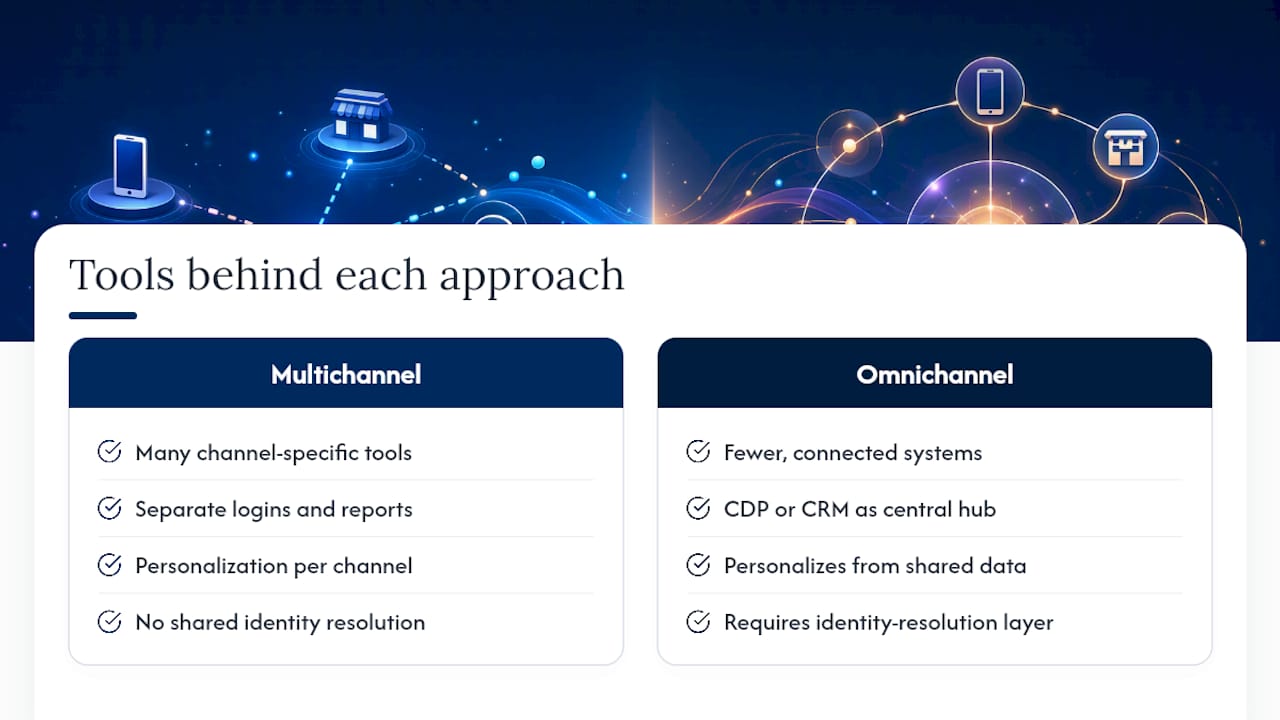
Multichannel operations tend to run on a collection of specialized, channel-specific tools: an email platform, a separate social scheduler, a standalone ad manager, each with its own login and its own report. That’s not necessarily inefficient. It’s often the right amount of tooling for a team still figuring out which channels convert.
Omnichannel operations run on a smaller number of connected systems instead. A CDP or CRM sits at the center, consolidating customer data that other tools read from and write to. Bloomreach’s comparison of the two models points to this as the defining technical difference: omnichannel personalizes based on shared data across every channel, while multichannel tools each operate on their own separate data set.
Identity resolution is the layer most teams underestimate. Recognizing that the person browsing on mobile is the same person who called last week requires matching identifiers, email, phone, account ID, across systems that weren’t originally built to talk to each other. That’s usually the hardest technical problem in any omnichannel build, harder than the customer-facing personalization everyone focuses on.
For sales and service operations specifically, routing technology matters as much as the CDP. A unified customer record is only useful if the system routing a call, chat, or lead actually uses that record to send the interaction to the right person with the right context already loaded. RevRing’s approach connects CRM data with call routing and automation for exactly this reason, so an agent picking up a call already has the customer’s history rather than starting from a blank screen.
Why Customers Notice the Difference Immediately
Customers rarely think in terms of “channels.” They think in terms of whether a company remembers them. That’s the entire experiential gap between multichannel and omnichannel, and it’s why the difference shows up in customer satisfaction scores faster than it shows up in a marketing dashboard.
In a multichannel setup, a customer who emails support and then calls the next day typically has to explain their issue twice. Nothing is technically broken. The systems simply don’t share information, so the second interaction starts from zero. Multiply that friction across a customer base and you get slower resolution times and lower satisfaction scores, even though every individual channel might be performing well on its own metrics.
In an omnichannel setup, that same customer’s second interaction starts with full context already visible to whoever picks up. Zendesk’s routing framework shows this directly: unified agent status and routing reduce how often customers have to repeat themselves, which shortens average handle time and tends to raise satisfaction scores as a result.
The financial impact backs this up. Average consumers now interact with brands across roughly eight to ten channels before a decision, which means the “remembering” problem isn’t rare, it’s the default condition of nearly every customer relationship today. Businesses that solve it convert that consistency into loyalty. Businesses that don’t lose customers to what feels like indifference, even when no one on the team intended it that way.
Why a Phased Approach Beats an All-or-Nothing Bet
The conventional advice treats omnichannel as the obvious upgrade every business should chase immediately. That’s backwards for most companies. The businesses that succeed with omnichannel are almost always the ones that ran multichannel long enough to know exactly which two or three touchpoints actually need connecting, then built a measurable pilot around those before touching anything else.
Prioritize customer context over channel count. A tightly integrated pair of systems that eliminates repeat conversations will outperform a half-connected sprawl of ten channels every time.
— Marc
How RevRing Supports the Shift From Multichannel to Omnichannel
Connecting channels around one customer record is exactly the infrastructure problem RevRing was built to solve. Instead of stitching together a CRM, a dialer, and a compliance tool separately, RevRing combines CRM connectivity, AI-driven call routing, and automation in one system, so a lead’s context follows them from first contact through every follow-up.
For insurance, real estate, and healthcare teams specifically, that connectivity solves the two hardest parts of going omnichannel at once: preserving customer context across every touchpoint and staying compliant with regulations like TCPA and HIPAA while doing it. Smart routing means a lead never has to repeat themselves to a new agent, and built-in compliance infrastructure means scaling your team doesn’t mean scaling your risk.
If you’re evaluating whether your current stack can support that kind of integration, explore RevRing’s platform or check current pricing plans to see which tier fits your team’s size and industry requirements.