Avoid Spam Flags: How Ops Should Choose Power or Predictive Dialing

Most B2B sales teams and any team handling compliance-sensitive or high-intent leads should choose a power dialer. It keeps a live rep on every connected call and protects caller ID reputation. A predictive dialer only earns its keep on large, high-volume floors, typically 15+ agents working lower-value leads, where throughput matters more than connection quality and someone is actively watching abandoned-call rates. Below, we break down the mechanics, the compliance stakes, and a decision checklist.
TL;DR:
- Power dialers are ideal for compliance-sensitive teams with fewer than 15 agents, as they keep abandonment rates near zero and support instant speed-to-lead connections.
- Predictive dialers can double call throughput but require at least 8 to 15 agents to avoid high abandonment and spam risk, making them suitable for large, lower-value campaigns.
- Careful monitoring of abandonment rates, answer rates, and caller ID flags during pilots is critical before full deployment of either dialer type.
- CRM integration and fast lead routing are better supported by power dialers, but predictive dialers need tight pacing controls to stay compliant.
- Combining power and predictive dialing on one platform, as RevRing does, allows flexible scaling without rebuilding compliance protocols or IT infrastructure.
Table of Contents
- Power Dialer vs Predictive Dialer: What Each One Actually Does
- How Does a Predictive Dialer Work?
- Predictive Dialer vs Power Dialer: The Metrics That Actually Decide It
- How to Choose Between a Power Dialer and Predictive Dialer
- RevRing’s Approach to Power and Predictive Dialing
- An Operator’s View on Rolling This Out
- Why RevRing Fits Teams Weighing Predictive vs Power Dialer Decisions
- Where to Verify the Compliance Details
- Sources
Power Dialer vs Predictive Dialer: What Each One Actually Does
A power dialer calls one number at a time and connects a rep the instant someone answers. There’s no algorithm guessing at agent availability, no dead air, no queue. The rep dials, the call rings, and if a human picks up, that rep is already there.
That 1:1 model is the whole point. It’s also why power dialers show up so often in discussions of predictive vs manual dialing as the middle ground, faster than dialing by hand but without the throughput tricks that create compliance risk.
Typical outcomes on a well-run power dialer campaign:
- Dials per hour: moderate, depending on list quality and voicemail rates
- Talk time: generally higher per connected call, since reps aren’t rushed into back-to-back pickups
- Voicemail handling: automated drop messages let reps skip past voicemail without losing pace
- Abandonment: effectively none, since no call connects without a rep already on the line
The tradeoff is a throughput ceiling. A single rep can only dial as fast as they can click. That’s a real constraint on massive outbound floors, but for teams selling considered purchases, insurance policies, real estate, legal services, it’s rarely the bottleneck. Deal size and lead quality usually matter more than raw dial volume in those environments.
Pro Tip: Pair a power dialer with a webhook that fires the moment a new lead hits your CRM. Reps calling within 60 seconds of a form fill see dramatically better contact rates than reps working a list from an hour-old batch.
RevRing’s power dialer is built around this exact pairing, immediate dialing tied to fresh lead delivery, rather than raw volume for its own sake.
How Does a Predictive Dialer Work?
A predictive dialer flips the model. Instead of one rep dialing one number, the system dials several numbers simultaneously, ahead of agent availability, and uses an algorithm to predict when a rep will free up. When someone answers, the system routes that live call to whichever rep the algorithm expects to be available next.
That prediction is where the name comes from, and it’s also where the risk lives. Industry explainers on power dialer vs predictive dialer selection consistently note that both models boost outbound capacity, but predictive dialing carries a structural exposure that power dialing doesn’t: calls that connect to a person with no rep ready to take them.
What predictive dialing typically delivers, and costs:
- Dials per hour: higher than a power dialer, since the system isn’t waiting on one rep’s click speed
- Talk-time gains: possible, but typically only once floor size is large enough to keep the prediction model accurate
- Abandoned calls: a live person may hear a few seconds of dead air before being connected or dropped
- Caller ID exposure: carriers may track silence-gap patterns and potentially flag numbers as “spam likely” based on that signature
Vendors build in pacing controls, abandonment-rate caps, and dynamic ratio adjustment to manage this. The FCC’s TCPA rules set the technical guardrails these controls are built to satisfy, including abandoned-call thresholds that trigger regulatory scrutiny. Practitioner guidance commonly puts the minimum viable floor size around 8 to 15 agents before the algorithm has enough data to pace accurately. Below that, abandonment rates swing unpredictably.
Predictive Dialer vs Power Dialer: The Metrics That Actually Decide It
Here’s the side-by-side that should drive your evaluation:
- Dialing model. Power dialer: 1:1, rep initiates every call. Predictive dialer: multi-line, algorithm initiates ahead of availability.
- Calls per hour. Power dialer: 60 to 90. Predictive dialer: often double that or more, but only once agent count supports it.
- Talk time. Power dialer: generally longer, unhurried connections. Predictive dialer: can dip if pacing runs too aggressive.
- Abandoned-call risk. Power dialer: near zero. Predictive dialer: real and requires active monitoring.
- Caller ID reputation. Power dialer: preserved, since calls present as human-dialed. Predictive dialer: exposed to spam-flagging from carrier silence-gap detection.
- CRM integration and speed-to-lead. Both connect to modern CRMs, but power dialing pairs more naturally with instant-response workflows on fresh leads.
The practical threshold: under roughly 15 agents, predictive dialing rarely earns back what it costs in abandonment risk. Below 8, most practitioners consider it unstable. Above that, on high-volume, lower-value campaigns, it starts to pay off.
During any pilot, watch three red-flag metrics closely: abandon rate creeping past your carrier’s tolerance, any uptick in “spam likely” labeling on outbound numbers, and answer rates that decline week over week, a sign your numbers are getting burned.
How to Choose Between a Power Dialer and Predictive Dialer
Run through this before signing anything:
- How many agents will actually be dialing at once?
- Are you calling warm, high-intent leads or a large, lower-quality list?
- Is speed-to-lead a top KPI, or is raw call volume the priority?
- What’s your compliance exposure, regulated industry, DNC list size, prior complaints?
- Does the dialer need to integrate with your existing CRM and fire webhooks for instant routing?
Then bring these questions to any vendor you’re evaluating:
- How do you report abandonment rate, and can I see it in real time?
- What pacing controls exist, and can I adjust them per campaign?
- How is DNC scrubbing handled, and how often does the list refresh?
- Does the platform support CRM and webhook integration for speed-to-lead?
- What’s the SLA for live-transfer connection time?
- What compliance certifications or frameworks does the platform support?
Pro Tip: Before rolling out either dialer type company-wide, run a two-week A/B pilot against baseline metrics you’ve already measured. Get compliance sign-off before scaling, not after.
If abandonment stays under control and answer rates hold steady through the pilot, that’s your scale signal. If either slips, that’s your stop signal.
RevRing’s Approach to Power and Predictive Dialing
RevRing runs both dialing modes on one platform, so operations leaders aren’t locked into a single throughput ceiling as lead mix shifts. The predictive dialer includes pacing controls and abandonment monitoring built to satisfy TCPA and DNC requirements, and healthcare clients get HIPAA BAA coverage where it applies.
What backs this up in practice:
- Industry-specific playbooks for insurance, real estate, legal, and healthcare intake
- Documented scaling from 12 to 180 agents without a compliance rebuild
- Native CRM connectivity with webhooks for speed-to-lead
- Lead marketplace integration so lead quality and dialing mode can be matched deliberately
Reporting dashboards surface abandonment rate and answer-rate trends in real time, so the decision checklist above isn’t a one-time exercise. It’s something operations can monitor weekly.
An Operator’s View on Rolling This Out
The pilots that fail almost always skip the baseline. Teams switch dialers, watch dial volume spike, and declare victory, without ever checking whether abandonment or answer rate moved in the wrong direction.
Run 90 days: two weeks baseline, two weeks controlled A/B, then scale only if abandonment and answer rate both hold. Staff for pacing, not for volume. A floor that’s understaffed for its dial ratio will burn numbers fast.
— Marc
Why RevRing Fits Teams Weighing Predictive vs Power Dialer Decisions
You don’t have to commit to one dialing model before you know how your leads and floor size will actually behave. RevRing runs power and predictive dialing on the same platform, with compliance tooling and CRM integration built in rather than bolted on.
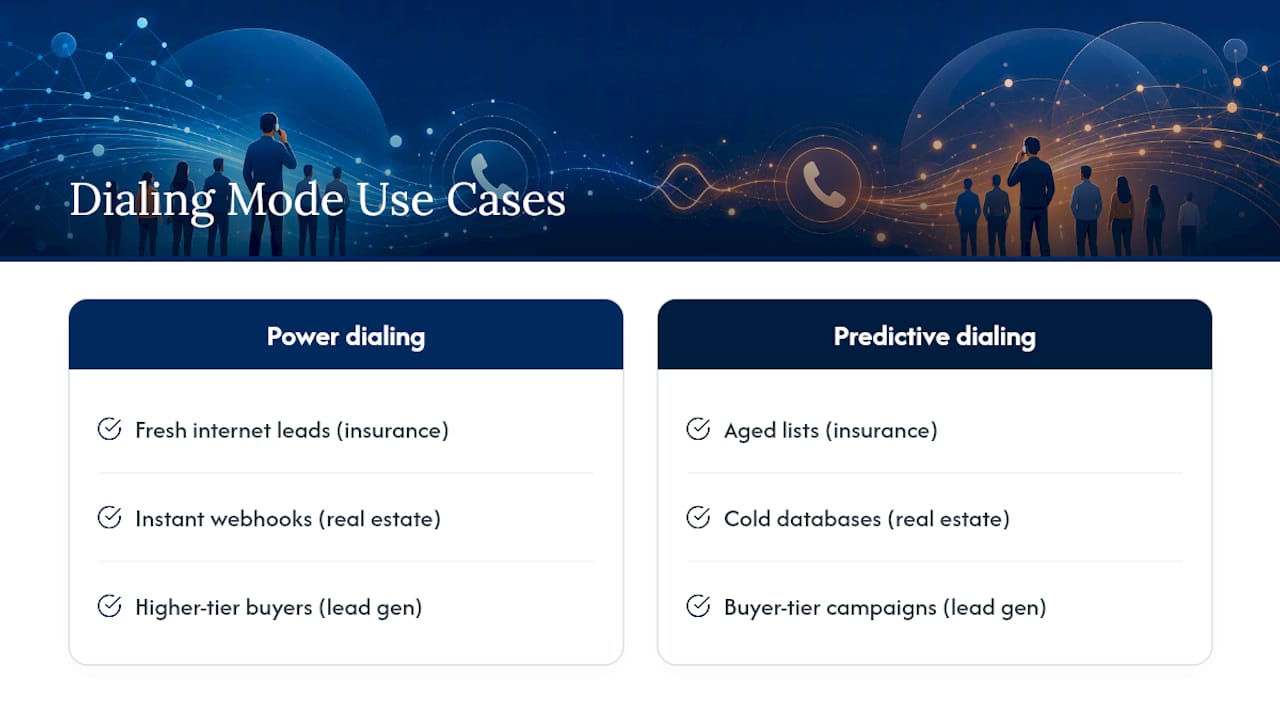
Insurance agencies use power dialing on fresh internet leads and predictive on aged lists. Real estate brokerages route new inquiries through instant power-dial webhooks while running predictive campaigns on cold databases. Lead generation companies match dialing mode to buyer tier through RevRing’s lead marketplace. For CRM-side workflows, partners like Loturn’s CRM integrations show how tightly dialing and lead routing can be wired together.
Clients report scaling from 12 to 180 agents without rebuilding their compliance stack. If you’re deciding which model fits your floor, book a demo or check the pricing plans to see what fits your team size today.
Where to Verify the Compliance Details
Before finalizing either dialer type, review the FCC’s TCPA guidance and the FTC’s telemarketing rules directly. Both agencies publish the abandoned-call thresholds and autodialer definitions that govern your rollout.