The 5-Step Checklist to Scale Sales Teams Without Breaking Them

Scaling a sales team comes down to five moves, in order: fix the system before adding headcount, gate every hire behind proven capacity, hire in waves instead of one big push, invest in managers and enablement before reps outnumber coaching bandwidth, and track leading indicators, not just closed revenue. Skip the order and you get a bloated payroll with a shrinking win rate. Follow it, and each new hire adds pipeline instead of diluting it.
- Fix the system (ICP, playbook, data hygiene) before hiring
- Gate hiring to proven pipeline and coaching capacity
- Hire in waves, not one large batch
- Invest in managers and enablement ahead of headcount
- Measure leading indicators weekly, not just bookings
Key Takeaways
Scaling a sales team successfully depends on sequencing system fixes before headcount, gating hiring waves behind proven ramp performance, and tracking leading indicators before they show up in revenue.
| Point | Details |
|---|---|
| Diagnose before hiring | Score the Five Inputs (leader capacity, pipeline, playbooks, people fit, systems) red/yellow/green first. |
| Hire in cohorts | Bring on 5 to 8 reps per wave, spaced roughly one quarter apart, gated by prior cohort ramp performance. |
| Structure onboarding tightly | A 30/60/90 milestone template with certification gates can improve rep retention by roughly 82%. |
| Watch leading indicators weekly | Track stage conversion and ramp attainment by cohort, not blended company averages, to catch problems early. |
| Pilot an integrated platform | Revring’s predictive dialer and AI automation helped one team scale outreach from 40 to 200 dials a day with no added headcount. |
Table of Contents
- What Is the Five Inputs Diagnostic for Scaling Sales Teams?
- How Do You Build a Repeatable Sales Playbook Before You Hire?
- How Should You Hire in Waves to Scale a Sales Team?
- What Onboarding and Coaching Cadence Shortens Ramp Time?
- What Tech Stack Lets a Sales Team Scale Without Chaos?
- Which KPIs Keep Sales Scaling Predictable?
- How Does an Integrated Revenue Platform Shorten the Path to Scale?
- What Are the Most Common Sales Scaling Mistakes and How Do You Fix Them?
- How Do You Manage Change When Scaling a Sales Team?
- What Does It Cost to Scale a Sales Team?
- How Do You Keep Culture Strong While a Sales Team Grows?
- How Do You Build Leadership Depth as a Sales Team Scales?
- What Sales Leaders Get Wrong About Scaling a Team
- Scale Faster With an Integrated Revenue Platform
- Frequently Asked Questions
- Sources
What Is the Five Inputs Diagnostic for Scaling Sales Teams?
Before you post a single job listing, score five inputs on a red, yellow, green scale. This is the fastest way to know whether you’re ready to scale from 5 reps to 50 or whether you’d just be hiring into chaos.
The Five Inputs are: sales leader capacity and structure (can your current managers absorb more reps without losing 1:1 time), pipeline volume and quality (is there enough qualified demand to feed new reps), documented stages and playbooks (would a new hire know exactly what to do on day one), people fit (do you have a hiring scorecard that predicts success, not just a job description), and systems and data hygiene (is your CRM trustworthy enough to run forecasts off of).
Score each red, yellow, or green. Red means stop and fix before hiring. Yellow means proceed cautiously with a smaller cohort. Green across all five means you’re clear to scale.
- Leader capacity: can each manager coach several reps without a drop in call quality?
- Pipeline: is coverage sufficient to support growth for the next quarters?
- Playbooks: are stages, exit criteria, and scripts written down anywhere?
- People fit: does your scorecard rank past hires against actual quota attainment?
- Systems: can you trust your CRM data enough to forecast from it?
Pro Tip: Set your first gating threshold at manager span, not budget. Hire past it and you’re not scaling, you’re diluting coaching.
How Do You Build a Repeatable Sales Playbook Before You Hire?
A repeatable process is the single biggest predictor of whether a team scales past 50 reps without collapsing into hero-dependency, where results depend on one or two star performers instead of the system itself. Document the playbook before you write the job posting, not after.
Core components to lock down first:
- Ideal customer profile (ICP): firmographics, buying triggers, disqualifiers
- Call frameworks: opening, discovery questions, transition to demo
- Qualification criteria: a MEDDIC or BANT variant your team actually uses
- Demo scripts: what gets shown, in what order, and why
- Pricing guardrails: discount thresholds and who can approve exceptions
- Objection-handling flows: the five objections you hear most, with responses
- Handoff rules: exactly what SDRs pass to AEs, and what AEs pass to customer success
Pair that with a certification gate before any rep touches live pipeline:
- Days 1 to 30: product certification, shadow calls, pass a mock discovery call
- Days 31 to 60: run supervised calls, pass a mock demo, handle first live leads with manager review
- Days 61 to 90: carry a full quota-bearing pipeline independently
Pro Tip: Every lost deal is enablement content waiting to happen. Build a weekly loss-review ritual that feeds objection-handling updates straight into your playbook, not a quarterly one that lets bad habits calcify.
How Should You Hire in Waves to Scale a Sales Team?
Hire in cohorts of 5 to 8 reps, spaced roughly one quarter apart, and gate each new wave behind the ramp performance of the last one. This single rule protects win rates better than almost anything else you can do, because it ties headcount growth to proven coaching capacity instead of hope.
If they hit 40%, you fix enablement before you hire again. That gating logic keeps a growing team from quietly turning into a mediocre one.
Role mix matters as much as headcount. Rules of thumb:
- One SDR can typically feed 1.5 to 2 AEs once qualification criteria are documented
- Sales engineers (SEs) get added once deal complexity, not just volume, becomes the bottleneck
- Account managers (AMs) split off from AEs once renewal and expansion revenue justify a dedicated role
- Generalist AEs work fine under 20 reps; specialization (by segment, vertical, or deal size) pays off past that
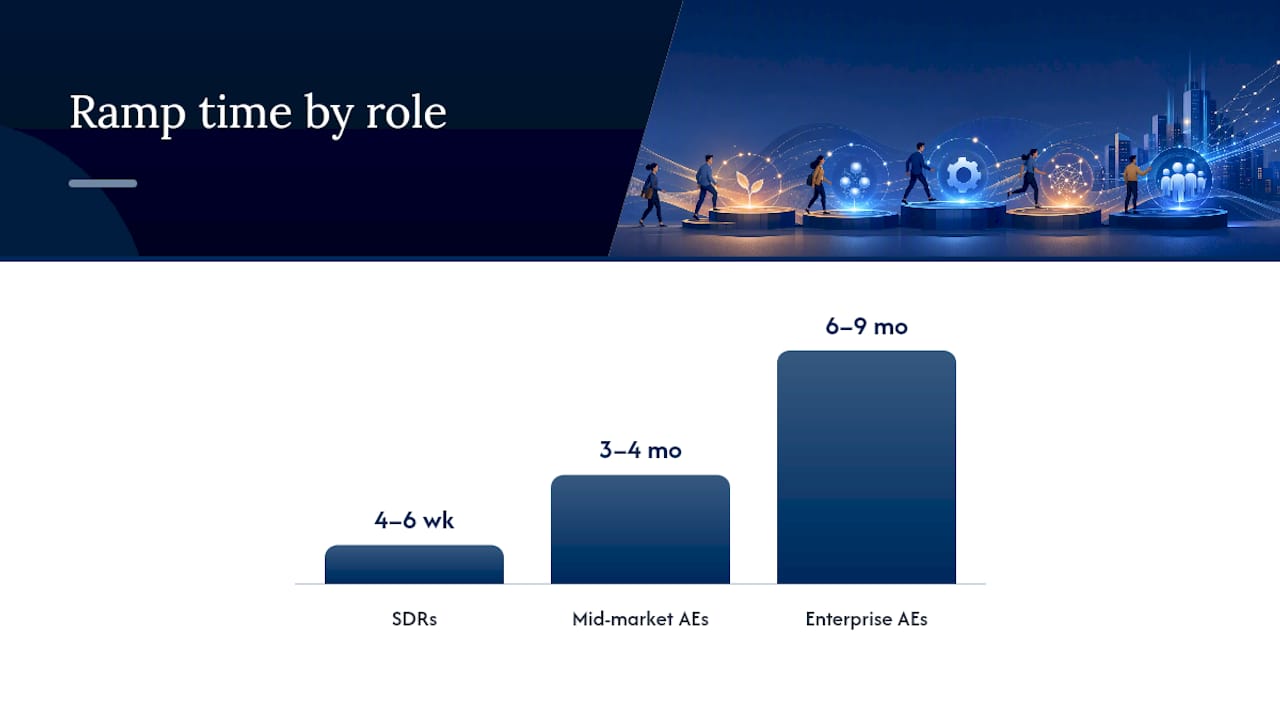
Ramp benchmarks to plan around, adjusted by deal complexity:
- SDRs: 4 to 6 weeks to full productivity
- Mid-market AEs: 3 to 4 months
- Enterprise AEs: 6 to 9 months given longer sales cycles
Screen for coachability, resilience, and prospecting grit in every interview loop. A candidate’s willingness to take feedback in a live role-play tells you more than their résumé does.
What Onboarding and Coaching Cadence Shortens Ramp Time?
Structured onboarding does more than get reps up to speed faster. It improves rep retention by roughly 82% compared to ad hoc, sink-or-swim onboarding. That statistic alone should settle any debate about whether formal training is worth the time investment.
A copyable milestone template:
- 30 days: complete certification, pass mock discovery and mock demo calls
- 60 days: handle live calls under manager review, pass a call-review audit
- 90 days: carry full quota independently with weekly pipeline inspection
Layer a coaching cadence on top: weekly 1:1s focused on pipeline health, biweekly call reviews scored against your playbook, monthly pipeline inspections with the full team, and quarterly skill workshops targeting the objection patterns showing up most in lost deals. Version your enablement content quarterly so it reflects what’s actually winning deals now, not what worked two hiring waves ago.
What Tech Stack Lets a Sales Team Scale Without Chaos?
Technology should amplify a process that already works, not paper over one that doesn’t. Automating repetitive administrative tasks measurably increases sales productivity, but only once the underlying motion is documented and consistent.
Prioritize by impact, in this order:
- CRM with enforced stages: a single source of truth where reps can’t skip required fields or invent their own pipeline stages
- Conversation intelligence: call recording and scoring that turns every call into coaching material
- Predictive dialer and call routing: a system like RevRing’s predictive dialer that raises talk time without adding headcount
- Lead scoring and routing rules: so reps spend time on leads that convert, not ones that don’t
- Automated follow-ups and reporting: freeing reps from admin work that eats into selling hours
Pro Tip: Add automation once your process is stable, not before. Automating a broken workflow just helps your team make the same mistakes faster.
Which KPIs Keep Sales Scaling Predictable?
Track activity quality over activity volume, stage conversion rate by hiring cohort, ramp attainment against your model, discount depth, average deal size, sales cycle length, and forecast accuracy. Together, these numbers tell you whether growth is healthy or whether you’re quietly trading win rate for headcount.
Build a dashboard that breaks each metric out per cohort and per manager, not just company-wide. A blended average hides the cohort that’s underperforming until it’s already dragged down your quarter.
- Stage conversion by cohort: catches quality erosion before it hits closed revenue
- Ramp attainment vs. model: flags a hiring wave that needs remediation, not more leads
- Discount depth: an early signal that pricing guardrails are slipping
- Forecast accuracy: the ultimate test of whether your pipeline data can be trusted
Inspect activity and conversion metrics weekly; review discount depth and forecast accuracy monthly. When a KPI signal fires, tie it to an action immediately: a ramp miss triggers a coaching intervention, a conversion drop triggers a playbook review, not just a note in a slide deck. Reliable pipeline data and clean process are what make any of this forecasting possible in the first place.
How Does an Integrated Revenue Platform Shorten the Path to Scale?
A real estate team scaled outreach from 40 dials a day to 200 without adding a single rep, simply by replacing fragmented tools with an integrated dialer, routing, and reporting workflow.
That result maps directly onto the diagnostic gaps most scaling teams hit: weak lead routing, capped dialer capacity, unreliable reporting, and messy CRM data. Revring pairs a predictive dialer with AI call scoring, CRM integrations, and a lead marketplace to close each gap without forcing a team to rebuild its process from scratch.
Outreach volume jumped from 40 to 200 dials per day, with no increase in headcount, once the team’s tools and workflows were integrated into one platform.
A short pilot checklist before rolling out an integrated platform:
- Audit current dialer capacity and lead routing rules for bottlenecks
- Confirm CRM fields required for reporting are actually being filled in
- Map your existing playbook stages to the platform’s workflow automation
- Pilot with one cohort before rolling out company-wide
What Are the Most Common Sales Scaling Mistakes and How Do You Fix Them?
Most scaling failures trace back to one of four errors, and each has a fast fix.
- Hiring too fast: pause the next wave and fix enablement before adding more reps
- Under-investing in managers: hire an experienced external manager rather than promoting your best rep and hoping they figure it out
- Poor data hygiene: enforce required CRM fields at the stage-gate level so bad data can’t move forward
- Discounting to close quota: tighten pricing guardrails and require approval above a set threshold
Pro Tip: Watch cohort-level leading indicators, not closed-won totals. A ramp miss shows up eight weeks before it shows up in your revenue number, and that head start is exactly when a fix is cheap.
How Do You Manage Change When Scaling a Sales Team?
Scaling a sales team is an organizational change project disguised as a hiring plan. Existing reps notice when new playbooks, tools, or reporting requirements show up, and how you communicate those changes determines whether the team absorbs growth or resists it.
Announce changes with the reasoning attached, not just the new rule. A rep who understands why a new qualification step exists follows it. A rep who’s just told “start doing this” quietly ignores it the first time they’re busy.
Roll out new process changes to one team or cohort before mandating them company-wide. This gives you real feedback and a working example to point to, rather than a policy nobody has tested. It also gives skeptics a peer they trust to validate the change instead of hearing it only from leadership.
Give existing top performers a voice early. Veteran reps who feel bypassed by new structure will undermine it in ways that are hard to trace back to a root cause, from quiet noncompliance to grumbling that spreads to new hires. Bring them into playbook reviews and let them flag what breaks their current workflow before you finalize a change.
Set a cadence for two-way communication, not just top-down announcements: a monthly forum where reps can push back on new tools or process changes before frustration turns into attrition. Scaling teams that skip this step often see their best people leave first, precisely because they’re the ones with the most options elsewhere.
What Does It Cost to Scale a Sales Team?
Budgeting for growth means accounting for more than base salary and commission. Recruiting costs, ramp-period productivity loss, management overhead, tooling, and enablement time all add up before a new cohort becomes profitable.
Build your budget around these categories:
- Compensation: base, commission, and any signing incentives for the role and market
- Ramp-period cost: the gap between what a rep costs and what they produce during their first 90 to 180 days
- Management overhead: a new manager hire once span of control tips past roughly 8 reps per manager
- Tooling and systems: dialer, CRM, conversation intelligence, and any per-seat licensing costs that scale with headcount
- Enablement time: the hours senior reps and managers spend certifying and coaching each new cohort, which is a real cost even though it rarely appears on an invoice
Model total cost per cohort, not per rep, since a wave of 6 hires shares onboarding and management overhead more efficiently than six separate one-off hires spread across the year. Factor in a realistic gap between hire date and full quota contribution. If your ramp benchmark says 4 months to productivity for a mid-market AE, budget for 4 months of below-quota performance rather than assuming immediate output. Review pricing and packaging for any platform before a rollout, so tooling costs scale predictably alongside headcount rather than surprising you at renewal.
How Do You Keep Culture Strong While a Sales Team Grows?
Culture erodes fastest during the exact period leaders are most distracted by hiring logistics, and that’s precisely why it needs deliberate attention rather than an assumption it will “just carry over” from the original team.

New hires absorb culture from what they see rewarded, not from what’s written in an employee handbook. If your top-performing legacy rep cuts corners on CRM hygiene and still gets celebrated in the team meeting, every new hire learns that CRM hygiene is optional, no matter what the onboarding deck says.
Protect a few non-negotiable rituals as headcount grows: team wins get called out publicly regardless of who’s watching, coaching feedback goes both directions between reps and managers, and losses get reviewed for lessons rather than blame. These small, consistent behaviors carry more cultural weight than a mission statement ever will.
Watch morale signals at the cohort level, the same way you watch performance signals. A new wave that’s quiet in team channels, skips optional workshops, or shows unusually high early attrition is telling you something about onboarding or manager fit before it shows up in a resignation letter.
Mix new hires with tenured reps in team structures rather than clustering an entire cohort together in isolation. A new wave that only interacts with each other never absorbs the informal norms that make a sales floor function, from how deals get discussed to how wins get celebrated.
How Do You Build Leadership Depth as a Sales Team Scales?
A team that scales past 20 or 30 reps without a leadership bench underneath the founder or VP of sales is one bad resignation away from a crisis. Succession planning has to start well before you think you need it.
Identify your next layer of managers from the traits that predict coaching success, not just quota attainment. The rep who closes the most deals isn’t automatically the one who can teach five other people to do the same. Look for reps who already mentor peers informally, who explain their process clearly when asked, and who show patience with reps who are struggling.
Give high-potential reps a taste of leadership before promoting them: let them run a portion of onboarding for the next cohort, have them lead a call-review session, or put them in charge of a specific playbook component. This tests their coaching instincts at low risk and signals to the whole team that leadership is earned through demonstrated skill, not tenure alone.
Build a simple two-tier succession map: one layer of ready-now candidates for the next manager opening, and a second layer of developing candidates who need six to twelve months of targeted growth. Revisit this map quarterly alongside your hiring plan, since a leadership gap discovered during a hiring wave is far more expensive to fix than one identified early.
What Sales Leaders Get Wrong About Scaling a Team
Most advice on scaling sales teams treats headcount as the growth lever and process as an afterthought you’ll “clean up later.” That ordering is backward, and it’s why so many companies double their sales team and watch win rate drop by double digits in the same quarter.
The conventional playbook says to hire ahead of demand, so you’re never caught short. In practice, that approach hires ahead of your ability to coach, certify, and manage those reps well. A cohort with no manager bandwidth behind it doesn’t ramp late. It ramps badly, permanently, because the bad habits it forms in the first 90 days rarely get corrected later.
What the research actually supports is less exciting but more reliable: sequencing beats speed. Fix your ICP and playbook, prove out a repeatable motion with a small team, then hire in gated waves tied to what your managers can actually absorb. The founders who scale cleanest aren’t the ones who hire fastest. They’re the ones who treat every hiring wave as a hypothesis to be tested against the last cohort’s ramp data, not a headcount target to hit by year end.
Scale Faster With an Integrated Revenue Platform
Most of the fixes in this article, fixing lead routing, cleaning CRM data, adding call scoring, adding dialer capacity, usually mean stitching together four or five separate tools and hoping the integrations hold. Revring exists specifically to remove that stitching work: predictive dialing, AI call scoring, CRM connectivity, and compliance infrastructure live in one platform instead of five.
That matters most for teams in regulated industries like insurance, real estate, and healthcare, where a fragmented stack doesn’t just slow down reps, it creates compliance risk on every call. Revring’s industry-tailored workflows come with playbooks built for how your team already sells, so a pilot doesn’t mean ripping out your process and starting over. If your Five Inputs diagnostic flagged systems or data hygiene as red or yellow, start by reviewing Revring’s pricing and packaging and scheduling a walkthrough of the predictive dialer against your current outreach volume.
Frequently Asked Questions
What’s the first step to scale a sales team without losing win rate? Run the Five Inputs diagnostic before hiring anyone. Fixing your ICP, playbook, and data hygiene first protects the win rate that new hires would otherwise dilute.
How many reps should you hire at once when scaling? Hire in cohorts of 5 to 8, spaced roughly a quarter apart, gated by whether the previous cohort hit its ramp attainment targets.
What ramp time should you expect for a new sales hire? SDRs typically ramp in 4 to 6 weeks, mid-market AEs in 3 to 4 months, and enterprise AEs in 6 to 9 months, depending on deal complexity.
When should you bring in sales automation tools? Add automation once your process is documented and consistent. Automating a broken workflow just makes existing mistakes happen faster.
What KPI catches scaling problems earliest? Ramp attainment by cohort, tracked weekly, flags a struggling hiring wave months before it would show up in closed revenue.