Stop SLA Drift: AI Backed Call Center Staffing Model for Managers

A dependable call center staffing model starts with an Erlang C baseline, then earns its keep once you layer in shrinkage, occupancy caps, multi-skill adjustments, and AI-deflection accounting. Get those levers right and you turn a math formula into an interval-by-interval schedule your team can actually work. Get them wrong, and you’re staffed for a call center that does not exist.
TL;DR:
- Adjust Erlang C calculations for shrinkage, occupancy, and multi-skill overhead to ensure staffing levels match real-world operational complexity.
- Use 30-minute intervals for forecasting and building shift templates, staggering start times to align staffing with demand peaks and troughs.
- Continuously validate the staffing model daily, weekly, and monthly by comparing predictions with actual data to prevent drift and maintain accuracy.
- Incorporate AI and self-service solutions to reduce contact volume but modify AHT assumptions to reflect the higher complexity of remaining interactions.
- Prepare for seasonal and unexpected volume changes by separate trend analysis, rapid activation plans, and scenario testing rather than relying solely on historical averages.
Table of Contents
- How Do You Calculate the Erlang C Staffing Baseline?
- How Do You Adjust Erlang C for Shrinkage and Occupancy?
- How Do You Turn Headcount Into an Agent Scheduling Model?
- How Often Should You Validate a Staffing Model?
- What Tools Actually Support a Call Center Staffing Model?
- What Does an Operational Playbook for Staffing Look Like?
- How Does Seasonal and Event Variability Change Staffing Needs?
- How Are AI and Chatbots Changing Staffing Requirements?
- How Do You Forecast Unexpected Call Volume Spikes or Drops?
- Why Does Cross-Training Matter in a Staffing Model?
- What Are the Cost Tradeoffs Between Staffing Models?
- The Real Failure Point in Most Staffing Models
- Sources
How Do You Calculate the Erlang C Staffing Baseline?
Erlang C is where every serious call center staffing model starts, even if it’s not where it ends. The formula answers one question: given a forecasted contact volume, an average handle time, and a target service level, how many agents does an interval need to keep wait times in check? It’s queueing theory built for phone lines, and it remains the industry’s default baseline calculation for a reason. It’s fast, it’s standardized, and it forces you to define your service level target instead of guessing at it.
Four inputs drive the calculation:
- Interval length — usually 15 or 30 minutes, matching how granular your forecast and schedule need to be.
- Forecasted contact volume for that specific interval, not a daily or weekly average.
- Average handle time (AHT), including talk time and any after-call work agents perform before taking the next contact.
- Target service level and acceptable wait time — commonly expressed as “80% of calls answered in 20 seconds,” though the numbers vary by contract or internal SLA.
Here’s a simplified worked example. Say a 30-minute interval forecasts 150 contacts with an AHT of 300 seconds (5 minutes), and your target is 80/20. Erlang C converts that into offered workload (about 12.5 erlangs, since 150 contacts × 300 seconds ÷ 1,800 seconds per half hour), then calculates the minimum agent count needed to hit that service level given random call arrival. In this scenario, you’d typically land somewhere around 16 to 18 agents once you factor in the added agents needed purely to control wait times under variable arrival patterns.
That number is a mathematical floor, not a schedule. Erlang C assumes single-skill agents, homogenous handle times, and no absenteeism. The SWPP’s guidance on calculating call center staff is explicit that intervalized inputs and grossing up for shrinkage are non-negotiable steps after the baseline is set, not optional refinements. Treat Erlang C as your starting number, never your final headcount.
How Do You Adjust Erlang C for Shrinkage and Occupancy?
The gap between “agents Erlang C says you need” and “agents you actually schedule” comes down to shrinkage, occupancy, and skill complexity. Skip these adjustments and your service level planning will look perfect on paper and fall apart by Tuesday afternoon.
Shrinkage measures the percentage of paid hours an agent is not available to take contacts. Calculate it by dividing non-productive paid time (breaks, training, coaching, PTO, team meetings) by total paid hours. Most operations land somewhere in the mid-thirties percentage range for shrinkage, though highly regulated environments with heavy training and compliance obligations can push this number higher. Pull your own shrinkage number from payroll and WFM data rather than borrowing an industry average. Your training calendar and attrition rate are yours alone.
Occupancy caps how much of an agent’s logged-in time can be spent actively handling contacts. Running occupancy above roughly 85% to 90% for extended stretches tends to accelerate burnout and erode quality, even when the math says you’re “fully staffed.” Building in an occupancy ceiling means adding agents beyond the raw Erlang output, on purpose.
Multi-skill routing complicates things further. When agents handle multiple queues, a single-skill Erlang model understates the agents you need, particularly in partial-pooling environments where skills only partially overlap. ViciStack’s breakdown of Erlang C versus real-world math points out that shrinkage, occupancy, and multi-skill overhead are the three most common blind spots that cause staffing models to underperform.
- Erlang C baseline: 17 agents
- Grossed up for 32% shrinkage: 17 ÷ 0.68 ≈ 25 agents
- Occupancy cap adjustment (target 85%): adds roughly 1 to 2 more agents
- Multi-skill overhead for blended queues: adds another 5% to 10% depending on skill overlap
Pro Tip: Recalculate shrinkage separately for each shift, not as one company-wide average. A night shift with less training and fewer meetings behaves nothing like a day shift, and blending them into one number quietly understaffs one of the two.
For blended inbound and outbound operations, calculate inbound capacity as its own Erlang problem first, then overlay outbound capacity on top. Treating blended work as a single Erlang input consistently underestimates the risk to inbound service level, since outbound dialing doesn’t pause just because inbound volume spikes.
How Do You Turn Headcount Into an Agent Scheduling Model?
A staffing number is useless until it becomes a schedule. This is where call center workforce management earns its name, converting interval-level headcount targets into shift templates real people can work.
Start with intervalization. A 30-minute grid is the standard for most operations and strikes a reasonable balance between precision and administrative overhead. A 15-minute grid gives you tighter control during sharp volume swings, like the top of the hour when consumer call patterns spike, but it multiplies the number of data points you have to forecast, staff, and validate. Use 30-minute intervals unless your volume curve genuinely demands finer granularity.
- Chart the interval headcount curve across the full operating day, so you can see where demand ramps up and tapers off rather than just staring at a daily total.
- Build shift templates with staggered starts. If your peak interval needs 25 agents but your trough needs 10, a single fixed shift for everyone wastes labor during the trough and leaves you short at the peak. Staggering start times in 15 or 30-minute increments smooths that curve.
- Layer in lunches and breaks against the curve, not against the clock. Never schedule 40% of your team’s lunch during your highest-volume interval.
- Add flexible capacity through part-time shifts, on-call pools, and remote agents who can absorb sudden surges without full-time commitments.
- Use shift bidding or transparent rotation so staggered and less desirable shifts don’t become a morale problem. Fairness mechanisms matter more than most staffing guides admit.
Split shifts and surge bands, where a handful of agents work a short block covering only the peak window, are worth testing if your volume curve has one sharp, predictable spike rather than a gradual build. They’re harder to staff voluntarily, so pair them with a pay differential or scheduling preference.
How Often Should You Validate a Staffing Model?
A staffing model isn’t a document you build once a year. It’s a live system that needs checking at three different speeds, and skipping any one of them is how a good model quietly goes stale.
- Daily (intraday): Reforecast against real-time volume, flag interval-level variance early, and activate on-call agents or voluntary overtime before service level actually slips.
- Weekly: Compare predicted contacts and AHT against what actually happened, and adjust shrinkage assumptions if a training week or holiday threw off the numbers.
- Monthly: Recalculate your baseline statistics from trailing data, run scenario tests against demand percentiles, and update the model’s core parameters rather than patching around them.
The SWPP’s staffing calculation methodology frames this cadence as the difference between a model that improves steadily and one that requires a painful annual overhaul. Formal allocation planning research under service-level contracts backs the same principle: treating staffing as an ongoing optimization problem, checked against scenario outcomes, consistently beats a static plan.
Track five numbers every cycle: forecast accuracy, service level attainment, occupancy, schedule adherence, and turnover. If forecast accuracy is drifting more than a few points month over month, your model’s assumptions, not your agents, are usually the problem.
What Tools Actually Support a Call Center Staffing Model?
Spreadsheets can carry a staffing model through the first year of a small operation. Past a certain size, they become the bottleneck.
Look for these capabilities when evaluating workforce management software:
- Interval-level forecasting that accounts for seasonality and day-of-week patterns, not a flat monthly average.
- Automated schedule generation that maps interval headcount directly into shift templates.
- Intraday reforecasting that flags variance in real time and suggests corrective action.
- Skills-based routing support, so the model reflects how agents are actually deployed across queues.
- Adherence dashboards that compare scheduled versus actual agent activity without a manual audit.
Salesforce’s guide to contact center workforce management describes how modern platforms enable “self-healing” schedules: automated reforecasting paired with voluntary overtime offers and on-call activation, cutting down the manual firefighting that eats a workforce planner’s week.
AI deflection adds a wrinkle worth planning for directly. Chatbots and self-service tools can resolve a meaningful share of routine contacts before they ever reach a queue, but the contacts that do reach agents tend to be the more complex ones. That shift can quietly raise your average handle time even as total contact volume drops, so don’t assume deflection is a pure headcount win. A rough rule of thumb: once you’re staffing past 50 agents, spreadsheet-based planning starts costing more in manual hours and forecast error than a WFM platform costs to license. A tool like RevRing’s predictive dialer can also help by managing dial pacing on the outbound side, so blended staffing calculations reflect actual throughput instead of theoretical capacity.
What Does an Operational Playbook for Staffing Look Like?
Playbooks turn a staffing model from a spreadsheet exercise into something a new workforce planner can pick up and run on day one. That matters most when you’re scaling fast: on organizations that expanded their agent headcount rapidly while keeping service level and compliance intact.
An integrated platform where the dialer, CRM, and compliance infrastructure share data reduces the manual reconciliation that eats into a workforce planner’s validation time. Capabilities worth folding into your playbook:
- AI predictive dialing that adjusts pacing automatically as agent availability shifts.
- CRM connectivity, like ZinCRM, so handle time reflects real workflow instead of app switching.
- Prebuilt workflow templates for industry-specific intake, reducing ramp time for new agents.
- Compliance infrastructure (TCPA, DNC, HIPAA BAA) built into the workflow rather than bolted on afterward.
How Does Seasonal and Event Variability Change Staffing Needs?
Seasonal swings are the most predictable form of volume variance, and they’re also the most commonly mishandled. Open enrollment for health insurers, tax season for financial services, and holiday retail surges all create demand spikes that a trailing-twelve-month average will systematically understate or flatten out.
The fix starts with separating trend from seasonality in your forecast rather than smoothing both into one number. If your call center handles insurance renewals, treat the six weeks around your peak enrollment window as a distinct forecasting period with its own historical baseline, not an extension of your typical month. Pull at least two, ideally three, years of interval-level data for that specific window, since a single prior season can be skewed by a one-off event.
Special events, product launches, service outages, a viral social media mention, are harder because they lack clean historical precedent. Build a rapid-response staffing tier into your model ahead of time: a pool of cross-trained agents, a pre-approved overtime budget, and a communication template for activating on-call staff within hours rather than days. The operations that handle surprise spikes well aren’t the ones with the best forecast. They’re the ones with the fastest activation process once the forecast turns out to be wrong.
Don’t forget the flip side. A slower-than-expected season means overstaffing costs money every single shift, so build a de-escalation plan (reduced overtime, shifted training schedules) with the same rigor you apply to surge planning.
How Are AI and Chatbots Changing Staffing Requirements?
AI-driven self-service and chatbots are reshaping what a staffing model needs to account for, and the change isn’t simply “fewer agents needed.” Deflection tools can resolve a meaningful share of routine, low-complexity contacts, things like password resets, appointment confirmations, and basic status checks, before they ever reach a live queue.
That shifts the mix of what remains. Contacts that do reach agents skew toward the more complex, higher-emotion, or higher-stakes end of the spectrum, which tends to push average handle time upward even as total contact volume declines. A staffing model built only on “AI reduces total volume” without adjusting AHT assumptions will overcorrect and understaff.
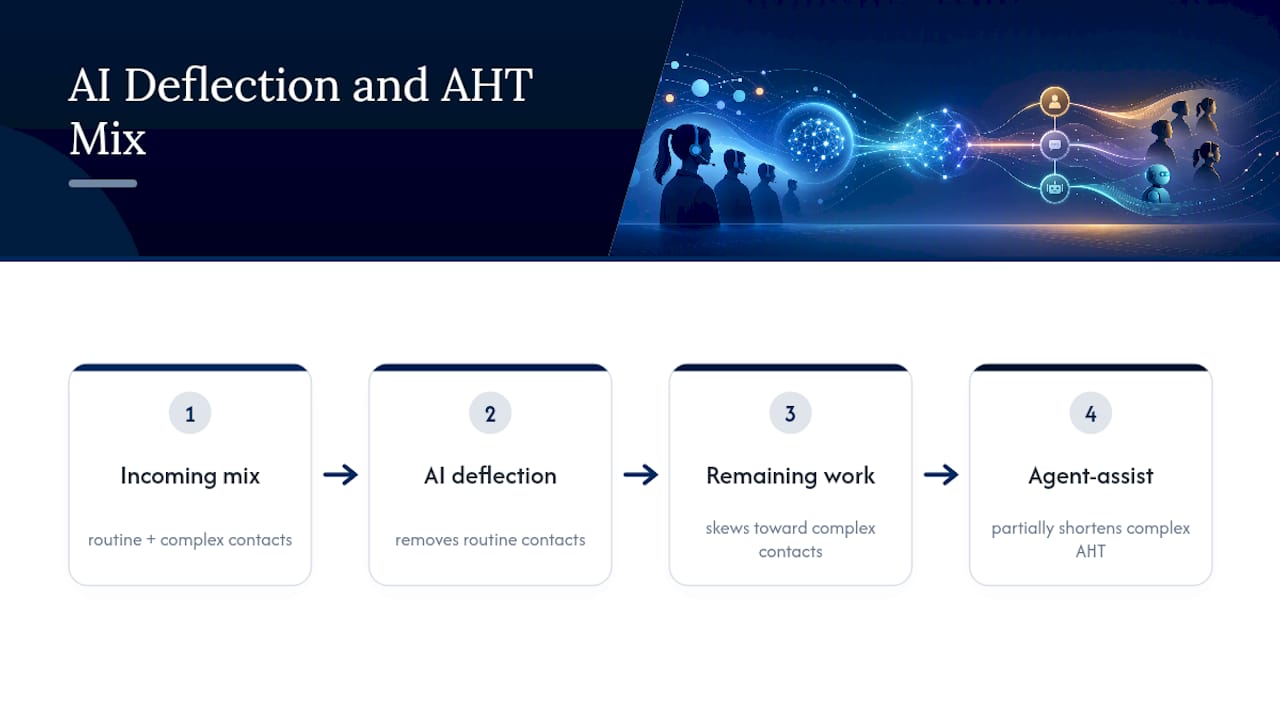
AI also changes intraday management itself. Real-time transcription, sentiment flags, and agent-assist tools can shorten handle time on complex calls by surfacing the right information mid-conversation, partially offsetting the AHT increase from deflection. AI and automation tools that handle routine follow-ups, like appointment reminders, free agents to focus on higher-value contacts that actually need a human.
The practical takeaway for your staffing model: track AHT by contact type, not as a blended average, once you introduce meaningful deflection. Otherwise you’ll be forecasting against a number that no longer reflects the work your agents are actually doing.
How Do You Forecast Unexpected Call Volume Spikes or Drops?
No forecast is immune to surprise, but a good call center staffing model builds in mechanisms to catch and respond to deviation fast, rather than pretending it won’t happen.
Start with variance thresholds. Set a rule that triggers a reforecast the moment actual interval volume deviates from prediction by a defined margin, commonly 10% to 15%, rather than waiting for a scheduled weekly review. That threshold turns “we noticed volume was off” into an automatic intraday action.
Layer in leading indicators specific to your business. A real estate brokerage might watch mortgage rate announcements. A healthcare intake line might track flu season case counts in its service region. These external signals rarely predict exact volume, but they flag direction early enough to pre-position on-call staff.
For sudden drops, resist the instinct to send agents home immediately. A short-term dip can reverse within hours, and understaffing the rebound often costs more in missed SLA than the labor saved. Use idle time productively instead, quality reviews, training modules, or proactive outbound work, so capacity stays intact without sitting fully idle.
Scenario testing deserves a permanent place in your monthly cadence, not just a crisis response. Running your model against a “volume up 20%” and “volume down 20%” scenario before it happens means your team already knows the activation steps when reality delivers the surprise.
Why Does Cross-Training Matter in a Staffing Model?
Cross-training determines how much flexibility your staffing model actually has when volume shifts unexpectedly between queues. A team where every agent handles only one skill is rigid by design, forcing you to staff each queue to its own worst case rather than sharing capacity across them.
Building cross-training into the model means deciding, deliberately, which skills pair well together. Pairing a low-complexity, high-volume skill with a low-volume, high-complexity one gives you a release valve. Agents can absorb overflow from the busy queue without abandoning the specialized one for long stretches.

The tradeoff is real: partial-skill pooling adds complexity to your staffing math that closed-form Erlang formulas don’t handle well. Simulation-based approaches model this more accurately than a straight Erlang calculation, since Erlang’s single-skill assumptions understate the agents needed once skills only partially overlap.
Beyond the math, cross-training has a retention benefit worth weighing on its own terms. Agents who develop a second or third skill tend to see a clearer growth path than agents stuck on a single queue indefinitely, and that visibility affects whether they stay long enough for your training investment to pay off.
What Are the Cost Tradeoffs Between Staffing Models?
Different structural choices, centralized versus decentralized, in-house versus outsourced, carry meaningfully different cost profiles, and the cheapest option on paper isn’t always the cheapest in practice.
A centralized model, running all agents from one location or one unified virtual team, typically produces lower per-agent overhead and simpler workforce management, since forecasting and scheduling happen against one combined volume curve instead of several fragmented ones. The tradeoff is concentration risk: a local event or system outage can take down your entire operation at once.
A decentralized model, distributing agents across multiple sites or a distributed remote workforce, spreads that risk but adds coordination overhead. Forecasting has to account for how volume splits across locations, and schedule adherence monitoring gets harder without unified tooling.
In-house teams cost more per agent in salary, benefits, and management overhead but give you direct control over training quality, compliance, and brand consistency, factors that matter enormously in regulated industries like healthcare or insurance.
Outsourced or blended models can lower direct labor costs and add flexibility for handling volume surges without permanent headcount commitments. The hidden cost is often quality variance and slower feedback loops when something needs to change quickly, since you’re coordinating across an organizational boundary rather than within one team.
The Outsource Accelerator’s definition of a staffing model frames this choice correctly: it’s not just a headcount decision, it’s a system that links forecasting, scheduling, and adherence monitoring, and each structural choice changes how much friction sits inside that system.
The Real Failure Point in Most Staffing Models
Most staffing model failures I’ve seen traced back aren’t math errors. Erlang C is well-understood, and most workforce planners can run the calculation correctly. The failure point is almost always the validation cadence, or the lack of one. Teams build a model once, apply it for a quarter, and treat drift in forecast accuracy as a scheduling problem instead of a signal the underlying assumptions have gone stale.
The conventional advice oversells the formula and undersells the recalibration habit. A model with a slightly imprecise baseline but a disciplined weekly reconciliation will outperform a mathematically perfect model that nobody revisits after month one. AI-augmented forecasting genuinely helps here, not because it’s smarter than a workforce planner, but because it catches intraday variance faster than any manual process can.
If you take one thing from this, prioritize the checking mechanism over the formula’s elegance. Build the daily, weekly, and monthly review into your calendar before you obsess over whether your shrinkage assumption is 31% or 33%. The gap between those two numbers matters far less than whether anyone notices when reality diverges from either one.
— Marc