Predictive Dialing for Contact Center Managers: Keep Abandon Rate <2%

A predictive dialer is an automated outbound system that uses statistical pacing to place multiple calls per agent, connecting live answers to available reps with near-zero idle time between conversations. It’s built for high-volume outbound operations, typically teams above eight to ten concurrent seats, and it only works when paired with tight TCPA and FCC compliance controls. Below that seat count, or without solid consent hygiene, predictive dialing generally creates more risk than reward.
TL;DR:
- Predictive dialing can increase call attempt volume three to four times over manual dialing but only yields optimal results with high-volume, low-value campaigns.
- Proper compliance involves maintaining a maximum 3% abandon rate and obtaining documented prior consent, especially for cell phone outreach.
- Under ten concurrent agents, predictive dialer benefits diminish, making power or progressive modes safer and more compliant choices.
- Machine learning features like adaptive pacing and AI call scoring improve accuracy and efficiency, especially for larger, complex campaigns.
- Low network jitter, proper number hygiene, and clear agent training are essential to maximize performance while avoiding reputation and compliance issues.
Table of Contents
- What Is Predictive Dialing and How Does the Pacing Algorithm Work?
- Predictive vs Power vs Progressive vs Preview: Which Mode Fits Your Team?
- What Benefits Does Predictive Dialing Deliver and Who Should Use It?
- What Compliance Rules Govern Predictive Dialing in the US?
- What Metrics Should You Track for a Healthy Predictive Dialing Campaign?
- How Do You Integrate a Predictive Dialer Into Your Existing Tech Stack?
- When Should You Choose Predictive Dialing, and How Do You Pilot It Safely?
- What Causes Predictive Dialing Campaigns to Fail, and How Do You Fix Them?
- How RevRing Puts This Playbook Into Practice
- What Data Security and Privacy Practices Matter Beyond TCPA Compliance?
- How Should You Train Agents to Work Effectively With a Predictive Dialer?
- What Hardware, Software, and Network Setup Does Predictive Dialing Require?
- What Advanced Features Should You Look for in a Predictive Dialer?
- How Does Predictive Dialing Affect Customer Experience, and How Do You Improve It?
- Marc’s Take: The Adoption Trade-Off Nobody States Plainly
- Try RevRing’s Predictive Dialer for Your Outbound Team
- Sources
What Is Predictive Dialing and How Does the Pacing Algorithm Work?
Predictive dialing runs on a statistical model, not a simple ratio. The system watches agent behavior in real time and decides how many lines to dial before an agent even finishes a call.
The pacing algorithm pulls from four core inputs:
- Average handle time (AHT), the typical length of a completed call including wrap-up.
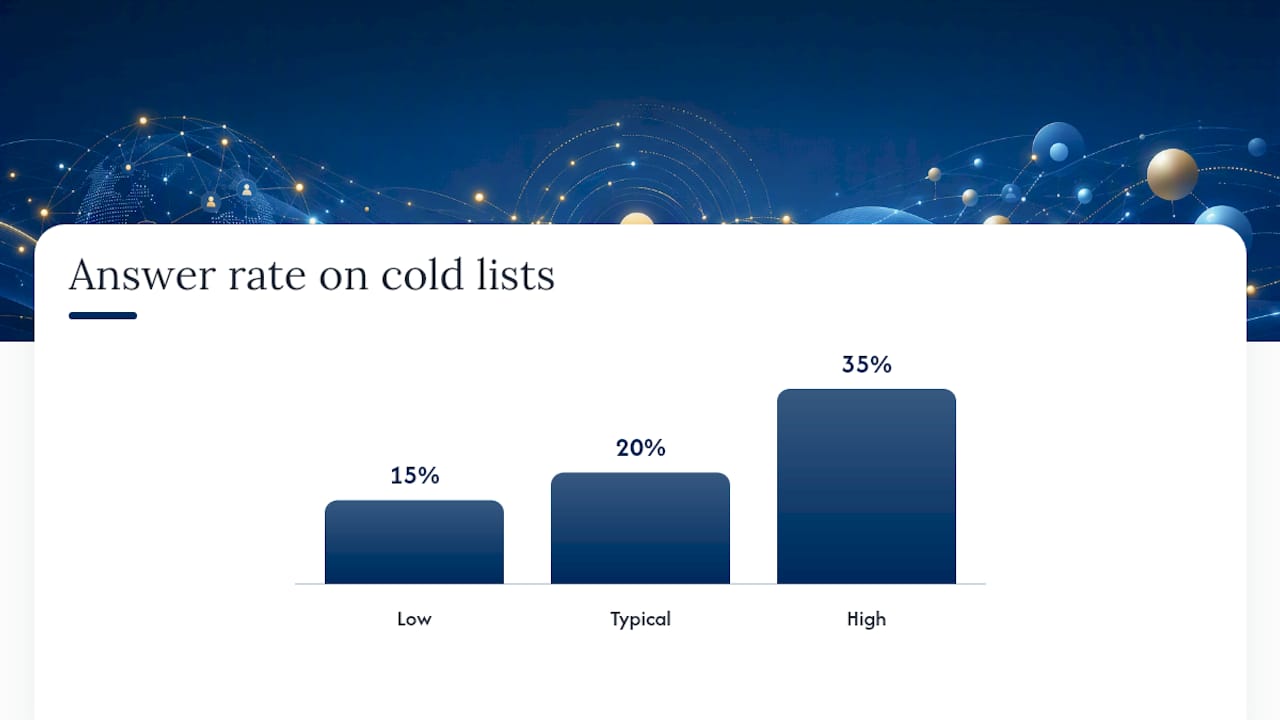
- Answer rate, which on cold outbound lists usually runs 15% to 35%, depending on list quality and time of day.
- Agent wrap-up time, the gap between hanging up and being ready for the next call.
- Sample interval, the frequency at which the system recalculates. Most platforms resample every 5 to 10 seconds, which keeps pacing responsive but can introduce volatility when call volume is thin.
Here’s the math in practice. Say you have 20 agents, average handle time of 4 minutes, and a 20% answer rate. The dialer estimates that to keep all 20 agents busy, it needs roughly five lines ringing for every one that connects. It might dial 90 to 100 numbers simultaneously across the campaign, not per agent, and recalibrate that ratio every few seconds as agents finish calls or a burst of no-answers comes in.
Answering-machine detection sits inside this loop too. The system has to guess, often within a second or two of pickup, whether it heard a live voice or a recorded greeting. Guess wrong too often and you either waste agent time on voicemails or abandon calls that were actually live people. This is precisely why the sample interval and detection accuracy matter more than the raw dial ratio. A dialer that recalibrates fast but reads voicemail poorly will hand agents a rough day, even if the throughput numbers look great on a dashboard.
Predictive vs Power vs Progressive vs Preview: Which Mode Fits Your Team?
Each dialing mode trades throughput against control, and picking the wrong one is one of the more common early mistakes ops teams make.
- Predictive dialing dials multiple lines per agent based on statistical pacing. Highest throughput, highest abandon risk if misconfigured, the least personalization time before connection.
- Power dialing dials one line per available agent, moving to the next contact the moment a call ends. Lower abandon risk than predictive, solid throughput, no algorithmic guesswork. RevRing’s power dialer is built for exactly this middle ground.
- Progressive dialing waits for an agent to signal readiness, then dials one number automatically. Slower pace, near-zero abandon risk, more time for agents to review account notes first.
- Preview dialing shows agents contact details before any call goes out, and dialing is manual from there. Slowest mode, but ideal for complex, high-value calls that need context before connecting.
Decision rules are fairly blunt in practice. Below roughly ten concurrent agents, predictive dialing usually isn’t worth the complexity; power or progressive modes deliver comparable results with far less compliance exposure. Above that threshold, with a healthy list and simple call scripts, predictive can start to pay off. High value-per-contact campaigns (complex B2B sales, legal intake, high-ticket insurance) tend to favor progressive or preview, where a wrong greeting or missed detail costs more than any throughput gain.
What Benefits Does Predictive Dialing Deliver and Who Should Use It?
The throughput difference is the headline number, and it’s a big one. Manual dialing typically produces around 30 dials per agent-hour. Predictive dialing, properly configured with clean lists, can push that to 90 to 120 dials per agent-hour, a three to four times increase in raw attempts.
That volume translates into a few concrete gains:
- Higher talk-time percentage, since agents spend less time manually dialing and waiting on rings.
- Lower cost-per-acquisition on high-volume campaigns, because more attempts convert into more contacts without adding headcount.
- Faster list burn-through, useful when leads decay quickly or when a compliance window limits how long a list stays workable.
The campaigns that benefit most share a common trait: high volume, relatively simple calls, and low value-per-individual-contact. Outbound sales prospecting, collections, appointment reminders, and initial lead qualification all fit that profile well. Complex consultative sales or anything requiring deep personalization before the greeting sees smaller gains, since the dialer’s speed advantage matters less when the conversation itself takes the bulk of the time. Realistic improvement ranges vary by list quality and industry, but teams running predictive on well-maintained lists routinely report the throughput jump above holding steady, even as answer rates soften over a campaign’s lifespan.
What Compliance Rules Govern Predictive Dialing in the US?
Get this section wrong and nothing else in this guide matters. Predictive dialing sits squarely inside TCPA and FCC territory, and the penalties for missing a guardrail are real.
Compliance benchmark: Regulators cap abandoned calls at 3% per 30-day campaign period and require a live agent connection within roughly 2 seconds of the called party’s greeting. Miss either threshold and you lose safe-harbor protection.
Three rules define the operating envelope:
- Prior express consent. US law requires documented consent before an automated dialer contacts a cell phone; a verbal agreement alone does not satisfy this requirement. Consent needs a paper trail: a signed form, a checked box with timestamp, or a recorded call clearly capturing agreement.
- Abandon-rate and connect-timing limits. The FCC’s safe-harbor threshold sits at 3% abandoned calls measured across a rolling 30-day campaign window, with the 2-second connect rule enforced per call.
- DNC scrubbing and audit logs. Every list needs a Do Not Call scrub before it goes live, and every campaign needs an audit trail showing when scrubs ran, what consent basis applies to each contact, and how abandon rates tracked over time.
Most compliance failures don’t come from the algorithm misbehaving, which is why maintaining proper SMS enrollment preview and opt-in consent practices is crucial. They come from gaps in third-party list consent, where a purchased or shared list carries no verifiable consent metadata. Build consent capture into your intake process before you ever load a list into the dialer, not after a complaint arrives.
What Metrics Should You Track for a Healthy Predictive Dialing Campaign?
A handful of numbers tell you whether a campaign is healthy or headed for trouble.
- Dials per agent-hour: your throughput baseline, typically 90 to 120 in a well-tuned predictive environment.
- Agent talk-time percentage: how much of paid agent time goes to live conversation versus idle or wrap-up.
- Abandon rate: the number to watch most closely.
- Right-party contact rate: the share of connections that reach the actual intended contact, not a wrong number or gatekeeper.
- Calls-per-conversion: ties dialer activity directly to revenue outcomes.
- STIR/SHAKEN attestation rate: increasingly tied to whether your calls even display as legitimate on the receiving end.
Target range: Set internal alerts at 2% abandon rate so you catch drift before you approach the 3% regulatory ceiling. Measure on a rolling basis, not just at campaign close, since a bad week can push a monthly average over the line without daily visibility.
RevRing’s speed-to-lead benchmark data is a useful reference point for how contact rate shifts as response time increases across a lead list.
How Do You Integrate a Predictive Dialer Into Your Existing Tech Stack?
Integration determines whether predictive dialing actually improves your operation or just adds another disconnected tool.
Run through this checklist before go-live:
- CRM bidirectional sync. Call dispositions need to write back to the CRM automatically, and lead status changes in the CRM need to reach the dialer without manual re-uploading.
- ACD and skill-based routing. Route connected calls to agents based on skill, language, or campaign specialty, not just whoever’s next in queue.
- Call recording and consent metadata. Every recorded call should tag the consent basis and timestamp alongside the audio file, so compliance audits don’t require reconstructing history from memory.
- Number hygiene infrastructure. Warm up new numbers gradually, rotate across a pool rather than hammering one line, and maintain STIR/SHAKEN attestation to protect answer rates.
Cloud-based predictive dialers generally offer fast setup with built-in CRM and ACD integrations, but fast setup and a responsible pilot aren’t the same thing. Rushing integration to hit a launch date is how consent metadata gets skipped.
Pro Tip: Sync your DNC list on a daily cadence, not weekly. A single stale list can undo weeks of clean compliance history in one bad campaign day.
Day-to-day hygiene matters as much as the initial setup: throttle dial ratios during low-answer periods, run weekly list-quality checks, and monitor number reputation the same way you’d monitor server uptime. For deeper number-health tactics, RevRing’s reputation management guide covers warm-up schedules and rotation cadences in more detail.
When Should You Choose Predictive Dialing, and How Do You Pilot It Safely?
Not every outbound team should run predictive, and jumping in without a pilot is how abandon-rate violations happen.
Check these four boxes before committing:
- Concurrent seats. You need roughly ten or more agents live at once for the statistical model to have enough activity to predict reliably. Below eight seats, the model simply doesn’t have enough data points to pace accurately.
- List health. Your contact list needs verified consent metadata and a recent DNC scrub before it touches the dialer.
- Campaign goals. High-volume, low-complexity calls fit predictive. Complex, consultative conversations don’t.
- Compliance ownership. Someone specific owns abandon-rate monitoring and audit logs, not “the team” in general.
Once those are set, pilot conservatively:
- Start with a dial ratio well below your target, closer to power-dialer pacing than full predictive.
- Run the pilot for one to two weeks, not a single day.
- Monitor abandon rate in real time, not at week’s end.
- Set a rollback trigger, if abandon rate crosses 2%, drop the ratio immediately rather than waiting to see if it self-corrects.
Scale up only once you’ve held steady abandon rates and stable answer rates across the full pilot window.
What Causes Predictive Dialing Campaigns to Fail, and How Do You Fix Them?
Most failures show up as one of three symptoms, and each has a fairly direct fix.
- Abandon-rate spikes: usually caused by dial ratios set too aggressively for current answer rates. Fix: drop the ratio immediately and let the algorithm recalibrate against real answer data before pushing volume back up.
- Falling answer rates over a campaign’s life: often a sign of number reputation decay, where carriers start flagging your outbound numbers as spam. Fix: rotate to a warmed number pool and check STIR/SHAKEN attestation status.
- Rapid reputation decline across multiple numbers: points to underlying list or consent problems rather than a dialer setting. Number reputation and consent hygiene, not algorithmic error, cause most deployment failures. Fix: pause the campaign, audit consent metadata, and rewarm affected numbers before resuming.
Preventive habits beat reactive fixes every time: run list hygiene checks weekly, roll out new campaigns in stages rather than full volume on day one, and keep a small pool of test numbers to verify pacing before committing your primary lines.
How RevRing Puts This Playbook Into Practice
Every checklist item above maps to a specific piece of infrastructure, and that’s the gap most standalone dialers leave open. RevRing’s predictive dialer connects pacing directly to CRM dispositions, so agent outcomes update lead status without a manual export step. Compliance infrastructure, including TCPA and DNC scrubbing, runs inside the same platform rather than as a bolt-on tool someone has to remember to check.
Some clients have scaled significantly in agent count while maintaining compliant dialing throughout expansions, a growth curve that can break most fragmented dialer and CRM setups long before agent count triples. Predictive dialer settings, CRM sync, and AI-driven call scoring can live in the same ecosystem, meeting integration checklist items, rather than requiring assembly from separate vendors.
What Data Security and Privacy Practices Matter Beyond TCPA Compliance?
Compliance covers consent and abandon rates. It doesn’t automatically cover what happens to the data itself once it’s inside your systems, and that’s a separate risk category operations managers need to own directly.
Call recordings, consent records, and customer PII sitting in your dialer platform need the same access controls you’d apply to any sensitive database. That means role-based access, so a junior agent can’t pull the full customer contact list, and encryption both at rest and in transit for recorded calls and stored consent metadata.
Retention policy matters more than most teams realize. Keeping call recordings indefinitely feels safer for audit purposes, but it also expands your exposure if a breach occurs. Set a retention window tied to your actual audit needs, typically matching the compliance windows already governing your consent records, and purge beyond that.
If you operate in regulated industries like healthcare, a Business Associate Agreement (BAA) becomes non-negotiable for any platform touching protected health information, separate from and in addition to TCPA consent requirements. Insurance and legal intake carry their own data handling expectations too, often set by state-level regulation rather than federal telemarketing rules.
Vendor access is the quiet risk most teams overlook. Every integration point, your CRM, your call recording storage, your analytics dashboard, is a potential access point for data leakage. Audit vendor permissions the same way you’d audit consent metadata: know exactly who can see what, and revoke access the moment a tool falls out of active use.
How Should You Train Agents to Work Effectively With a Predictive Dialer?
Agents working a predictive dialer face a different rhythm than agents on manual or preview dialing, and untrained agents are where a lot of throughput gains quietly disappear.
The core skill is fast context absorption. Because predictive dialing connects agents to live calls with almost no lead time, agents need to read account context, or hear a brief AI-generated summary, in the two or three seconds before the greeting. Training should include timed drills specifically on this handoff, not just script memorization.
Build training around these priorities:
- Rapid disposition accuracy. Agents need to code call outcomes correctly and quickly, since disposition data feeds directly back into pacing and CRM status. Sloppy disposition entry corrupts your metrics before you even notice a problem.
- Compliance awareness at the agent level. Every agent should understand why consent metadata matters, not just that it’s a rule. Agents who understand the “why” catch consent gaps that pure script-following misses.
- Idle-time discipline. In predictive mode, the gap between calls is deliberately short. Agents need practiced wrap-up habits, not improvised ones, or that gap starts creeping longer and throughput erodes.
- Escalation triggers. Agents should know exactly when to flag a number as bad, a script as underperforming, or a list as feeling off, since frontline agents often spot reputation decay before dashboards show it.
New agents typically need a shortened ramp period on predictive specifically, since the pacing pressure is unlike anything in progressive or preview modes. A week of shadowing on power dialing before moving to full predictive volume tends to smooth that transition considerably.
What Hardware, Software, and Network Setup Does Predictive Dialing Require?
The infrastructure bar for predictive dialing is lower than it used to be, but it’s not zero, and network quality specifically gets underestimated more than any other requirement.
On the network side, bandwidth and jitter matter more than raw speed. A cloud-based predictive dialer needs stable, low-latency internet at every agent workstation, since even brief connection drops during a live call damage both customer experience and your abandon-rate numbers. Wired connections outperform WiFi for agent stations running high call volume, particularly in larger centers where WiFi congestion during peak hours is a real, measurable problem.
Hardware requirements are modest for the agent side: a modern workstation, a quality headset with noise cancellation, and a reliable connection are usually sufficient for cloud-based platforms. The heavier infrastructure lives on the software side, integration with your CRM, ACD, call recording, and analytics stack, most of which runs through APIs rather than on-premise servers. Teams building custom pacing logic or deeper integrations often work directly with developer documentation, and platforms like Genesys publish detailed API references for exactly that kind of customization.
Redundancy planning deserves more attention than it typically gets. A predictive dialer that goes down mid-campaign doesn’t just pause, it can leave live calls hanging or abandon connections outright, which directly threatens your compliance numbers. Confirm your platform’s failover setup and uptime commitments before scaling volume, not after an outage teaches you the hard way.
What Advanced Features Should You Look for in a Predictive Dialer?
Basic pacing gets you the throughput gains. Machine learning enhancements are where modern platforms start separating from older, static-ratio systems.
Adaptive pacing is the clearest example. Instead of recalculating dial ratios purely from recent historical averages, machine learning models can weight recent trends more heavily, adjusting faster when answer rates shift due to time of day, day of week, or even broader spam-labeling trends across carriers. This reduces the lag between a real change in answer behavior and the dialer catching up to it.
AI call scoring is the other feature worth prioritizing. Rather than reviewing call quality manually or sampling a small percentage of calls, AI scoring can flag every connected call against script adherence, sentiment, and compliance language in near real time. That data feeds back into agent training and, over time, into which scripts and lists are actually converting.
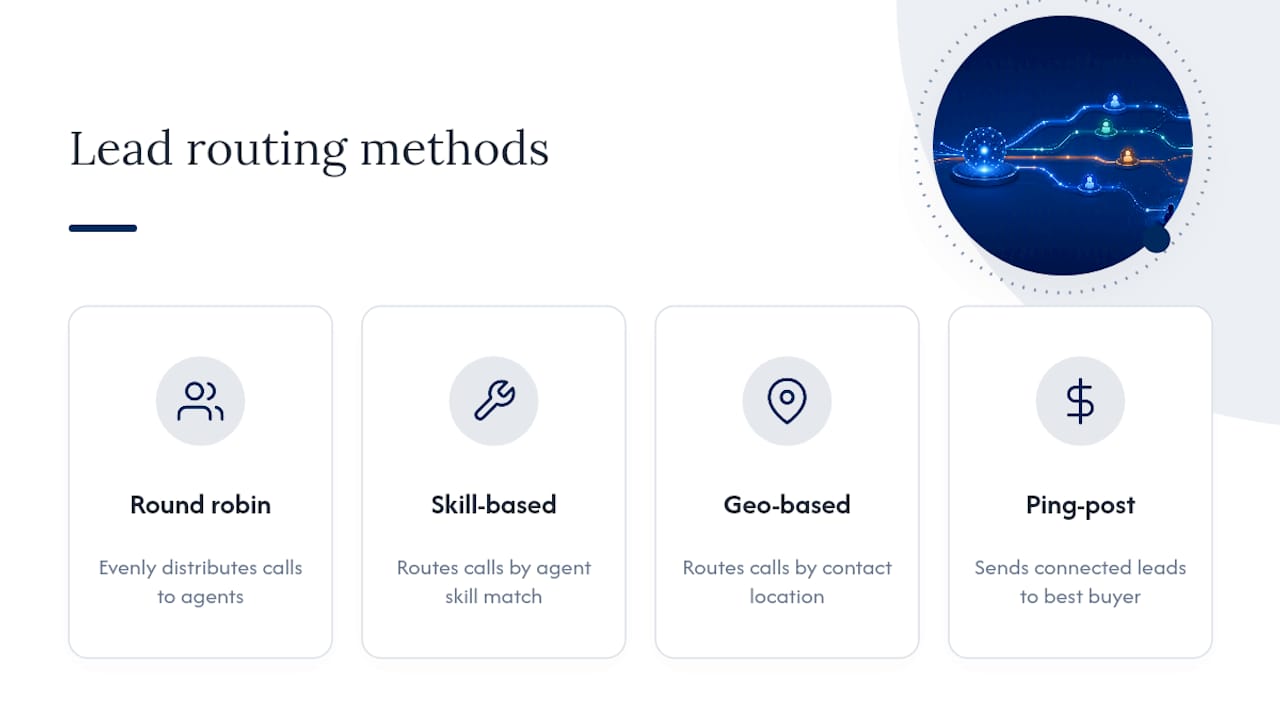
Smart lead routing extends the pacing concept beyond just “next available agent.” Round robin, skill-based, geo-based, and multi-buyer ping-post routing all let you match connected calls to the agent or buyer best positioned to convert that specific contact, rather than treating every connection as interchangeable. For lead generation operations selling to multiple buyers, this routing layer often matters as much as the dialer’s raw pacing accuracy.
Look for platforms that let you adjust these settings by campaign rather than applying one global configuration across every list. A collections campaign and a lead-qualification campaign have different risk tolerances and different ideal pacing curves, and a one-size configuration will underperform on at least one of them.
How Does Predictive Dialing Affect Customer Experience, and How Do You Improve It?
Predictive dialing has a customer experience cost built into its design, and pretending otherwise sets teams up for the exact abandon-rate problems this guide keeps returning to.
The core tension is simple: every abandoned call, every dead-air moment before an agent picks up is a real person on the other end who answered their phone and got silence or a hang-up. Beyond the regulatory penalty, that experience shapes whether that person answers your number again, and it shapes whether carriers start flagging your number as suspicious. Customer experience and number reputation are more connected than most teams initially assume.
A few practices measurably improve the experience without sacrificing throughput:
- Tighten connect timing. The closer you run to that 2-second connect window, the less dead air a live answer experiences, and dead air is often what makes an answered call feel like a robocall even when a live agent eventually picks up.
- Personalize the opening seconds. Even a brief, accurate greeting referencing why you’re calling reduces the “who is this” friction that drives fast hang-ups.
- Respect time-of-day preferences. Calling patterns that ignore recipient time zones or repeat-call fatigue erode both experience and answer rates simultaneously.
- Route to the right agent, not just any agent. A contact who’s called before and reached a specific rep benefits from continuity; smart routing can preserve that connection instead of treating every call as a cold handoff.
Ultimately, a lower abandon rate isn’t purely a compliance metric. It’s a direct proxy for how many real people are having a bad interaction with your brand on any given day.
Marc’s Take: The Adoption Trade-Off Nobody States Plainly
Predictive dialing rewards teams that treat compliance as infrastructure, not an afterthought bolted onto a fast-growing campaign. The technology works. The organizations that fail at it usually skipped the boring part: documented consent, list hygiene, and a compliance owner with actual authority to pause a campaign. Pilot with your abandon-rate and consent metadata dialed in first. Speed comes second.
— Marc
Try RevRing’s Predictive Dialer for Your Outbound Team
If your team has cleared the seat threshold and the compliance groundwork this guide covers, RevRing gives you predictive dialing, CRM sync, and compliance infrastructure in one connected platform instead of stitching together separate vendors for each piece.
That connection matters most during growth. Teams scaling fast need dial pacing, lead routing, and consent tracking that don’t fall out of sync with each other the moment agent count jumps. RevRing’s predictive dialer ties directly into AI automation for call scoring and into ZinCRM for disposition tracking, so the pilot checklist from earlier in this guide runs through one system instead of five. Lead generation teams evaluating volume-heavy campaigns can also check RevRing’s lead generation industry page for workflow specifics tied to that use case.
Measure any platform against the pilot success criteria you set earlier: abandon rate, dials-per-agent-hour, and consent audit trail. Then book a demo to see how RevRing’s setup handles your specific volume and compliance requirements before you commit to a full rollout.