Skills Based Routing for Contact Centers: Six Step Rollout 4–6 Weeks

Skills-based routing (SBR) connects each caller to the agent best equipped to solve their specific problem, instead of the next agent in line. That single change drives higher first-contact resolution and shorter handle times, because the right expert answers on the first try instead of a third transfer. If your contact reasons span multiple products, languages, or compliance tiers, SBR is worth piloting now.
TL;DR:
- Effective skill tagging and data accuracy are crucial, as incomplete or incorrect contact reason labels limit routing improvements regardless of system sophistication.
- Starting with a small set of high-impact skills and continuously refining proficiency thresholds helps prevent noise and ensures better agent matching.
- Regularly reviewing agent skills and occupancy data, at least quarterly, maintains routing precision and prevents drift from changing agent capabilities.
- Long waits and high abandonment rates often signal gaps in agent coverage or overly broad fallback settings, which require staffing adjustments or more specific skill assignments.
- AI-enhanced routing improves first-contact resolution by selecting agents most likely to solve cases quickly, based on outcome data, beyond static skill proficiency.
Table of Contents
- How Does Skill Based Routing Work?
- What Metrics Does Skills-Based Routing Improve?
- How Do You Set Up Skills-Based Routing?
- What Are the Best Practices for Skill-Based Call Allocation?
- What Goes Wrong With Skills-Based Routing?
- How Does AI Improve Skills-Based Routing?
- When Should You Prioritize Skills-Based Routing?
- Scale Skills-Based Routing Without the Rebuild
- Sources
How Does Skill Based Routing Work?
Traditional automatic call distributors (ACDs) treat every agent as interchangeable and send calls in arrival order. Skills-based routing replaces that first-come, first-served model with a matching engine that checks what a caller needs against what each available agent can actually do, routing calls to suitably skilled agents rather than strictly by queue position.
The system runs on three inputs working together:
- Skill taxonomy. Some centers use binary tags (agent has the skill or doesn’t); others weight skills on a proficiency scale, say 1 to 5, so a caller needing advanced technical support skips a generalist entirely.
- Data tagging. IVR selections, CRM records, and prior interaction history feed the routing engine the “required skill” for each contact before it ever reaches an agent queue.
- Matching logic. The engine finds every agent who holds the required skill, then applies tie-breakers, usually longest idle time, current occupancy, or proficiency score, to pick the best available match.
- Fallback rules. When no qualified agent is free within a set wait threshold, the system overflows the contact to a broader skill group or a cross-trained agent rather than stranding the caller.
That fallback layer matters more than most managers assume. Without it, a caller needing a rare skill combination, say bilingual support plus a specific product line, can wait far longer than the caller who just needs general help. Good SBR configurations always define an escape hatch before the queue gets deep.
What Metrics Does Skills-Based Routing Improve?
Skill matching moves five numbers you already track. First-contact resolution (FCR) rises because the agent on the line actually has the expertise to close the issue. Average handle time (AHT) drops because agents aren’t researching territory outside their skill set. Transfer rate falls for the same reason, and abandonment tends to decrease because qualified agents resolve faster and clear the queue. CSAT typically follows all four upward.
Organizations that implement skills-based routing commonly report higher FCR, lower AHT, and improved satisfaction scores, because callers reach the right expert on the first attempt.
Before you roll out SBR broadly, capture a 30-day baseline on each metric by contact type. Set a target lift, even a conservative one, so you can translate the gain into dollars: fewer transfers means fewer agent-minutes per resolved case, and that scales directly into staffing cost.
One caveat outranks the rest: the entire uplift depends on how accurately you’ve tagged skills and contact reasons. Sloppy taxonomy or incomplete IVR data caps your results no matter how good the matching engine is.
- Track FCR, AHT, transfer rate, abandonment, CSAT, and per-skill occupancy weekly during rollout.
- Compare pre and post-SBR baselines by contact type, not just in aggregate.
- Revisit skill tags monthly for the first quarter, since early tagging is almost always incomplete.
How Do You Set Up Skills-Based Routing?
Rolling out SBR works best as a staged pilot, not a big-bang cutover. Here’s the sequence that keeps risk low while you learn what your data actually supports.
- Inventory contact reasons and set goals. Pull three to six months of interaction data and rank contact types by volume and complexity.
- Build a skills taxonomy. Decide binary versus proficiency-weighted skills, then define proficiency levels (novice, competent, expert) for anything nuanced.
- Map skills to IVR and CRM tags. Every contact needs a required-skill label attached before it hits the queue, across voice, chat, and email alike.
- Assign skills to agents and pilot narrow. Start with two or three high-impact skills rather than your full taxonomy.
- Configure fallback and service-level targets. Set the wait threshold that triggers overflow, and define who receives it.
- Iterate on pilot results. Adjust proficiency thresholds and skill definitions based on real occupancy and resolution data.
Pro Tip: Practical rollout guidance favors piloting a small set of high-impact skills first, then monitoring occupancy by skill before expanding. Trying to launch twenty skills simultaneously is the fastest way to bury your data in noise.
Connecting your CRM to the routing layer early makes step three far easier. Tools like RevRing’s CRM integration let context from prior interactions inform the skill tag automatically, instead of relying on agents to guess from an IVR menu selection alone.
What Are the Best Practices for Skill-Based Call Allocation?
SBR degrades quietly if nobody maintains it. Skill assignments drift, agents pick up new expertise nobody’s logged, and thresholds set at launch stop matching real call volume six months later.
- Review agent skills on a set cadence, quarterly at minimum, and let managers approve any agent self-reported update rather than accepting it automatically.
- Resist over-segmentation. Start with broad skill categories, like language or product line, and split a skill only when data shows the broad version is hurting resolution rates.
- Watch occupancy by skill group, not just overall occupancy. A team can look fine in aggregate while one skill group is drowning and another sits idle.
- Cross-skill deliberately. Agents holding two or three adjacent skills absorb volume spikes far better than a roster of narrow specialists.
- Feed outcome data back into the taxonomy. If a skill group’s CSAT lags consistently, the fix is usually the skill definition, not the agent.
What Goes Wrong With Skills-Based Routing?
Most SBR failures show up as one of three symptoms: abandonment creeping up, long waits concentrated on a specific skill, or transfer rates that haven’t actually dropped since your ACD days. Each points to a different root cause.
- Rising abandonment overall usually means your fallback thresholds are set too loose, callers are waiting past their patience limit before overflow kicks in.
- Long waits for one specific skill almost always means agent coverage for that skill is too thin relative to volume; re-balance staffing or cross-train more agents into it.
- Transfer rates that haven’t improved point to incomplete skill mapping. If your IVR only captures half the real contact reasons, half your calls are still landing on the wrong agent by default.
Run a weekly report on wait time by skill and transfer reason by destination skill. Those two views catch most tagging gaps before they show up in a customer complaint. Traditional staffing formulas like Erlang-C were built for single-skill queues, and they tend to understate real wait times once you layer proficiency weighting and overflow rules on top, which is exactly why a diagnostic report beats a theoretical model here.
How Does AI Improve Skills-Based Routing?
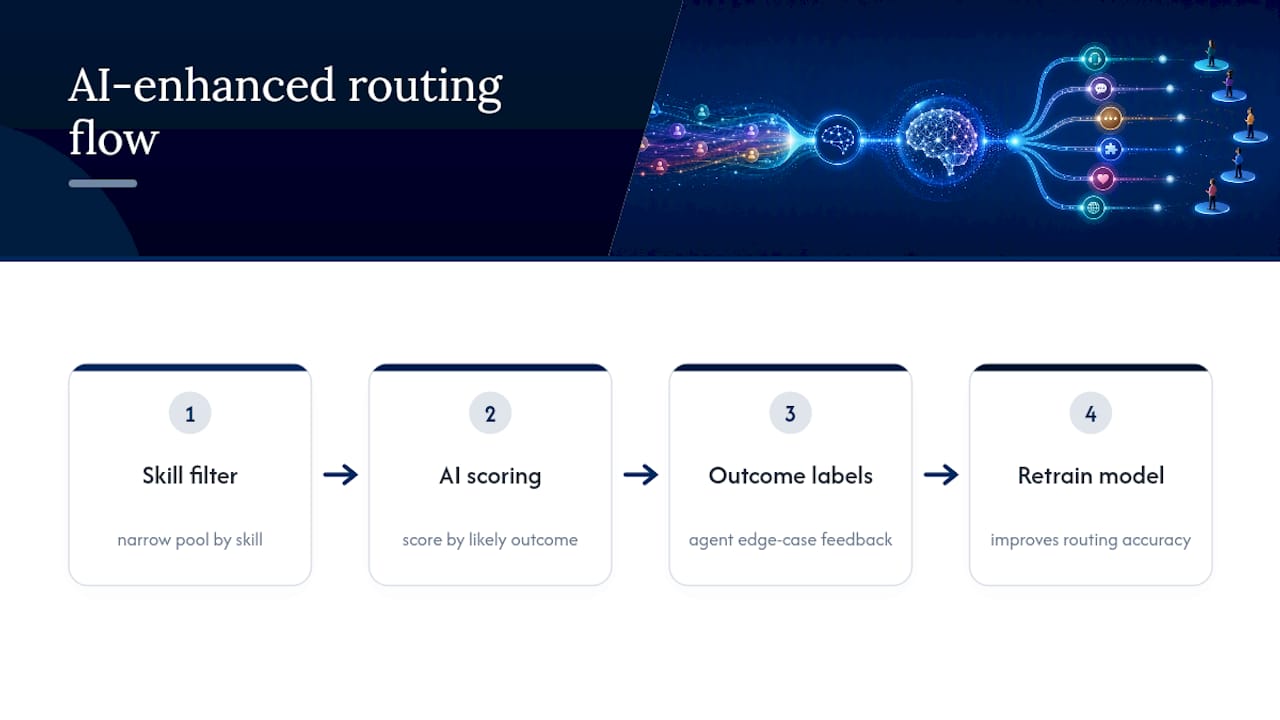
Rule-based SBR answers one question: who’s qualified? AI answers the harder one: among the qualified agents, who’s most likely to resolve this specific case fastest, with the best outcome? The matching engine still narrows the pool by skill first; AI optimizes inside that pool using outcome-based scoring instead of static proficiency numbers.
Agent-sourced skill updates, logged when an agent successfully handles an edge case outside their assigned skill, become labeled training data. Feed enough of those back into the model, and routing accuracy improves without a single manual taxonomy edit.
Pro Tip: Don’t skip the feedback loop. A model trained once at launch and never retrained drifts the same way a static skills taxonomy does.
RevRing’s platform maps directly onto this progression: AI call scoring layers outcome data on top of skill tags, CRM connectivity keeps required-skill data current automatically, and built-in compliance workflows keep TCPA and HIPAA requirements intact as routing logic gets more sophisticated. For teams exploring AI voice automation alongside routing, partners like Wattle’s AI voice agents show how agent profiles extend into automated call handling.
When Should You Prioritize Skills-Based Routing?
SBR earns priority the moment your contact reasons diversify, multiple products, languages, or compliance tiers, and a single generalist queue starts producing visible transfer chains. If your volume is low and uniform, delay it; the taxonomy overhead won’t pay back yet.
Expect a working pilot in four to six weeks and a full rollout in one to two quarters, based on typical RevRing engagement timelines. Move faster once your first skill group hits target FCR.
— Marc
Scale Skills-Based Routing Without the Rebuild
Most centers stall on SBR not because the concept is hard, but because their CRM, telephony, and compliance tools don’t talk to each other, so every skill update means updating three systems by hand. Revring closes that gap: skill tags, AI call scoring, and CRM data live in one connected platform, so a proficiency change or a new contact reason propagates everywhere at once.
Insurance, real estate, and healthcare teams use Revring’s smart lead routing and predictive dialer to combine skill, geo, and priority rules without stitching together separate vendors, all while keeping TCPA and HIPAA compliance workflows intact. One documented case scaled from 12 to 180 agents on the platform without breaking routing accuracy or compliance controls.
If your current setup has you managing skills in a spreadsheet and hoping the IVR data lines up, schedule a live demo and see how the checklist above maps directly onto Revring’s configuration screens.