Call Center Shrinkage: How Insurance Agencies Calculate It

Shrinkage is the share of paid agent time when nobody is available to take or make a call. Breaks, training, meetings, sick days and system downtime all count. To calculate it, divide the hours agents were unavailable by the hours you paid for, then multiply by 100. To staff for it, divide the agents you need on the phones by (1 minus your shrinkage rate). Most agencies get that second step wrong, and the result is a floor that is short-handed at the exact hours leads are hottest.
This guide covers the formula, what belongs in the count, a worked example for an outbound insurance floor, a realistic range, and how to cut shrinkage without gutting coaching or compliance work.
TL;DR
- Formula: shrinkage % = hours agents were unavailable for calls ÷ total paid (or scheduled) hours × 100. Pick one denominator and keep it.
- Staffing: divide required agents by (1 − shrinkage). Multiplying by (1 + shrinkage) leaves you short.
- Range: a Spring 2024 survey found half of respondents plan on 26% to 36%. Your own measured number matters more than any average.
- Lower it carefully: move training and coaching into slower intervals. Do not cut them, and do not cut breaks.
- Not the same as occupancy: idle time while logged in and available is an occupancy issue, not shrinkage.
Table of Contents
- What shrinkage means on an insurance call floor
- The shrinkage formula
- What belongs in the count
- Using shrinkage to staff the floor
- What is a reasonable shrinkage rate?
- Reducing shrinkage without hurting the floor
- Where the real gain sits: the hours you do have
- Where RevRing.com fits
- Perspective
- FAQ
- Sources
What shrinkage means on an insurance call floor
Picture a 10-agent outbound team scheduled for 40 hours each. That is 400 scheduled hours. If agents are on the phones, in the CRM, or waiting for the next dial, they are available. If they are in a carrier product training, a Monday sales meeting, a one-on-one, out sick, or locked out because the system is down, they are not. The share of the 400 hours spent in that second group is your shrinkage.
The definition is simple. SWPP, the Society of Workforce Planning Professionals, describes shrinkage as the percent of paid work time that people are not available to take calls. The same source warns there is no industry standard you can borrow. What matters is what your own floor loses.
For an agency owner, shrinkage is a scheduling number. It tells you how many licensed agents you must put on the schedule to get a target number actually dialing or answering at any moment. Ignore it and your plan on paper never matches the floor in real life.
Shrinkage, occupancy and adherence are different measures
Three terms get mixed up, and mixing them breaks the math.
- Shrinkage is time agents are unavailable for customer interactions. An agent in training adds to it.
- Occupancy is how much of an available agent’s time goes to actual call work. An agent logged in and waiting for a call is available but not occupied. TDSGS notes a center can have high shrinkage and high occupancy at once. Too few agents are available, and those who are available barely get a breather. That means long queues, rushed conversations and burnout.
- Schedule adherence is whether agents follow the schedule. Consaltek Solutions points out that an agent attending a scheduled training session is perfectly adherent and still counts toward planned shrinkage.
Idle time while available and after-call work stay out of the shrinkage count. They belong to occupancy and handle time.
The shrinkage formula
The basic formula:
Shrinkage % = (hours unavailable for calls ÷ total paid hours) × 100
The version TDSGS publishes uses scheduled time as the base: unavailable scheduled time ÷ total scheduled time × 100. Its example is 100 unavailable hours out of 400 scheduled hours, which is 25%. SWPP uses paid hours: 555 shrinkage hours ÷ 2,080 paid hours is 27%, and 718 hours ÷ 1,950 paid hours is 37% once family and medical leave is included.
The denominators differ, so pick one and stay with it. If you compare your number with an outside benchmark built on a different base, you will draw the wrong conclusion. A paid-hours base is the easier one for an agency, because it ties straight to payroll.
Calculate it over a long enough window
A single week misleads. A week with two sick days and a carrier training looks nothing like the week after. Call Centre Helper gives the formula as external plus internal shrinkage hours, divided by total hours available, and says it is normally expressed across a full 12 months. Its example: 84.5 shrinkage days out of 260 working days is 32.5%.
For day-to-day scheduling, track it weekly and by interval too. Insurance floors are seasonal. Open enrollment periods, post-lead-drop surges and end-of-quarter pushes all change both volume and absence patterns.
What belongs in the count
Split your shrinkage into two buckets. They have different owners and different fixes.
External shrinkage (mostly outside your control)
- Sick days
- Vacation and public holidays
- Paid breaks
- Absenteeism and late arrivals
- Leave such as FMLA
Internal shrinkage (mostly inside your control)
- Team meetings and one-on-ones
- Coaching and call review sessions
- Product, carrier and compliance training
- System downtime
- Unplanned breaks away from the desk
- Time helping other departments or on special projects
This list follows Call Centre Helper’s breakdown. Agencies have a few extras worth tracking in their own categories: licensing and appointment paperwork, carrier portal quoting done off the dialer, and callbacks or research that agents do away from the phone. SWPP’s survey notes that over 40% is common where agents do off-phone duties like research and callbacks.
Write your categories down. Define what counts, who logs it and where. TDSGS recommends separating planned from unplanned items so each gets its own controls: planned shrinkage is scheduled around demand, unplanned shrinkage is managed through attendance and system reliability.
An agency with a bigger back office has more to count. HR leave, onboarding and agent time-off tracking all feed the external bucket, which is where HR software for insurance agents helps keep absences recorded in one place so planned time off can be scheduled around call demand.
Using shrinkage to staff the floor
This is where the number pays for itself.
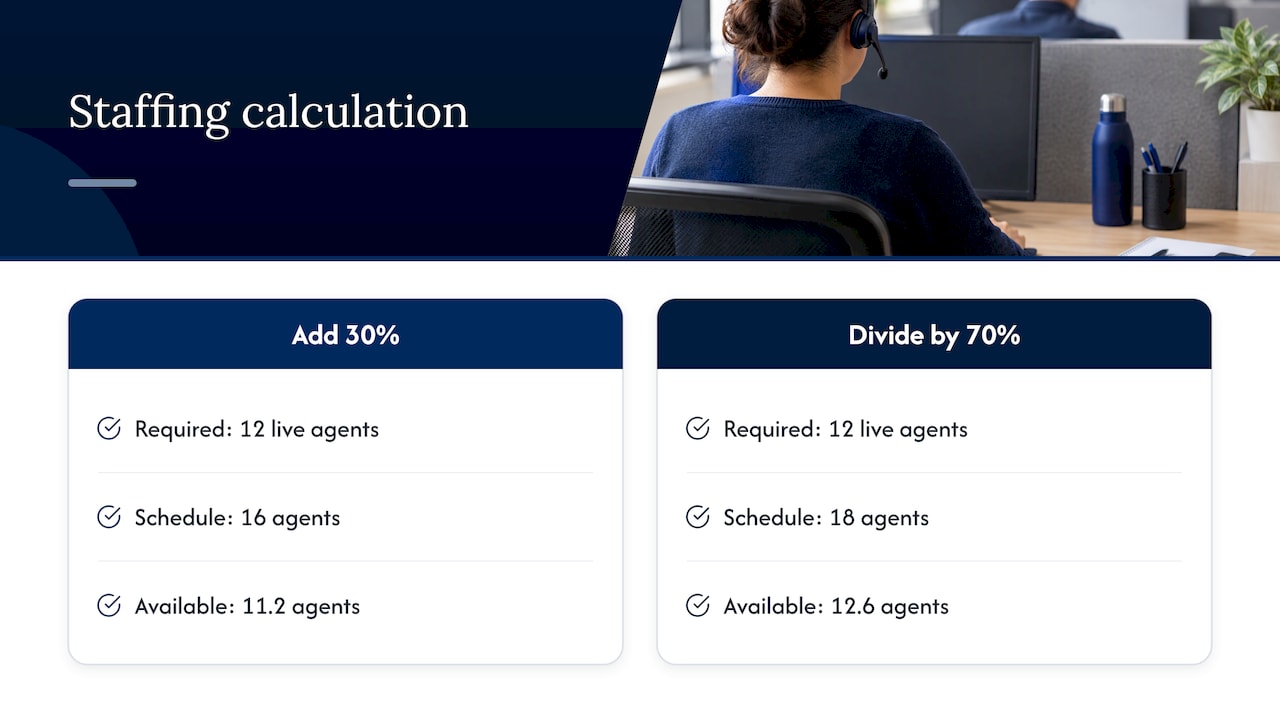
Say your lead volume and talk time tell you that 12 agents need to be on live calls at your busiest hours. Your measured shrinkage is 30%.
The tempting move is to add 30%: 12 × 1.30 = 15.6, so about 16 agents. Check the result. 16 agents with 30% unavailable leaves only 11.2 available. You are short.
The correct calculation divides by the productive share:
Agents to schedule = required agents ÷ (1 − shrinkage)
12 ÷ 0.70 = 17.1, so schedule 18 agents. 18 × 0.70 = 12.6 available, which covers the 12 you need.
SWPP shows the same correction with 23 required staff at 27% shrinkage: 23 ÷ 0.73 = 31.5, so 32 agents. Inflating 23 by 27% gives 29, and only 21 of those would be available. SWPP’s 2024 survey gives a second illustration: if 70 agents are needed and you plan at 90% productive, schedule 78.
The gap grows as shrinkage grows. That is why a floor that “added a cushion” still runs hot every afternoon.
Shrinkage changes by day and hour
A flat annual percentage hides real swings. The SWPP survey team suggests different assumptions per day of week and even per hour of day. A Monday-morning sales meeting, a Friday-afternoon absence pattern and a mid-day break window all shift availability at specific times. If your best contact hours are 10 a.m. to 1 p.m. and 4 p.m. to 6 p.m. local time, those are the hours where unplanned shrinkage costs the most.
What is a reasonable shrinkage rate?
The honest answer is the one you measure. Still, you need a sanity check.
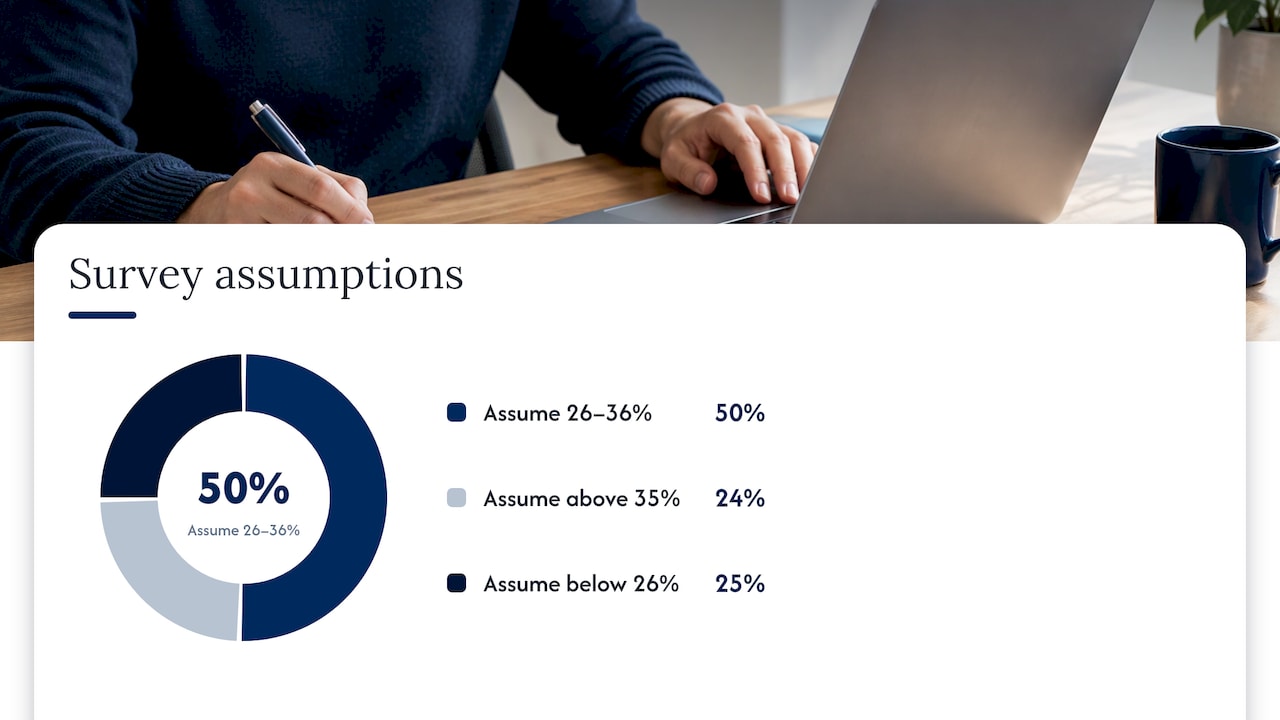
- SWPP’s Spring 2024 survey, with financial, healthcare and insurance among the biggest participant industries, found half of respondents assume 26% to 36% for long-term planning. 24% assume above 35%, and 25% assume below 26%.
- Under 20% is unusual in North American centers once all breaks, vacation, sick time, FMLA, training, meetings, coaching and downtime are counted.
- Over 40% is common where agents do off-phone work.
The survey also says there is no reasonable loss percentage that applies to all or even most centers. Borrowing someone else’s entitlements or assumptions can lead to inconsistent service, overtime and intraday chaos. Use outside ranges to check that your count is complete. If your number comes out at 12%, you are probably missing categories, not running a miracle floor.
Your best benchmark is your own trend, quarter over quarter, with definitions held constant.
Reducing shrinkage without hurting the floor
Cutting shrinkage by squeezing breaks or skipping training works for a month. Then quality drops, absenteeism rises and turnover follows. TDSGS warns that reducing shrinkage by overworking agents leads to lower quality, higher absenteeism and higher turnover. Aim to move time, not delete it.
- Define categories in writing. Everyone logs time the same way, so the data holds up.
- Track by interval. Look at 15- or 30-minute blocks, then by day, shift and team. Patterns show up that the weekly average hides.
- Move coaching and training to slow intervals. Hold smaller, staggered sessions when contact rates are low rather than pulling the whole team at once.
- Fix system downtime. Dialer outages, CRM lag and login problems are shrinkage nobody chose. Track them as their own line.
- Watch adherence for support, not punishment. Real-time adherence views help you spot a late start or an extended break while there is time to fix the schedule.
- Plan time off. Absences that are scheduled and approved are easier to staff around than surprise call-outs.
- Review consistently off-plan periods. SWPP’s survey says analyzing them reveals improvements that lower cost and make agents’ work lives more stable.
Keep compliance and licensing time in the plan
Compliance training, consent-handling reviews and license renewals are not waste. Put them on the calendar as planned shrinkage so they do not collide with peak calling windows. Our guide to insurance agent license tracking covers how agencies keep renewals from turning into last-minute scrambles that pull an agent off the phones.
Where the real gain sits: the hours you do have
Shrinkage tells you how many hours are available. What happens inside those hours is a separate question, and for an outbound floor it is where most of the revenue is.
An agent who is available but spends the hour on manual dialing, voicemails and wrong numbers has high availability and low talk time. That is an occupancy and productivity problem. Dialing mode matters here: preview, progressive, power and predictive dialers handle different volumes and risk levels, and our comparison of a power dialer vs. a predictive dialer for insurance agencies walks through which fits which floor.
Coaching is the other lever. It is internal shrinkage by definition, so it should be efficient. Reviewing every call by hand eats manager hours, and picking calls at random wastes agent time. Our call coaching playbook lays out how managers focus sessions on the calls that teach something. For a view on matching staffing to demand, see our call center staffing model.
Where RevRing.com fits
Shrinkage is a planning discipline, and a spreadsheet is enough to compute it. The tools that matter are the ones that raise what each available hour produces and keep the off-phone work short.
RevRing.com puts CRM, calling and dialing (preview, progressive, power and multi-line predictive), two-way texting, AI call scoring and coaching, lead routing, license tracking and commission tracking on one platform. Agencies can run fully on RevRing CRM or connect HubSpot, Pipedrive or GoHighLevel at no extra cost. Compliance checks, including DNC and litigator screening, calling-hours rules by time zone and consent records, run before each call, so agents are not stopping to check lists by hand. See the insurance solution or the dialer, and review plans and per-seat pricing.
This is general workflow guidance plus product description. Your compliance obligations depend on your state, carriers and counsel, and no software removes them.
Perspective
Most agency owners we talk to about staffing think in headcount. They count licensed agents and assume that is capacity. It is not. Capacity is the agents who are actually on a call or ready to take one, and shrinkage is the gap between the two.
Our view is that the fix is rarely a bigger team. Measure your real unavailable hours first. Then look at what each available hour produces. A floor with clean lead routing, a dialer matched to its volume and coaching aimed at the right calls gets more from the same schedule.
That is why we built RevRing.com as one platform. When dialing, texting, CRM, scoring and compliance checks sit together, there is less switching between tools and fewer manual steps between a lead arriving and a conversation starting. Fewer tabs, fewer gaps. Start by measuring your number, then decide what to change.
Marc
FAQ
What is the shrinkage formula?
Shrinkage % = hours agents are unavailable for calls ÷ total paid or scheduled hours × 100. If 100 of 400 scheduled hours are unavailable, shrinkage is 25%. Keep the same denominator every time so trends stay comparable.
How do I calculate shrinkage for a month?
Add every unavailable hour from your defined categories, such as breaks, training, meetings, sick days, vacation and downtime. Divide by total paid hours for that month, then multiply by 100. Because one month swings with holidays and training, also check a rolling 12-month figure for planning.
What is a good shrinkage percentage for an insurance sales team?
There is no universal target. A survey of call center professionals found half assume 26% to 36%. Use that range to check your count is complete, then manage to your own quarter-over-quarter trend.
Does idle time count as shrinkage?
No. Time when an agent is logged in and available but waiting is an occupancy matter. Shrinkage covers time when the agent is not available at all, such as training, meetings, breaks and absences. After-call work is handle time, not shrinkage.