Cut Reassignments in 30–60 Days: Round Robin vs Skill Based for Ops

Round robin wins for high-volume, homogeneous work where any qualified agent can close the ticket. Skill-based routing wins when the task needs specialist knowledge or carries SLA risk. Most mature operations run both, splitting queues by category and rotating fairly inside each one. The trade-off is always fairness and speed versus accuracy: track reassignment rate, first-contact resolution (FCR), and escalations to know which side of that line you’re standing on.
TL;DR:
- Round robin works best when work is high-volume, simple, and agents are cross-trained on similar tasks, but it misses nuances in complex or specialized queues.
- Skill-based routing improves accuracy and FCR in technical, compliance-heavy, or multi-product environments but requires active taxonomy ownership and regular updates.
- A hybrid approach, combining category-based routing with round robin within pools, allows operations to balance fairness, speed, and precision across different queues.
- Key metrics like reassignment rate, FCR, and SLA compliance should be monitored monthly, with quick fixes focused on taxonomy accuracy, fallback rules, and agent capacity issues.
- Testing a targeted 30-60 day hybrid routing pilot on a high-reassignment or complex queue can identify the best configuration before full-scale deployment.
Table of Contents
- Round Robin vs Skill-Based Routing: A Side-By-Side Comparison
- When Should You Use Round-Robin Routing?
- When Should You Use Skill-Based Routing?
- How Do You Build a Hybrid Round-Robin and Skill-Based System?
- What Metrics Should You Track, and How Often?
- How Do You Diagnose and Fix Routing Failures Fast?
- RevRing’s Approach to Routing: What a Configurable Setup Looks Like
- What Ops Managers Get Wrong About This Decision
- Ready to Test a Hybrid Routing Model?
- Sources
Round Robin vs Skill-Based Routing: A Side-By-Side Comparison
Round robin assigns work in a fixed rotation. Every agent gets the next available ticket, call, or lead in sequence, regardless of what’s inside it. Skill-based routing matches the work to the agent who’s actually qualified to handle it, using tags, taxonomies, or intent detection to make the call.
The G2 guide on routing selection frames the decision correctly: use round robin when most agents can handle the same requests and workload balance matters most; use skill-based routing when tickets need specialist knowledge and FCR is the priority. That’s the whole decision tree, but the operational details underneath it are where teams get tripped up.
Here’s how the two stack up on what ops managers actually manage:
| Dimension | Round robin | Skill-based routing |
|---|---|---|
| Best for | High-volume, similar-complexity tickets | Specialized, technical, or compliance-heavy work |
| Setup complexity | Low. Rotation logic ships out of the box | Higher. Requires a skill taxonomy and ownership |
| Speed to assign | Fast. No matching logic to evaluate | Slower unless automated, since routing has to check qualifications first |
| Impact on FCR | Neutral to negative on complex work | Positive when the taxonomy is accurate |
| Workload fairness | High by design | Uneven. Specialists absorb disproportionate volume |
| Maintenance overhead | Low. Occasionally adjust for capacity | Ongoing. Taxonomy drifts without an owner |
A general support queue fielding password resets and billing questions is a textbook round-robin case: any trained agent closes the ticket, and rotation keeps the queue moving without anyone waiting on a specific person. A healthcare intake line handling insurance verification, prior authorization, and clinical scheduling is the opposite case. Send those calls round robin and you’ll get agents transferring work they can’t legally or practically resolve, which shows up in your data as rising reassignment rates.
The trade-offs come down to a short list:
- Round robin is simple, fast, and fair, but it can’t tell the difference between a five-minute question and a twenty-minute compliance issue.
- Skill-based routing raises accuracy and FCR but only if someone owns the taxonomy and keeps it current.
- Round robin degrades quietly. Skill-based routing degrades loudly. Miss a fallback rule and tickets stall with no qualified agent in sight.
- Neither model fixes an understaffed queue. Both just distribute the pain differently.
The LeanData research on lead distribution notes that round robin’s simplicity is also its blind spot: it produces mismatches once work becomes specialized, because the rotation logic has no concept of topic-fit. That’s the core reason ops managers eventually split queues rather than picking one model for everything.
When Should You Use Round-Robin Routing?
Round robin earns its place when the work itself is undifferentiated. If your team fields a high volume of similar requests, and most agents are cross-trained to close them, rotation is the right default. It’s also the right call for smaller or generalist teams where building a skill taxonomy would cost more in maintenance than it returns in accuracy.
Three signals tell you round robin is the correct fit:
- Ticket complexity is flat. Most requests take a similar amount of time and expertise to resolve.
- Your team is cross-trained. Any agent on the roster can close most incoming work without escalation.
- Volume is the constraint, not accuracy. Speed to assignment matters more than perfect matching.
Plain round robin has variants worth knowing. Load-balanced rotation skips agents who are already at capacity. Weighted rotation sends more volume to your highest performers or newest hires, depending on the goal. Capacity-aware rotation checks real-time availability, not just a static schedule, before assigning the next item. The LeanData documentation on distribution variants describes exactly this kind of load-aware and schedule-aware logic, built to skip agents who are unavailable or already full.
A round-robin setup that holds up under real volume needs a checklist, not just a rotation rule:
- Confirm presence and availability status is synced in real time, not on a fixed shift schedule.
- Build leave and time-off handling into the rotation so absent agents get skipped automatically.
- Set up a fallback pool for when the primary rotation runs dry or every agent is at capacity.
- Monitor reassignment rate weekly. A rising number means the queue has quietly become more specialized than your rotation assumes.
- Track average handle time by agent. Wide variance often signals mismatched skill inside a “simple” queue.
Pro Tip: Round robin hides overload well because it looks fair on paper. Check individual agent capacity, not just queue-level averages, since one overworked agent can be masked by three under-loaded ones in the same rotation.
When Should You Use Skill-Based Routing?
Skill-based routing pays off when the cost of a mismatch is high. Multi-product support lines, multilingual queues, and compliance-heavy intake in insurance, legal, or healthcare all fall into this category. Send a HIPAA-sensitive intake call to a generalist and you risk more than a slow resolution. You risk a compliance gap.
The Crisp comparison of routing methods confirms the upside is real: skills-based routing improves assignment accuracy and FCR, but it demands a maintained taxonomy and clear ownership to avoid drift.
Before building skill-based rules, three things need to already exist:
- A skill taxonomy that’s specific, not aspirational. “Billing” is too broad. “Billing disputes over $500” is usable.
- A named owner for the routing logic. Taxonomies without an owner rot within a quarter.
- A classification method. Manual tagging works at low volume; automated intent classification scales better as ticket count grows.
Three anti-patterns wreck skill-based rollouts every time. Skills defined too broadly route everything to the same three agents. Taxonomies nobody owns become outdated the moment the product line changes. And single-expert bottlenecks form when only one person on the team holds a rare skill tag, so every complex ticket queues behind that one person regardless of urgency.
Rolling it out cleanly means starting narrow:
- Pick one high-value, high-mismatch queue as your pilot, not the whole operation.
- Define three to five skill tags maximum for that queue. Resist the urge to get granular on day one.
- Assign a routing owner responsible for tag accuracy and quarterly review.
- Build a fallback rule that routes to a generalist pool when no specialist is available within your SLA window.
- Measure FCR and reassignment rate for 30 days before expanding the taxonomy to other queues.
Pro Tip: If your skill-based queue stalls more than it used to, the problem is almost always a missing fallback rule, not a bad taxonomy. Fix the fallback before you touch the tags.
How Do You Build a Hybrid Round-Robin and Skill-Based System?
Most real operations don’t pick one model. They layer both, and the layering pattern matters more than which model gets top billing.
Category-first, then round robin inside pools. Route by category or skill first (billing, technical, sales), then rotate evenly among the agents qualified for that category. You get accuracy from the first pass and fairness from the second.
Priority-aware routing. Combine skill match with urgency, so a VIP account or SLA-breach risk jumps the rotation even inside a specialist pool.
Intent-based prefilter, then skill routing. AI classification reads the incoming request and tags it automatically, removing the manual tagging step before skill-based rules apply.
Channel matters here too. Chat tends to be skill-critical since customers expect an immediate, accurate answer with no room for a transfer. Email tolerates round-robin fallback well, since a slightly slower but fair rotation rarely costs you the customer. Phone sits in between, which is why blended queues often combine both models by time of day and volume, a pattern covered in more depth in this breakdown of blended call center operations.
A practical way to test hybrid routing without disrupting the whole operation:
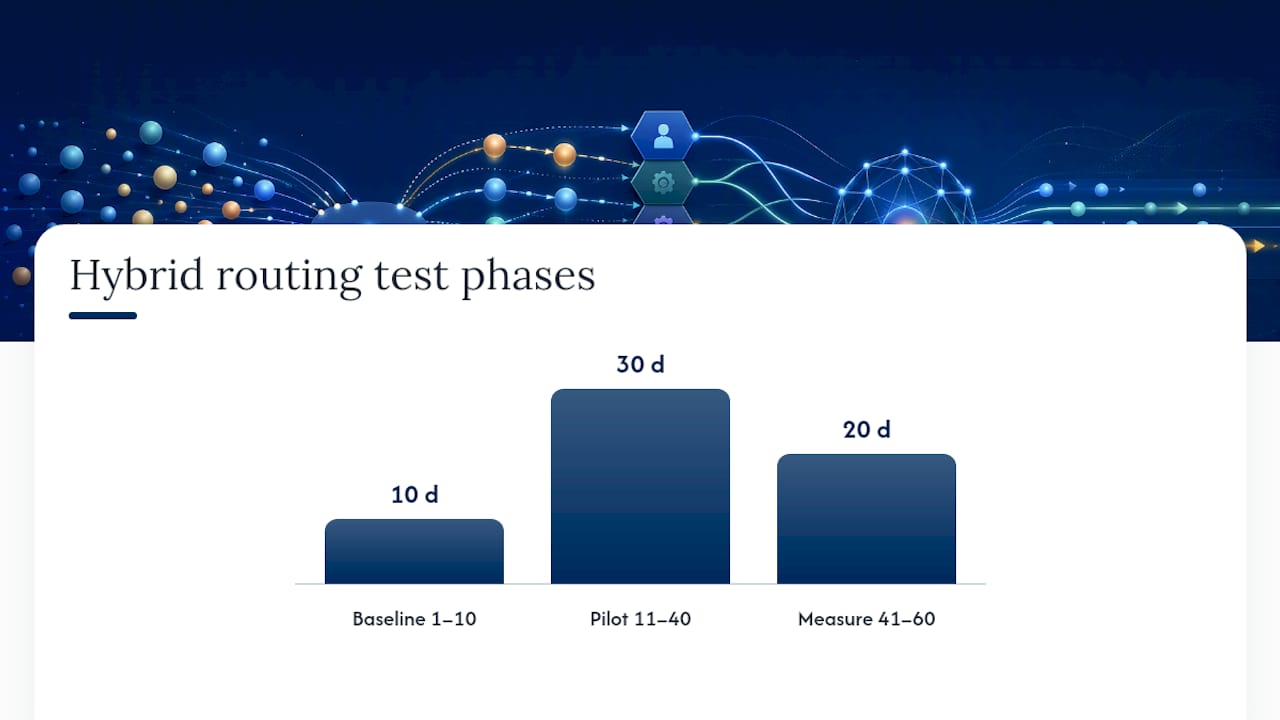
- Days 1 to 10: Pick one queue with visible reassignment problems. Define your baseline FCR, reassignment rate, and escalation count.
- Days 11 to 40: Apply category-first routing with round robin inside each skill pool. Change nothing else.
- Days 41 to 60: Measure the delta. The Assign recommends exactly this scoped approach, starting with one queue and one clear metric before rolling changes out further.
What Metrics Should You Track, and How Often?
Six numbers tell you almost everything about whether your routing model is working:
- Reassignment rate. How often a ticket or lead gets moved after initial assignment. Rising numbers mean your model is mismatching work.
- First-contact resolution (FCR). The share of issues closed without a transfer or callback.
- Average handle time (AHT). Wide swings by agent often expose a skill mismatch hiding inside a “simple” queue.
- SLA compliance. Percentage of tickets resolved inside the promised window, tracked by queue.
- Specialist utilization. How evenly load is spread among agents holding the same skill tag.
- Customer effort score (CES). A direct signal of how much work the customer had to do to get resolved.
Reassignment rate is the earliest warning sign in most routing setups. A ticket that gets moved once might be normal. A queue where 15 to 20 percent of tickets get reassigned is telling you the routing logic no longer matches the actual work coming in, and it’s usually cheaper to fix that gap now than after FCR has already dropped.
Watch for a few red flags specifically: reassignment rate climbing month over month, AHT variance widening across agents doing “the same” job, and CES scores dropping in a queue where FCR looks fine. That combination usually means the model is matching the wrong things, not that agents are underperforming.
A monthly review checklist keeps drift from becoming a crisis:
- Pull reassignment rate and FCR by queue, not just company-wide.
- Compare specialist utilization against generalist pool utilization.
- Flag any skill tag that hasn’t been touched or reviewed in 90 days.
- Cross-check CES trends against AHT trends for early mismatch signals.
The assign.cloud guide recommends a monthly cadence for drift checks and a quarterly cadence for structural design changes, which keeps small fixes from turning into full rebuilds. A live dashboard tracking these numbers, built around definitions covered in this guide to call center KPIs, makes the monthly review a fifteen-minute task instead of a data-pulling exercise.
How Do You Diagnose and Fix Routing Failures Fast?
Most routing failures show a consistent symptom before they become a crisis. The fix depends on catching the right one early.
- Symptom: reassignment rate spikes in one queue. Likely cause: the work in that queue got more complex without the routing rule catching up. Fix: add a temporary skill gate for the highest-mismatch subcategory while you rebuild the taxonomy.
- Symptom: one agent or small group is buried while others sit idle. Likely cause: a skill tag with only one or two qualified agents. Fix: cross-train a backup agent and add a fallback pool immediately.
- Symptom: FCR drops even though skill tags look accurate. Likely cause: taxonomy drift. Categories no longer match what customers are actually asking. Fix: pull a sample of misrouted tickets and rebuild the tags around real recent volume.
- Symptom: tickets stall with no assignment. Likely cause: missing fallback rule when no qualified agent is available. Fix: add a generalist fallback pool with an SLA-based escalation trigger.
The quick triage flow is always the same: detect the metric that moved, isolate which queue caused it, apply the narrowest fix that addresses the cause, then measure again before touching anything else. Move from a tactical fix to a bigger tooling change, like intent-based classification, only after the same failure repeats across multiple queues rather than once.
RevRing’s Approach to Routing: What a Configurable Setup Looks Like
RevRing’s platform supports round robin, skill-based, geo, ping-post, and multi-buyer routing inside one system, which matters because most operations end up needing more than one model as they grow.
A generic starting configuration for regulated teams adopting hybrid routing looks like this:
- Specialize the two or three queues with the highest compliance risk first (intake verification, prior authorization, clinical scheduling).
- Leave general inquiry and low-risk categories on round robin until volume data justifies splitting them.
- Configure a generalist fallback pool for every specialist queue, with an SLA-based escalation trigger.
- Use AI call scoring and automation to reduce manual tagging overhead as the taxonomy grows.
What Ops Managers Get Wrong About This Decision
The conventional advice treats round robin and skill-based routing as a philosophical choice, pick a lane and defend it. That’s backwards. Neither model is a value statement about fairness or expertise. Both are just distribution mechanics, and the right one depends entirely on what’s moving through the queue this quarter, not what moved through it last year.
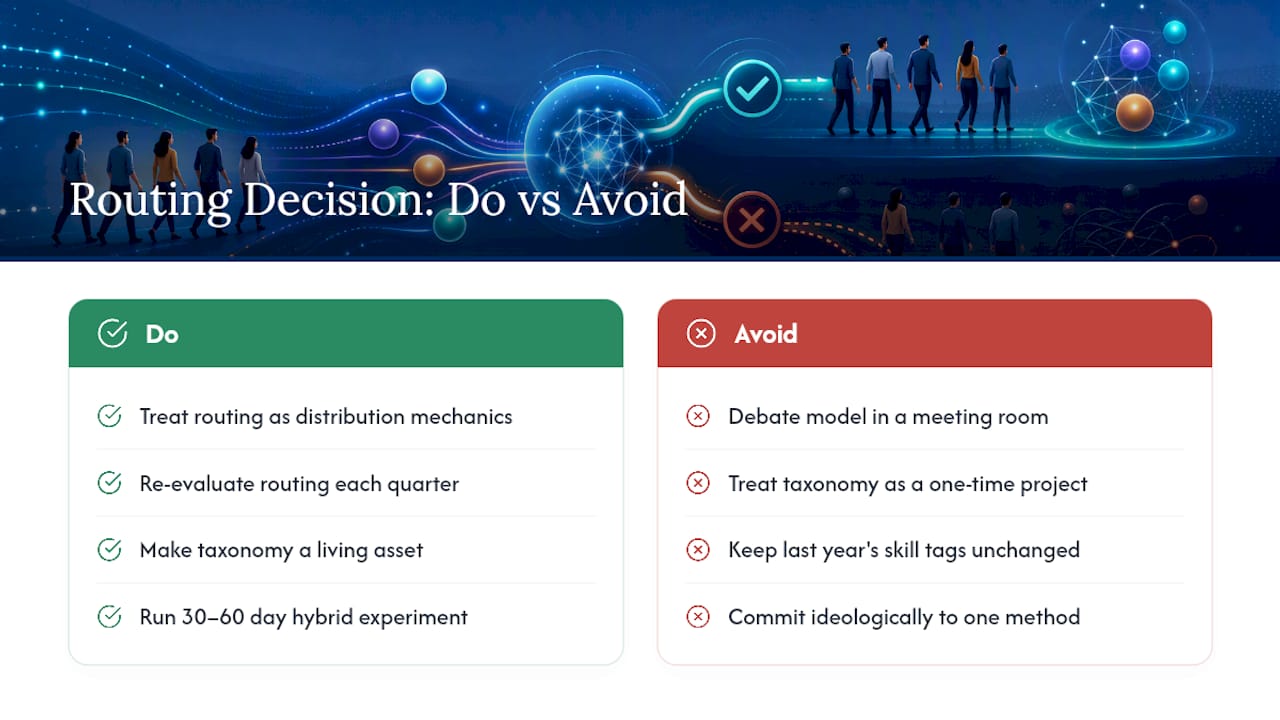
The bigger mistake is treating the taxonomy as a one-time project instead of a living asset. A skill tag built for last year’s product lineup routes this year’s tickets wrong, and nobody notices until reassignment rate has already climbed for two months. Ownership matters more than the initial design.
If you take one thing from this: don’t debate the model in a meeting room. Pick your worst-performing queue, run a 30 to 60 day hybrid experiment on it, and let reassignment rate and FCR make the argument for you. The G2 research on routing selection backs this: evaluation should follow the KPIs, not an ideological commitment to one method.
— Marc
Ready to Test a Hybrid Routing Model?
RevRing runs round robin, skill-based, geo, and multi-buyer routing inside the same platform, so you can test a hybrid model without stitching together three separate tools. Routing rules connect directly to AI call scoring, a predictive dialer, and compliance infrastructure built for TCPA, DNC, and HIPAA requirements, which matters the moment your pilot queue touches regulated data.
Before booking a call with sales, run the 30 to 60 day experiment outlined above: pick one queue, set your baseline for reassignment rate and FCR, and apply category-first routing with round robin inside each skill pool. Bring those numbers to the conversation. It’s the fastest way to know exactly which routing configuration your team needs, and it turns the demo into a fitting exercise instead of a pitch. For operations weighing a broader platform switch, the RevRing platform supports this kind of phased rollout without forcing a full cutover on day one, and teams in regulated industries can see how the fallback and compliance pieces fit together on the healthcare industry page.